
 English
 Español
 中文
中文 हिन्दी
 Français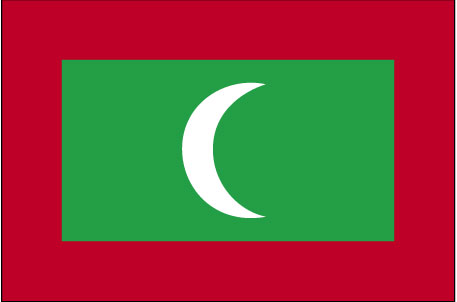
Maldives
Dhivehi Raajje
Declare Your Relationship to Maldives
CountryReports Community
- Studying0
- From Maldives1
- Maldives heritage1
- Visited1
- Want to visit0
Customs and Culture
Customs and Culture
Cultural Attributes
The Maldives is a deeply Islamic nation, and Islam permeates nearly every aspect of daily life, social customs, and legal structure. The country officially follows Sunni Islam, and citizenship is legally tied to the Islamic faith — non-Muslims cannot hold Maldivian citizenship. The call to prayer, heard five times daily, shapes the rhythm of life across the islands, and Friday remains the primary day of communal worship and rest. Maldivian culture reflects a layered history of influences from South Asia, Arabia, and East Africa, shaped by centuries of trade along Indian Ocean routes. The native language, Dhivehi, is an Indo-Aryan language with its own unique script called Thaana, which is written from right to left. Dhivehi remains the official language and is spoken exclusively throughout the islands, though English is widely used in tourism and government contexts. Traditional arts hold a significant place in Maldivian identity. Boduberu, a form of music and dance rooted in East African traditions, features large drums and call-and-response vocals and is performed at community celebrations and festivals. Lacquerwork, known locally as liyaa, involves intricate hand-carved wooden objects adorned with geometric patterns in red, black, and yellow — a craft recognized for its cultural heritage. Family and community bonds are central to Maldivian social life. The extended family unit plays an important role in daily decisions, childcare, and social support. Hospitality toward guests is highly valued, and visitors are typically offered refreshments such as sweet tea and short eats like masroshi, a pastry filled with smoked tuna and coconut. Fish, particularly tuna, forms the cornerstone of the Maldivian diet and cultural identity. The nation's fishing heritage is so significant that a fisherman appears on the national coat of arms. Traditional crafts such as boat-building, mat-weaving from reeds by women in Gaafu Alifu Atoll, and natural rope-making using coconut fiber reflect a culture historically adapted to life on small, resource-limited islands surrounded by the Indian Ocean.

Pearls of the Indian Ocean
Diet
Most Maldivian men are fisherman and at the end of the day they bring the fish home for the women to cook over an open fire. Most is prepared for export but some is eaten as part of the daily diet along with coconuts, papayas, pineapples, pomegranates and sweet potatoes.

Family
Most Maldivian men make their living as fisherman. At the end of the day they bring their catch home to the women who cook and smoke the fish over an open fire. Most of the fish is prepared for export.
Student Life
Unique to Maldives, modern and traditional schools exist side by side. The traditional schools are staffed by community-paid teachers without formal training and provide basic numeracy and literacy skills in addition to religious instruction. The modern schools, run by both the government and private sector, provide primary and secondary education. Primary and secondary education is available throughout the country and primary education is compulsory. As the modern English-medium school system expands, the traditional system is gradually being upgraded. By early 2003, every inhabited island was equipped to provide primary school education up through grade seven. Secondary schools (grades 8 through 10) are available in atoll capitals and on the islands with larger populations. Five schools have higher secondary classes, two in Capital Male and in three atolls. Only around 5% of students go to high school, but literacy is high at 98%. Seven post-secondary technical training institutes provide opportunities for youth to gain skills that are in demand.
Holidays
Independence Day
7/26Independence Day
Dates of Interest
- July 26th
What should I know about food and eating in the Maldives?
Fish, particularly tuna, is the cornerstone of the Maldivian diet and cultural identity, and guests are typically welcomed with refreshments.
Do
- Accept offered refreshments like sweet tea and short eats such as masroshi (a pastry filled with smoked tuna and coconut)
- Expect meals built around fish, coconuts, and fruits like papayas, pineapples, pomegranates, and sweet potatoes
Good to know
- A fisherman appears on the national coat of arms, reflecting how central fishing is to the culture
- Traditionally, men bring home the day's catch and women cook and smoke the fish over an open fire
- Much of the fish caught is prepared for export
What cultural etiquette should travelers be aware of in the Maldives?
The Maldives is a deeply Islamic nation where Sunni Islam shapes daily life, social customs, and law, and hospitality toward guests is highly valued.
Do
- Respect the rhythm of the five daily calls to prayer
- Recognize Friday as the primary day of communal worship and rest
- Use English, which is widely used in tourism and government contexts
Good to know
- The native language is Dhivehi, written in the Thaana script from right to left
- Non-Muslims cannot hold Maldivian citizenship, as citizenship is legally tied to the Islamic faith
What role do family and community play in the Maldives?
Family and community bonds are central to Maldivian social life, with the extended family playing an important role in daily decisions, childcare, and social support.
Good to know
- Hospitality toward guests is highly valued
- Traditionally men make their living as fishermen while women cook and smoke the catch
What traditional arts and crafts are part of Maldivian culture?
Traditional arts and crafts hold a significant place in Maldivian identity, reflecting a culture adapted to life on small islands.
Good to know
- Boduberu is a form of music and dance rooted in East African traditions, featuring large drums and call-and-response vocals at community celebrations
- Lacquerwork (liyaa) involves hand-carved wooden objects with geometric patterns in red, black, and yellow
- Other traditional crafts include boat-building, mat-weaving from reeds, and rope-making from coconut fiber
Last updated: 2026-07-12 · Sources: CountryReports
Photos of Maldives
Photos of Maldives
Travel and Tourism
Travel and Tourism
- Travel Alert Status
- Level 2: Exercise Increased Caution
- Currency
- rufiyaa (MVR)
- Time Difference
- UTC+5 (10 hours ahead of Washington, DC, during Standard Time)
- Climate
- tropical; hot, humid; dry, northeast monsoon (November to March); rainy, southwest monsoon (June to August)
- Airports
- 5
Read the full travel guide — health, safety, vaccinations, disease risk, sanitation, and transit details.
View full travel guideHistory
History
Historical Eras
Early Settlement
400 BCE – 1153
The earliest inhabitants of the Maldives were likely migrants from southern India, followed by Indo-European-speaking peoples from Sri Lanka around the 4th–5th centuries BCE. The islands developed as a Buddhist maritime society, with Arab and East African sailors gradually expanding their cultural influence. Maldivian legend attributes the founding of the first ruling line to a Sinhalese prince, Koi Male, who settled in the archipelago.
Islamic Sultanate
1153 – 1558
In 1153, the Maldives converted to Sunni Islam, marking the establishment of the sultanate and a profound transformation of Maldivian identity, law, and culture. The sultanate governed the archipelago as an independent polity for centuries, its rulers legitimized by Islamic authority and sustained by maritime trade across the Indian Ocean. Mopla pirates from the Malabar Coast periodically harassed the islands, yet the sultanate maintained its sovereignty.
Portuguese Occupation
1558 – 1573
Portugal conquered the Maldives in 1558, imposing foreign rule over the sultanate for fifteen years. The occupation was marked by resistance from the Maldivian population, culminating in the successful uprising led by the warrior-patriot Muhammad Thakurufar Al-Azam, who expelled the Portuguese in 1573. His victory restored the Islamic sultanate and enshrined him as a national hero.
British Protectorate
1887 – 1965
The Maldives formally became a British protectorate in 1887, with Britain controlling the archipelago's foreign affairs while the sultanate retained internal governance. In 1953 a brief republican experiment failed and the sultanate was restored. The protectorate relationship endured until July 25, 1965, when the Maldives achieved full independence, though it rejoined the Commonwealth only in 1982.
Second Republic & Modern Era
1968 – present
On November 11, 1968, the sultanate was abolished and the Republic of Maldives was proclaimed in its present form. The nation developed tourism and fishing as economic pillars, though it faces existential challenges from rising sea levels and was severely struck by the 2004 Indian Ocean tsunami. Political liberalization efforts, growing youth crime linked to heroin addiction, and climate vulnerability define the archipelago's contemporary trajectory.
Overview
Timeline of Key Events
1558 – 1573
Portuguese occupation, which ends after expulsion by locals.
Portuguese occupation, which ends after expulsion by locals.
1558
Islands become a protectorate first of the Dutch rulers of Ceylon (Sri Lanka).
Islands become a protectorate first of the Dutch rulers of Ceylon (Sri Lanka) and later of the British who take control of Ceylon in 1796.
1982
Rejoins Commonwealth.
Rejoins Commonwealth.
2002
Concern over the Maldives’ vulnerability to rising sea levels.
Concern over the Maldives’ vulnerability to rising sea levels prompts government to announce decision to take legal action against US for refusing to sign Kyoto Protocol.
2004
Tsunami generated by a powerful undersea earthquake off the Indonesian coast hits the Maldives.
Scores of people are killed and many islands suffer severe damage when a tsunami generated by a powerful undersea earthquake off the Indonesian coast hits the Maldives. The government says the disaster has set development work back by 20 years.
Read the full history profile — narrative overview, defining eras, and the complete timeline in one place.
View expanded historyInteresting Facts
Interesting Facts
Maldives has the world's highest marraige rate for an independent country with 19.7 per 1,000 persons (US Virgin Islands is at 35.1 per 1,000).
See every fact — trivia, oddities, and curious tidbits gathered from across the country.
View all interesting factsGeography and Environment
Geography and Environment
- Terrain
- flat, with white sandy beaches
- Climate
- tropical; hot, humid; dry, northeast monsoon (November to March); rainy, southwest monsoon (June to August)
- Natural Hazards
- low level of islands makes them very sensitive to sea level rise
- Current Environmental Issues
- depletion of freshwater aquifers threatens water supplies; global warming and sea level rise; coral reef bleaching
Read the full geography and environment profile — terrain, climate, natural resources, hazards, land use, and international agreements.
View full geographyPeople & Demographics
People & Demographics
Languages Spoken
Maldivian Dhivehi (dialect of Sinhala, script derived from Arabic), English spoken by most government officials
- Maldivian Dhivehi
Population
- Population
- 395,650
- Population in Major Urban Areas
- MALE (capital) 132,000
- Nationality Noun
- Maldivian(s)
- Ethnic Groups
- South Indians, Sinhalese, Arabs
Education
- Literacy Definition
- age 15 and over can read and write
Unique to Maldives, modern and traditional schools exist side by side. The traditional schools are staffed by community-paid teachers without formal training and provide basic numeracy and literacy skills in addition to religious instruction.
The modern schools, run by both the government and private sector, provide primary and secondary education. Primary and secondary education is available throughout the country and primary education is compulsory. As the modern English-medium school system expands, the traditional system is gradually being upgraded. By early 2003, every inhabited island was equipped to provide primary school education up through grade seven. Secondary schools (grades 8 through 10) are available in atoll capitals and on the islands with larger populations. Five schools have higher secondary classes, two in Capital Male and in three atolls. Only around 5% of students go to high school, but literacy is high at 98%.
Seven post-secondary technical training institutes provide opportunities for youth to gain skills that are in demand.
Read the full people and society profile — demographics, health, education, religion, languages, and notable people.
View full people and societyGovernment & Politics
Government & Politics
Country Identity
- Country Name
- Maldives
- Full Country Name
- Republic of Maldives
- Local - Long
- Dhivehi Raajjeyge Jumhooriyyaa
- Local - Short
- Dhivehi Raajje
Government Structure
- Government Type
- republic
- Legal System
- based on Islamic law with admixtures of English common law primarily in commercial matters; has not accepted compulsory ICJ jurisdiction
- Executive Branch
- chief of state: President Mohamed MUIZZU (since 17 November 2023); note - the president is both the chief of state and head of government head of government: President Mohamed MUIZZU (since 17 November 2023); note - the president is both the chief of state and head of government cabinet: Cabinet of Ministers appointed by the president and approved by the People's Majlis elections: president directly elected by absolute majority popular vote in two rounds if needed for a five-year term (eligible for a second term); election last held on 9 September 2023, with a runoff held on 30 September 2023 election results: Mohamed MUIZZU elected president in runoff; percent of popular vote - Mohamed MUIZZU (PNC) 54.1%, Ibrahim Mohamed SOLIH (MDP) 45.9%
- Legislative Branch
- unicameral People's Council or Majlis (50 seats; 42 elected by popular vote, 8 appointed by the president; members serve five-year terms) elections: last held 22 January 2005 (next to be held NA 2010) election results: percent of vote - NA; seats - independents 50
- Judicial Branch
- High Court
- Suffrage
- 21 years of age; universal
- Constitution
- adopted January 1998
- Independence
- 26 July 1965 (from UK)
- National Holiday
- Independence Day, 26 July (1965)
Capital City
- Capital Name
- Male
- Capital - geographic coordinate
- 4 10 N, 73 30 E
- Capital Time Difference
- UTC+5 (10 hours ahead of Washington, DC, during Standard Time)
derived from the Sanskrit word "mahaalay" meaning "big house"
Military
Branches: Maldives National Defense Force (MNDF): Marine Corps, Security Protection Group, Coast Guard (
Embassy / Diplomatic Mission
U.S. Embassy Colombo, Sri Lanka
210 Galle Road, Colombo 3, Sri Lanka
Telephone: (94) (11) 249-8500
Emergency after-hours telephone: (94)-77-725-6307
Facsimile: (94) (11) 249-8590
E-mail: colomboacs@state.gov
Read the full government profile — flag symbolism, national anthem, and other national symbols.
View full government detailsEconomy
Economy
Tourism is the largest sector of the Maldivian economy, directly contributing around 25% of GDP and, together with related activities, accounting for over two-thirds of the country's foreign exchange earnings. Tourism-related taxes and import duties together generate the bulk of government revenue. Fishing, historically the backbone of the economy, remains the second-leading industry and the largest source of employment outside tourism, with tuna being the principal export.
The Maldivian government launched an economic reform program in 1989, lifting import quotas, opening certain exports to the private sector, and gradually liberalizing regulations to attract foreign investment. These reforms have helped transform the Maldives into one of the higher-income economies in South Asia, classified by the World Bank as an upper-middle-income country.
Agriculture and manufacturing play a comparatively minor role, constrained by limited arable land, a small domestic labor force, and the geographic dispersion of the islands. Most staple foods, fuel, and consumer goods must be imported. Industrial activity is modest and consists mainly of fish processing, garment production, boat building, and handicrafts.
The economy remains highly vulnerable to external shocks, as demonstrated by the sharp contraction during the COVID-19 pandemic and the subsequent strong rebound driven by the return of international tourists. Public debt has risen significantly in recent years, prompting concerns about fiscal sustainability.
Maldivian authorities continue to express deep concern about the impact of coastal erosion and climate change on this low-lying nation, where more than 80% of the land area lies less than one meter above sea level, making it one of the countries most threatened by rising sea levels.
Snapshot
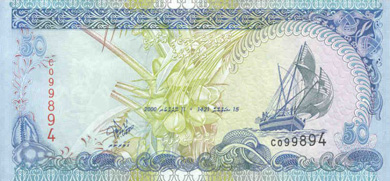
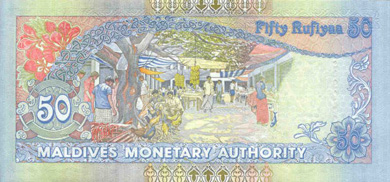
- Currency Name and Code
- Rufiyaa (MVR)
- GDP Real Growth Rate
- -5.5%
Banknotes
Budget & Public Finance
- Fiscal Year
- calendar year
- Annual Budget
- $362,000,000 (USD)
- External Debt
- $316,000,000 (USD)
Labor, Industry & Trade
- Labor Force by Occupation
- agriculture 22%; industry 18%; services 60%
- Industries
- fish processing, tourism, shipping, boat building, coconut processing, garments, woven mats, rope, handicrafts, coral and sand mining
- Agriculture Products
- coconuts, corn, sweet potatoes; fish
- Export Commodities
- fish, clothing
- Export Partners
- US 52.6%, Sri Lanka 13.3%, Thailand 9.5%, Japan 7.6%, UK 4.7%
- Import Commodities
- consumer goods, intermediate and capital goods, petroleum products
- Import Partners
- Singapore 26.6%, UAE 15%, Sri Lanka 13.2%, India 7%, Malaysia 5.7%, Thailand 4.1%
Energy
- Oil Production
- 0 bbl/day
- Oil Consumption
- 4,000 bbl/day
- Oil Reserves
- 0 bbl/day
- Natural Gas Production
- 0 cu m
- Natural Gas Consumption
- 0 cu m
- Natural Gas Imports
- 0 cu m
- Natural Gas Exports
- 0 cu m
- Natural Gas Reserves
- 0 cu m
Communications
- Telephone System
- general assessment: telephone services have improved; inter-atoll communication through microwave links; all inhabited islands and resorts are connected with telephone and fax service domestic: each island now has at least 1 public telephone, and there are mobile-cellular networks with a rapidly expanding subscribership that has reached 135 per 100 persons international: country code - 960; linked to international submarine cable Fiber-Optic Link Around the Globe (FLAG); satellite earth station - 3 Intelsat (Indian Ocean)
- Internet Country Code
- .mv
News & Weather
News & Weather
Current Weather
Latest News
A $14,325 Maldives Vacation Is Now Just $2,999 - Fodors Travel Guide
Fodors Travel Guide · 16h ago
Parents of teenager who died during 2024 Maldives school trip sue SJI International - CNA
CNA · 23h ago
SJII faces negligence claim after student's Maldives death - The Straits Times
The Straits Times · 1d ago
Family of S'porean teen who died on Maldives school trip suing SJI International for alleged negligence - Mothership
Mothership · 1d ago
Antonino Silvestro has been appointed as Commercial Director at Conrad Maldives Rangali Island - Hospitality Net
Hospitality Net · 12h ago
A Wave Of New Luxury Resort Brands Is Coming To The Maldives - Forbes
Forbes · 55d ago
Bank of Maldives to Transform Core Banking with Finastra - PR Newswire
PR Newswire · 7h ago
Centara Hotels & Resorts Maldives Celebrates Prestigious International Accolades Across Award-Winning Island Portfolio - EIN News
EIN News · 1h ago
News via Google News
Climate Overview
tropical; hot, humid; dry, northeast monsoon (November to March); rainy, southwest monsoon (June to August)
Videos
Videos
2 curated YouTube videos.
Source: YouTube
Source: YouTube
Frequently Asked Questions
Frequently Asked Questions
What is the population of Maldives?
What should I know about food and eating in the Maldives?
What cultural etiquette should travelers be aware of in the Maldives?
What role do family and community play in the Maldives?
What traditional arts and crafts are part of Maldivian culture?
What is the capital of Maldives?
Where is Maldives located?
What ocean and seas border Maldives?
What religion is practiced in Maldives?
What is the currency of Maldives?
What language is spoken in Maldives?
What is the geography of Maldives like?
What is Maldives known for?
Last reviewed 2026