
 English
 Español
 中文
中文 हिन्दी
 Français
Yemen
Al Yaman
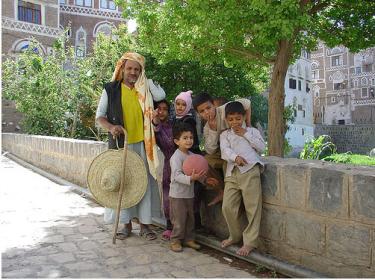
Declare Your Relationship to Yemen
CountryReports Community
- Studying2
- From Yemen0
- Yemen heritage0
- Visited1
- Want to visit0
Customs and Culture
Customs and Culture
About the People
As Yemenis talk to each other the often touch each other. They talk loudly, repeat themselves often and interrupt each other. Schedules are loose and flexible.
Cultural Attributes
As Yemenis talk to each other the often touch each other. They talk loudly, repeat themselves often and interrupt each other. Schedules are loose and flexible.

Land of Frankincense and Ancient Towers
Greetings, Gestures & Visiting
The official language is Arabic and typical arabic greetings are common. Marhaba is hello.
In hot coastal regions men wear lightweight shirts with and embroidered skirt called a futa and a straw hat or other head covering. In the cooler highlands men wear a shirt called a zanna with a jacket. A man's jambiyya (ceremonial dagger) identifies his clan which is sometimes worn tucked in the belt at his waist. Women wear bright colored cloth imported from India called sitaras and lots of jewelry.
Diet
Staples include rice, bread, vegetables, lamb and fish in the coastal regions. Lunch is the largest meal, It generally consist of chicken, lamb or beef with cooked vegetables, rice, flat bread soaked in buttermilk and covered with tomatoes, onions and spices. Breakfast is a light meal usually a bean dish called ful or scrambled eggs with tomatoes. The evening meal is called supper and is much like breakfast. Salta a meat broth with onions, tomatoes, eggs and hulba (an herb) is a favorite dish. Shourba bilsen, a soup made from lentils is also popular.

Family
Most families are large with more than seven members. Several generations may live together. Men and women are separated in public. Women keep themselves veiled and fully covered when anyone but family are present.
Recreation
Soccer is the most popular sport. For men chewing qat is a favorite pastime. Women's afternoon gatherings are known as tafritas.
Holidays
Unification Day
5/22Independence
Dates of Interest
- July - August
Ramadan, the greatest religious observance in Islam, is an annual month of fasting. The exact dates of Islamic holidays cannot be determined in advance, due to the nature of the Islamic lunar calender. Estimates are based on expected visibility of the hilal (waxing crescent moon following a new moon) and may vary according to location.
How do people greet each other in Yemen?
Arabic is the official language and typical Arabic greetings are common; "Marhaba" means hello.
Good to know
- Use "Marhaba" to say hello
What are the dining customs and typical foods in Yemen?
Staples include rice, bread, vegetables, lamb, and fish in coastal regions, with lunch as the largest meal of the day.
Good to know
- Breakfast is light, often ful (a bean dish) or scrambled eggs with tomatoes
- Lunch typically features chicken, lamb, or beef with cooked vegetables, rice, and flat bread soaked in buttermilk topped with tomatoes, onions, and spices
- Supper, the evening meal, is much like breakfast
- Try local favorites like salta (a meat broth with onions, tomatoes, eggs, and the herb hulba) and shourba bilsen (a lentil soup)
What social etiquette should I expect in Yemen?
Yemenis often touch each other while talking, speak loudly, repeat themselves, and interrupt one another, and schedules are loose and flexible.
Good to know
- Expect physical contact and animated conversation
- Don't rely on strict punctuality, as schedules are flexible
How should I dress in Yemen?
Dress varies by region: in hot coastal areas men wear lightweight shirts with an embroidered skirt called a futa and a head covering, while in the cooler highlands men wear a shirt called a zanna with a jacket.
Good to know
- A man's jambiyya (ceremonial dagger) identifies his clan and is sometimes worn tucked in the belt
- Women wear brightly colored cloth called sitaras, imported from India, and lots of jewelry
What is family life like in Yemen?
Most families are large, often with more than seven members, and several generations may live together.
Good to know
- Men and women are separated in public
- Women keep themselves veiled and fully covered when anyone but family is present
What do people do for recreation in Yemen?
Soccer is the most popular sport, while chewing qat is a favorite pastime for men.
Good to know
- Women hold afternoon gatherings known as tafritas
Last updated: 2026-07-12 · Sources: CountryReports
Photos of Yemen
Photos of Yemen
Family
Sana’a
Food
Father and son going to the friday prayer in Sanaa’
Yemeni, wearing the skirt called "futa"
Veiled woman in Sanaa’
Old fashioned Yemini veil from Sanaa called "sitara"
Children swinging on a car in the streets of Sanaa
Transportation
The big hennashop at Bab al-Yemen in Sanaa’
Henna merchants at Bab al-Yemen in Sanaa’
Woman at market


Travel and Tourism
Travel and Tourism
- Travel Alert Status
- Level 4: Do Not Travel
- Currency
- Yemeni rial (YER)
- Time Difference
- UTC+3 (8 hours ahead of Washington, DC, during Standard Time)
- Climate
- The interior highlands have two rainy seasons a year: the first in March and April, and a second with heavier rainfall in July and August. For the rest of the year, sunny, clear weather is the rule, with occasional dust storms. In winter, night temperatures in Sanaa can drop to 30°F, with sunshine and daytime highs of 70°F. Summer temperatures are moderate, with highs of 85°F, dropping to the low 60s at night. To the west in the Tihama (lowlands adjoining the Red Sea) where there is a mixture of African and Arab cultures, the weather is hot and humid for much of the year. Even in winter, daytime highs can be in the 90s. During the summer, torrential monsoons occur. Aden and the southern coast are similarly hot and humid, with summer temperatures frequently in the 100s. However, winter temperatures are far milder and more pleasant. The Hadhramaut and the interior desert regions extending east from Aden to the Omani border are hot and dry. To the east of the highland interior, the terrain slopes down to the sandy wastes of the deserts of inner Arabia, the famous "Empty Quarter."
- Airports
- 44
Read the full travel guide — health, safety, vaccinations, disease risk, sanitation, and transit details.
View full travel guideRecipes
Recipes
History
History
Historical Eras
Ancient Kingdoms
1200 BCE – 628
Yemen was home to the Minaean, Sabaean, and Himyarite kingdoms, which dominated the ancient spice and incense trade routes. These sophisticated states maintained extensive commercial networks stretching to the Mediterranean world. The region subsequently came under Ethiopian and Persian rule before the Persian governor of Yemen embraced Islam in 628 CE, ending the pre-Islamic era.
Islamic & Zaydi Era
628 – 1839
Arab Islamic caliphates extended control over Yemen in the 7th century, and following the fragmentation of the Abbasid caliphate, Zaydi Imams established a durable theocratic order across northern Yemen. The Ottomans absorbed much of the region in the 16th century but were largely expelled by the 1630s, after which Zaydi Imams reasserted authority. In the south, the Kathiridi sultanate and other tribal confederations maintained distinct political structures alongside intermittent Ottoman encroachments from 1849 onward.
Colonial Division
1839 – 1918
Britain captured the strategic port of Aden in 1839, administering it as part of British India and gradually extending protectorates over the surrounding tribal territories. The Ottomans simultaneously pressed their occupation of northern Yemen, though fierce tribal resistance confined effective Turkish control largely to urban centers. The opening of the Suez Canal in 1869 amplified Aden's commercial and strategic importance, deepening the geopolitical division of Yemeni territory.
Divided Independence
1918 – 1990
The collapse of the Ottoman Empire in 1918 brought independence to North Yemen under Imam Yahya and his successors, while the south remained under British rule until 1967, when Marxist NLF guerrillas seized power and eventually proclaimed the People's Democratic Republic of Yemen in 1970. A republican revolution overthrew the Imamate in North Yemen in 1962, sparking a civil war drawing in Egypt, Saudi Arabia, and Jordan. The two Yemeni states engaged in recurrent border conflicts and ideological rivalry through the 1970s and 1980s despite nominal agreements to pursue unification.
Unified Republic
1990 – 2014
North and South Yemen merged on May 22, 1990, forming the Republic of Yemen under President Ali Abdullah Saleh. A southern secessionist uprising in 1994 was swiftly suppressed by northern forces, and a border agreement with Saudi Arabia was reached in 2000. The period nonetheless saw mounting instability, including Houthi insurgencies in the north, a resurgent southern separatist movement, and the growing presence of Al-Qaeda in the Arabian Peninsula.
Civil War & Crisis
2014 – present
Houthi forces seized Sanaa in late 2014 and advanced southward, prompting a Saudi-led military coalition to intervene in 2015 in support of the internationally recognized government. The conflict has produced one of the world's worst humanitarian catastrophes, with widespread famine, disease, and mass displacement. Yemen remains fractured among multiple armed factions, with no durable political settlement achieved.
Overview
Egyptian Sunni caliphs occupied much of north Yemen throughout the 11th century. By the 16th century and again in the 19th century, north Yemen was part of the Ottoman Empire, and in some periods its Imams exerted control over south Yemen.
Former North Yemen
Ottoman control was largely confined to cities with the Imam’s suzerainty over tribal areas formally recognized. Turkish forces withdrew in 1918, and Imam Yahya strengthened his control over north Yemen. Yemen became a member of the Arab league in 1945 and the United Nations in 1947.
Imam Yahya died during an unsuccessful coup attempt in 1948 and was succeeded by his son Ahmad, who ruled until his death in September 1962. Imam Ahmad’s reign was marked by growing repression, renewed friction with the United Kingdom over the British presence in the south, and growing pressures to support the Arab nationalist objectives of Egyptian President Gamal Abdul Nasser.
Shortly after assuming power in 1962, Ahmad’s son, Badr, was deposed by revolutionary forces, which took control of Sanaa and created the Yemen Arab Republic (YAR). Egypt assisted the YAR with troops and supplies to combat forces loyal to the Imamate. Saudi Arabia and Jordan supported Badr’s royalist forces to oppose the newly formed republic. Conflict continued periodically until 1967 when Egyptian troops were withdrawn. By 1968, following a final royalist siege of Sanaa, most of the opposing leaders reached a reconciliation; Saudi Arabia recognized the Republic in 1970.
Former South Yemen
British influence increased in the south and eastern portion of Yemen after the British captured the port of Aden in 1839. It was ruled as part of British India until 1937, when Aden was made a crown colony with the remaining land designated as east Aden and west Aden protectorates. By 1965, most of the tribal states within the protectorates and the Aden colony proper had joined to form the British-sponsored federation of south Arabia.
In 1965, two rival nationalist groups--the Front for the Liberation of Occupied South Yemen (FLOSY) and the National Liberation Front (NLF)--turned to terrorism in their struggle to control the country. In 1967, in the face of uncontrollable violence, British troops began withdrawing, federation rule collapsed, and NLF elements took control after eliminating their FLOSY rivals. South Arabia, including Aden, was declared independent on November 30, 1967, and was renamed the People’s Republic of South Yemen. In June 1969, a radical wing of the Marxist NLF gained power and changed the country’s name on December 1, 1970, to the People’s Democratic Republic of Yemen (PDRY). In the PDRY, all political parties were amalgamated into the Yemeni Socialist Party (YSP), which became the only legal party. The PDRY established close ties with the Soviet Union, China, Cuba, and radical Palestinians.
Republic of Yemen
In 1972, the governments of the PDRY and the YAR declared that they approved a future union. However, little progress was made toward unification, and relations were often strained. In 1979, simmering tensions led to fighting, which was only resolved after Arab League mediation. The northern and southern heads of state reaffirmed the goal of unity during a summit meeting in Kuwait in March 1979. However, that same year the PDRY began sponsoring an insurgency against the YAR. In April 1980, PDRY President Abdul Fattah Ismail resigned and went into exile. His successor, Ali Nasir Muhammad, took a less interventionist stance toward both the YAR and neighboring Oman. On January 13, 1986, a violent struggle began in Aden between Ali Nasir Muhammad and the returned Abdul Fattah Ismail and their supporters. Fighting lasted for more than a month and resulted in thousands of casualties, Ali Nasir’s ouster, and Ismail’s death. Some 60,000 persons, including Ali Nasir and his supporters, fled to the YAR.
In May 1988, the YAR and PDRY governments came to an understanding that considerably reduced tensions including agreement to renew discussions concerning unification,
Timeline of Key Events
1000 BCE
A state centered around ancient trade routes rises.
A state centered around ancient trade routes rises. It is called Saba, most of its power is based on agricultural wealth arising from the famous dam of Ma’rib, and the trade of frankincense. The citizens mostly practice a worship of idols.
395
The Holy Roman Emperor Theodisius makes Christianity the new state religion.
The Holy Roman Emperor Theodisius makes Christianity the new state religion. Christian reluctance to trade and use frankincense, upsets Saba’s trade and sends the state into decline.
575
The Persians take control of a weakened Saba.
The Persians take control of a weakened Saba.
628
The Persian governor of Yemen converts to Islam.
The Persian governor of Yemen converts to Islam, followed by the rest of his subjects. During this time, the first Yemeni mosque is built in Sana’a.
628 – 1962
The Zayidi dynasty takes power in the north as a strict Islamic state.
The Zayidi dynasty takes power in the north as a strict Islamic state.
1454 – 1967
The Kathirids take power in the south.
The Kathirids take power in the south and remain the dominant force in the region until 1967.
1500 – 1600
Ottomans absorb part of Yemen into their empire but are expelled in the 1600s.
Ottomans absorb part of Yemen into their empire but are expelled in the 1600s.
Read the full history profile — narrative overview, defining eras, and the complete timeline in one place.
View expanded historyInteresting Facts
Interesting Facts
It was known to the Romans as "Arabia Felix" ("Happy Arabia") because of the riches its trade generated; Augustus Caesar attempted to annex it, but the expedition failed;
See every fact — trivia, oddities, and curious tidbits gathered from across the country.
View all interesting factsGeography and Environment
Geography and Environment
- Terrain
- narrow coastal plain backed by flat-topped hills and rugged mountains; dissected upland desert plains in center slope into the desert interior of the Arabian Peninsula
- Climate
- The interior highlands have two rainy seasons a year: the first in March and April, and a second with heavier rainfall in July and August. For the rest of the year, sunny, clear weather is the rule, with occasional dust storms. In winter, night temperatures in Sanaa can drop to 30°F, with sunshine and daytime highs of 70°F. Summer temperatures are moderate, with highs of 85°F, dropping to the low 60s at night. To the west in the Tihama (lowlands adjoining the Red Sea) where there is a mixture of African and Arab cultures, the weather is hot and humid for much of the year. Even in winter, daytime highs can be in the 90s. During the summer, torrential monsoons occur. Aden and the southern coast are similarly hot and humid, with summer temperatures frequently in the 100s. However, winter temperatures are far milder and more pleasant. The Hadhramaut and the interior desert regions extending east from Aden to the Omani border are hot and dry. To the east of the highland interior, the terrain slopes down to the sandy wastes of the deserts of inner Arabia, the famous "Empty Quarter."
- Natural Hazards
- sandstorms and dust storms in summer
- Current Environmental Issues
- very limited natural fresh water resources; inadequate supplies of potable water; overgrazing; soil erosion; desertification
Read the full geography and environment profile — terrain, climate, natural resources, hazards, land use, and international agreements.
View full geographyPeople & Demographics
People & Demographics
Religion
Languages Spoken
Arabic
- Arabic
Population
- Population
- 23,495,361
- Population in Major Urban Areas
- SANAA (capital) 2.419 million; Aden 784,000
- Nationality Noun
- Yemeni(s)
- Ethnic Groups
- predominantly Arab; but also Afro-Arab, South Asians, Europeans
Education
- Literacy Definition
- age 15 and over can read and write
Health Information
- Major Infectious Diseases — degree of risk
- high
Read the full people and society profile — demographics, health, education, religion, languages, and notable people.
View full people and societyGovernment & Politics
Government & Politics
Country Identity
- Country Name
- Yemen
- Full Country Name
- Republic of Yemen
- Local - Long
- Al Jumhuriyah al Yamaniyah
- Local - Short
- Al Yaman
Government Structure
- Government Type
- republic
- Legal System
- based on Islamic law, Turkish law, English common law, and local tribal customary law; has not accepted compulsory ICJ jurisdiction
- Executive Branch
- chief of state: The presidency and governmental structure of Yemen have been in a state of significant transition and conflict since 2015. Abd al-Rab Mansur al-HADI, who served as Vice President under longtime President Ali Abdallah SALIH, assumed the presidency in February 2012 following SALIH's resignation amid the Arab Spring uprisings. Al-HADI was recognized internationally as Yemen's legitimate president; however, his government was displaced from Sanaa in 2014–2015 by Houthi forces. In April 2022, al-HADI transferred presidential authority to a newly formed Presidential Leadership Council (PLC), chaired by Rashad Muhammad al-ALIMI, effectively ending his individual tenure. The PLC serves as the internationally recognized governing authority, though its control over Yemeni territory remains contested. head of government: Prime Minister Maeen Abd al-Malik SAEED has served as head of government since October 2018, operating under the framework of the internationally recognized government. The cabinet functions in coordination with the Presidential Leadership Council following the 2022 restructuring of executive authority. cabinet: Council of Ministers appointed by the president on the advice of the prime minister. elections: Prior to the ongoing conflict, the president was elected by direct popular vote for a seven-year term. The most recent uncontested presidential transition occurred in February 2012, when al-HADI ran unopposed in an election endorsed by the Gulf Cooperation Council as part of a political transition agreement. No free national elections have been held since the outbreak of the civil war in 2015. election results: Abd al-Rab Mansur al-HADI elected president in February 2012; percent of vote — al-HADI 99.8%, with the election conducted as a single-candidate referendum under the GCC-brokered transition deal.
- Legislative Branch
- a new constitutional amendment ratified on 20 February 2001 created a bicameral legislature consisting of a Shura Council (111 seats; members appointed by the president) and a House of Representatives (301 seats; members elected by popular vote to serve six-year terms) elections: last held 27 April 2003 (next to be held in April 2009) election results: percent of vote by party - NA; seats by party - GPC 228, Islah 47, YSP 7, Nasserite Unionist Party 3, National Arab Socialist Ba'th Party 2, independents 14
- Judicial Branch
- Supreme Court
- Suffrage
- 18 years of age; universal
- Constitution
- 16 May 1991; amended 29 September 1994 and February 2001
- Independence
- 22 May 1990, Republic of Yemen was established with the merger of the Yemen Arab Republic [Yemen (Sanaa) or North Yemen] and the Marxist-dominated People's Democratic Republic of Yemen [Yemen (Aden) or South Yemen]; previously North Yemen had become indep
- National Holiday
- Unification Day, 22 May (1990)
Capital City
- Capital Name
- Sanaa
- Capital - geographic coordinate
- 15 21 N, 44 12 E
- Capital Time Difference
- UTC+3 (8 hours ahead of Washington, DC, during Standard Time)
the name is reputed to mean "well-fortified" in Sabaean, the South Arabian language that went extinct in Yemen in the 6th century A.D.
Military
Branches: Land Forces, Naval and Coastal Defense Forces (includes Marines), Air and Air Defense Force (al-Quwwat al-Jawwiya al-Yemeniya), Border Guards, Stategic Reserve Forces
Embassy / Diplomatic Mission
U.S. Embassy Sana’a
Dhahr Himyar Zone, Sheraton Hotel District
P.O. Box 22347
Sana’a, Yemen
Telephone: (967) (1) 755-2000
U.S. Citizen Emergency After-Hours Telephone: (967) (1) 755-2000 (press 0 for emergencies) or 737-789-261 (for emergencies involving U.S. citizens that cannot wait until normal business hours). Visa and routine passport questions will not be answered on this phone.
Read the full government profile — flag symbolism, national anthem, and other national symbols.
View full government detailsEconomy
Economy
Yemen remains one of the poorest countries in the Arab world, and its economy has been devastated by the civil war that began in 2014. Once reliant on oil and gas exports for the majority of government revenue, Yemen has seen production collapse due to the ongoing conflict, infrastructure damage, and the disruption of export terminals. GDP has contracted by roughly half since the war began, and the country faces what the United Nations has described as one of the world's worst humanitarian crises, with the majority of the population requiring humanitarian assistance.
The Yemeni rial has lost much of its value, fueling severe inflation and pushing basic goods out of reach for many households. The economy is effectively split between areas controlled by the internationally recognized government, headquartered in Aden, and those held by the Houthi movement in the north, each operating separate central bank functions and monetary policies. Food insecurity is widespread, and millions face acute malnutrition, with famine conditions reported in parts of the country.
Yemen's economic challenges are compounded by a high population growth rate, depleted foreign reserves, scarce water resources, and damaged infrastructure across the energy, transport, and health sectors. Houthi attacks on Red Sea shipping since late 2023 have further disrupted regional trade and complicated recovery efforts. International donors, including Saudi Arabia, the United Arab Emirates, and Western governments, continue to provide budgetary and humanitarian support, but sustainable recovery will depend on a durable political settlement, restoration of oil exports, currency stabilization, and long-term reconstruction investment.
Snapshot
- Currency Name and Code
- Yemeni Rial (YER)
- GDP — official exchange rate
- $14,340,000,000 (USD)
- GDP Real Growth Rate
- 2.4%
- Gini Index
- 33.4
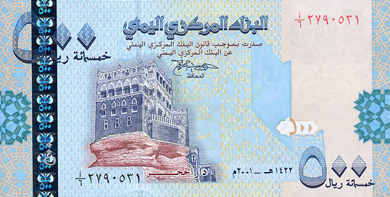
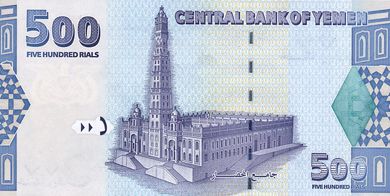
Banknotes
Budget & Public Finance
- Fiscal Year
- calendar year
- Annual Budget
- $5,719,000,000 (USD)
- Public Debt (% of GDP)
- 35.9%
- External Debt
- $5,859,000,000 (USD)
- Investment (% of GDP)
- 14.3%
- Economic Aid
- $2,300,000,000 (USD)
- Current Account Balance
- $1,282,000,000 (USD)
- Reserves of Foreign Exchange
- $2,147,483,647 (USD)
Labor, Industry & Trade
- Labor Force by Occupation
- most people are employed in agriculture and herding; services; construction; industry; and commerce account for less than one-fourth of the labor force
- Household Income — highest 10%
- 25.9%
- Industries
- crude oil production and petroleum refining; small-scale production of cotton textiles and leather goods; food processing; handicrafts; small aluminum products factory; cement
- Agriculture Products
- grain, fruits, vegetables, pulses, qat (mildly narcotic shrub), coffee, cotton; dairy products, livestock (sheep, goats, cattle, camels), poultry; fish
- Export Commodities
- crude oil, coffee, dried and salted fish
- Export Partners
- Thailand 19%, India 16.7%, China 15.3%, South Korea 12.4%, Malaysia 6.1%, US 5.4%
- Import Commodities
- food and live animals, machinery and equipment, chemicals
- Import Partners
- UAE 16%, Saudi Arabia 12.7%, China 6.2%, Kuwait 5.5%, US 4.7%
Energy
- Oil Production
- 387,500 bbl/day
- Oil Consumption
- 80,000 bbl/day
- Oil Reserves
- 4,370,000,000 bbl/day
- Natural Gas Production
- 0 cu m
- Natural Gas Consumption
- 0 cu m
- Natural Gas Imports
- 0 cu m
- Natural Gas Exports
- 0 cu m
- Natural Gas Reserves
- 478,600,000,000 cu m
Communications
- Telephone System
- general assessment: since unification in 1990, efforts have been made to create a national telecommunications network domestic: the national network consists of microwave radio relay, cable, tropospheric scatter, GSM and CDMA mobile-cellular telephone systems; fixed-line and mobile-cellular teledensity remains low by regional standards international: country code - 967; landing point for the international submarine cable Fiber-Optic Link Around the Globe (FLAG); satellite earth stations - 3 Intelsat (2 Indian Ocean and 1 Atlantic Ocean), 1 Intersputnik (Atlantic Ocean region), and 2 Arabsat; microwave radio relay to Saudi Arabia and Djibouti
- Internet Country Code
- .ye
News & Weather
News & Weather
Current Weather
Latest News
Yemen’s Houthis declare naval blockade on Saudi Arabia, widening threat to global oil supplies - NBC News
NBC News · 18h ago
US launches new strikes after Iran-backed Houthis declare blockade of another key oil route - SMH.com.au
SMH.com.au · 12h ago
Yemen's Houthis declare naval blockade on Saudi Arabia, widening threat to global oil supplies - New York Post
New York Post · 11h ago
Health response brings lifesaving care closer to thousands in Yemen - UN News
UN News · 12h ago
The Houthis just announced a blockade on Saudi Arabia. What does it mean for the global economy? - Atlantic Council
Atlantic Council · 7h ago
Yemen’s Iran-backed Houthis announce maritime blockade of Saudi Arabia - The Times of Israel
The Times of Israel · 16h ago
Yemen’s Houthis declare ‘maritime blockade’ on Saudi Arabia - Anadolu Ajansı
Anadolu Ajansı · 18h ago
Houthis declare naval blockade on Saudi Arabia - The Jerusalem Post
The Jerusalem Post · 19h ago
News via Google News
Climate Overview
The interior highlands have two rainy seasons a year: the first in March and April, and a second with heavier rainfall in July and August. For the rest of the year, sunny, clear weather is the rule, with occasional dust storms. In winter, night temperatures in Sanaa can drop to 30°F, with sunshine and daytime highs of 70°F. Summer temperatures are moderate, with highs of 85°F, dropping to the low 60s at night.
To the west in the Tihama (lowlands adjoining the Red Sea) where there is a mixture of African and Arab cultures, the weather is hot and humid for much of the year. Even in winter, daytime highs can be in the 90s. During the summer, torrential monsoons occur. Aden and the southern coast are similarly hot and humid, with summer temperatures frequently in the 100s. However, winter temperatures are far milder and more pleasant. The Hadhramaut and the interior desert regions extending east from Aden to the Omani border are hot and dry. To the east of the highland interior, the terrain slopes down to the sandy wastes of the deserts of inner Arabia, the famous "Empty Quarter."
Videos
Videos
2 curated YouTube videos.
Source: YouTube
Source: YouTube
Frequently Asked Questions
Frequently Asked Questions
What is the population of Yemen?
How do people greet each other in Yemen?
What are the dining customs and typical foods in Yemen?
What social etiquette should I expect in Yemen?
How should I dress in Yemen?
What is family life like in Yemen?
What do people do for recreation in Yemen?
What is the capital of Yemen?
Where is Yemen located?
What countries border Yemen?
What religion is practiced in Yemen?
What is the currency of Yemen?
What language is spoken in Yemen?
What is Yemen's geography like?
What is Yemen known for?
Last reviewed 2026