
 English
 Español
 中文
中文 हिन्दी
 Français
Saudi Arabia
Al Arabiyah as Suudiyah
Declare Your Relationship to Saudi Arabia
CountryReports Community
- Studying2
- From Saudi Arabia1
- Saudi Arabia heritage3
- Visited1
- Want to visit0
Customs and Culture
Customs and Culture
About the People
Saudis attempt to maintain traditions even though society is being modernized. The Saudi people are a very religious. Islamic customs play a key role in determining cultural practices.
Saudi Arabians prefer to establish trust and confidence before proceeding with business. Personal and family honor is important and can be easily offended.
Cultural Attributes
Saudis attempt to maintain traditions even though society is being modernized. The Saudi people are very religious. Islamic customs play a key role in determining cultural practices.
Saudi Arabians prefer to establish trust and confidence before proceeding with business. Personal and family honor is important and can be easily offended.

Keeper of the Sacred Sands
Greetings, Gestures & Visiting
There are several forms of greeting in Saudi Arabia. A handshake is the most common form of greeting. One uses the right hand to shake while saying "As-Salaamu Alaykum" which means peace be upon you. Shaking hands with a woman is not the norm.
Greetings are an important part of Saudi culture. Men typically greet each other with a handshake and may exchange kisses on the cheek if they are close friends or family members. Women greet each other with verbal greetings and may exchange kisses on the cheek or hugs if they are close. When greeting someone of the opposite gender, it's best to wait for them to initiate the greeting.
Pointing with the finger or signal to another person with the hand is impolite. One should avoid using the left hand to make gestures., Both hands are used when passing something to someone else and should never pass with the left hand alone. Pointing the bottom of one's foot toward another person is considered rude.
When visiting people in Saudi Arabia, it's important to adhere to cultural customs and etiquette to show respect and appreciation for your hosts.
Hospitality: Saudi Arabia is known for its hospitality, and guests are often treated with great respect and generosity. When invited to someone's home, it's customary to bring a small gift such as dates, chocolates, or flowers for the host. It's also polite to accept any food or drink offered by your host, as refusing may be seen as impolite.
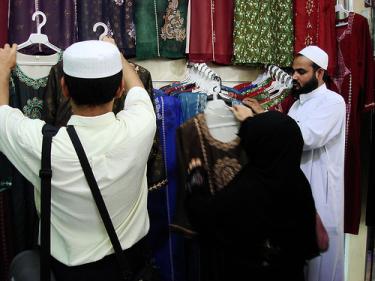
Dress Code: Saudi Arabia has conservative dress codes, especially in public places and when visiting someone's home. Men typically wear long pants and shirts with sleeves, while women are expected to dress modestly, covering their arms and legs, and wearing a headscarf (hijab) if they are Muslim. Avoid wearing tight or revealing clothing.
Respect for Elders: Respect for elders is highly valued in Saudi culture. When visiting someone's home, greet the oldest person first and show deference to them throughout your visit. Address elders with titles such as "Sheikh" for men and "Sheikha" for women, followed by their first name.
Removing Shoes: It's customary to remove your shoes before entering someone's home in Saudi Arabia, especially if the floors are covered with carpets or rugs. You may be offered slippers or indoor shoes to wear instead.
Conversation Topics: When engaging in conversation, avoid sensitive topics such as politics, religion, and personal matters unless your host brings them up. Instead, focus on topics such as family, culture, food, and general interests.
Seating Arrangements: In traditional Saudi homes, there may be separate seating areas for men and women. Follow your host's lead when determining where to sit. If unsure, ask your host for guidance.
Timekeeping: Punctuality is appreciated in Saudi culture, so try to arrive on time for social engagements. However, it's also common for events to start later than scheduled, so be prepared for some flexibility in timing.
Women usually veil their faces in public and wear a "abaaya". Men typically wear a headdress called a "ghutua" and a long white shirt called a "thobe". Modesty is of utmost importance, even in the heat of the Saudi summers. Both Saudi men and women wear traditional Arab clothing.
Diet
Saudi dishes are composed mainly of rice with lamb or chicken and are mildly spicy. Kabsah (rice and lamb) is a favorite dish throughout the country. Coffee or tea is served before all meals. Muslims do not eat pork or drink alcohol.
In general, food is eaten with the fingers of the right hand only. Bread may be torn with the left hand but is eaten with the right. The main meal of the day is in mid-afternoon.
Saudi meals often include rice with lamb or chicken.. Kabsah (rice and lamb) is a popular dish throughout Saudia Arabia. Muslims do not eat pork or drink alcohol. Tea or Coffee is served before meals.

Family
Numerous rules govern women's actions and customs and are designed to respect and protect a woman's modesty and innocence. In Saudi Arabia, separation of males and females is the norm. Men doctors do not provide medical treatment to women or children. Men and women typically do not work together in their jobs. Women cannot drive a car or ride bicycles. Women are not permitted to socialize in public with other men and a male relative usually accompanies them.
Dating Customs
Dating is not done in Saudi society. A traditional wedding is an Islamic ceremony followed by separate parties for the men and women. A woman's chastity is highly valued and is considered the most important thing a woman can bring to her marriage. Marriages are usually arranged, but some young men in urban areas can choose their brides.
Recreation
In Saudi Arabia, recreational activities vary depending on factors such as location, gender, and social status. While the country is known for its conservative cultural norms, there are still several recreational activities that Saudis and expatriates enjoy.
Shopping: Shopping malls are popular recreational destinations in Saudi Arabia, offering a wide range of retail stores, restaurants, cafes, entertainment facilities, and recreational activities such as cinemas and amusement parks. Malls also provide air-conditioned spaces, making them attractive during hot weather.
Social Gatherings: Saudis place a strong emphasis on socializing with family and friends. Gathering for meals, coffee, or tea is a common pastime, particularly during weekends and holidays. Majlis (traditional sitting rooms) serve as spaces for social interaction, where people gather to chat, share stories, and enjoy each other's company.
Outdoor Activities: Despite the desert climate, outdoor recreational activities are popular in Saudi Arabia. These may include picnics, barbecues, camping, hiking, and desert safaris. Many Saudis enjoy spending time in the desert, exploring its natural beauty and engaging in activities such as sandboarding and dune bashing.
Sports: Sports are an integral part of recreational life in Saudi Arabia. While traditional sports such as camel racing and falconry are still practiced, modern sports such as football (soccer), basketball, volleyball, tennis, and cricket are also popular. Saudi Arabia has invested heavily in sports infrastructure, including stadiums, sports clubs, and fitness centers.
Cultural Events: Saudis take pride in their cultural heritage and often participate in cultural events and festivals. These may include traditional dances, music performances, art exhibitions, poetry readings, and cultural workshops. Events such as the Janadriyah Festival celebrate Saudi culture and heritage, attracting visitors from across the country.
Religious Activities: Religious activities play a significant role in Saudi recreational life, particularly for Muslims. Visiting mosques for prayers, attending religious lectures, and participating in religious gatherings and rituals are common recreational pursuits. During the holy month of Ramadan, Muslims engage in special religious activities and communal iftars (breaking of the fast).
Indoor Activities: Given the extreme temperatures during certain times of the year, indoor recreational activities are popular. These may include indoor sports facilities, fitness centers, swimming pools, bowling alleys, billiards halls, and gaming arcades.
Travel: With its diverse landscapes and rich cultural heritage, Saudi Arabia offers opportunities for domestic travel and exploration. Many Saudis enjoy visiting historical sites, natural attractions, and tourist destinations within the country, such as Jeddah's Old Town, the Nabatean ruins of Al-Ula, and the Red Sea coastline.
Holidays
Unification of the Kingdom
9/23Independence
Christmas
12/25Christmas
This Country is entirely Muslin and public celebrations of Christmas are not tolerated in any form. Foreign visitors may hold private holiday observances according to their country of origin.
Dates of Interest
- July - August
Al-Quds Day, also known as Jerusalem Day, is an annual event observed on the last Friday of Ramadan to express solidarity with the Palestinian people and their struggle for the liberation of Jerusalem. While it is not an official holiday in Saudi Arabia, some individuals participate in demonstrations or rallies to support the Palestinian cause.
How do people greet each other in Saudi Arabia?
A handshake with the right hand is the most common greeting, accompanied by "As-Salaamu Alaykum" (peace be upon you). Greetings between opposite genders are not the norm, so wait for the other person to initiate.
Do
- Shake with the right hand and say "As-Salaamu Alaykum"
- Let the other person initiate when greeting the opposite gender
- Greet the oldest person first when visiting a home
Don’t
- Don't assume you should shake hands with a woman
Good to know
- Men who are close friends or family may exchange cheek kisses
- Women may exchange verbal greetings, cheek kisses, or hugs if close
What are the dining customs in Saudi Arabia?
Food is eaten with the fingers of the right hand only, and the main meal is in mid-afternoon. Coffee or tea is served before meals, and common dishes include Kabsah (rice and lamb).
Do
- Eat with the fingers of your right hand
- Accept coffee or tea served before the meal
- Accept food or drink offered by your host
Don’t
- Don't eat pork or drink alcohol (Muslims abstain)
- Don't eat with the left hand
- Don't refuse offered food or drink, as it may seem impolite
Good to know
- Bread may be torn with the left hand but is eaten with the right
- Kabsah (rice and lamb) is a favorite dish throughout the country
What etiquette should I know when visiting a Saudi home?
Show respect through hospitality customs: bring a small gift, remove your shoes, and defer to elders. Saudi Arabia is known for treating guests with great respect and generosity.
Do
- Bring a small gift such as dates, chocolates, or flowers
- Remove your shoes before entering
- Greet and show deference to the oldest person
- Address elders as "Sheikh" (men) or "Sheikha" (women) with their first name
Don’t
- Don't raise sensitive topics like politics, religion, or personal matters unless the host does
- Don't ignore separate seating areas for men and women
Good to know
- Focus conversation on family, culture, food, and general interests
- Arrive on time, but be prepared for events to start later than scheduled
- Follow your host's lead on seating; you may be offered indoor slippers
How should I dress in Saudi Arabia?
Dress conservatively and modestly, as modesty is of utmost importance even in summer heat. Avoid tight or revealing clothing.
Do
- Men: wear long pants and shirts with sleeves
- Women: cover arms and legs, and wear a headscarf (hijab) if Muslim
- Dress modestly in public and in homes
Don’t
- Don't wear tight or revealing clothing
Good to know
- Saudi women often wear an "abaaya" and veil their faces in public
- Saudi men typically wear a headdress ("ghutua") and a long white "thobe"
Are there gestures to avoid in Saudi Arabia?
Avoid pointing, using the left hand, and showing the sole of your foot, as these are considered rude.
Do
- Use both hands when passing something to someone
Don’t
- Don't point with your finger or signal with your hand
- Don't make gestures or pass items with the left hand alone
- Don't point the bottom of your foot toward another person
What should I know about family and gender customs in Saudi Arabia?
Separation of males and females is the norm, with many customs designed to protect a woman's modesty. Dating is not done, and marriages are usually arranged.
Do
- Respect the separation of men and women in public and social settings
Don’t
- Don't expect men and women to socialize together in public
Good to know
- Women are usually accompanied by a male relative in public
- Weddings are an Islamic ceremony followed by separate parties for men and women
What do people do for recreation in Saudi Arabia?
Popular activities include shopping malls, social gatherings for meals and coffee, outdoor desert activities, sports, cultural events, and religious activities.
Good to know
- Malls offer shops, restaurants, cinemas, and air-conditioned relief from the heat
- Outdoor options include picnics, camping, hiking, desert safaris, sandboarding, and dune bashing
- Football, basketball, volleyball, tennis, and cricket are popular, alongside camel racing and falconry
- Explore sites like Jeddah's Old Town, the Nabatean ruins of Al-Ula, and the Red Sea coastline
Last updated: 2026-07-12 · Sources: CountryReports
Photos of Saudi Arabia
Photos of Saudi Arabia


Travel and Tourism
Travel and Tourism
- Travel Alert Status
- Level 3: Reconsider Travel
- Currency
- Saudi riyal (SAR)
- Time Difference
- UTC+3 (8 hours ahead of Washington, DC, during Standard Time)
- Climate
- Riyadh’s climate has a greater difference between winter and summer temperatures than elsewhere in the Kingdom. Riyadh has practically no humidity, making summers especially dry and dusty. Annual rainfall averages 2 to 4 inches, usually concentrated in a few torrential rainfalls in early spring. Winters produce moderate daytime temperatures from November through February. Evenings are sometimes cool enough to require residential heating. Jeddah, the commercial center, has a tropical climate — mild in winter and hot and very humid in summer. Summer lasts 8 to 10 months, with temperatures moderating in November. Relief from the heat often comes at sunset when sea breezes arrive. Except on the few occasions when it rains, the sun shines daily. Winter is comparable to the spring and summer seasons of resorts on the Mediterranean Sea. Dhahran’s climate, like that of Jeddah, is very humid, 60% – 90%, with summer lasting from April through October. The average maximum shade temperature in July and August is 110 °F, with "in sun" temperatures up to 150 °F. From December to April, it is cooler and pleasant, with indoor heating required at times, especially in the areas north of Dhahran. Rainfall in both Jeddah and Dhahran is sparse, about 3 – 4 inches a year concentrated in a few heavy showers during fall and spring.
- Airports
- 204
Read the full travel guide — health, safety, vaccinations, disease risk, sanitation, and transit details.
View full travel guideRecipes
Recipes
Green Coriander Salad
Main Dish
Main Dish
Kharoof Mahshi - Roast Stuffed Kid
Main Dish
Koazy Al-Macarona - Macaroni Koazy
Main Dish
Aish Bel-Lahm - Bread with Meat
Main Dish
Fakhitha Bel Laban - Leg of Lamb with Yogurt
Main Dish
Dajaj Bel Laban - Chicken with Yogurt
Main Dish
Kebab Bel Laban - Kebab with Yogurt
Main Dish
PremiumKebab Bel Laban - Kebab with Yogurt Al-Motubug - Stuffed Pastry Squares
Main Dish
PremiumGreen Coriander Salad
Side Dish
PremiumAroz Saudi - Saudi Rice
History
History
Historical Eras
Pre-Islamic Arabia
3000 BCE – 622
The Arabian Peninsula was home to ancient trade kingdoms such as the Nabataeans and the Sabaeans, as well as nomadic Bedouin tribal confederations. Mecca emerged as a significant religious and commercial center, housing the Kaaba. The birth of the Prophet Muhammad around 570 CE set the stage for a transformative religious revolution that would reshape the peninsula and the wider world.
Early Islamic Era
622 – 1517
The Hijra of 622 CE marks the founding moment of the Islamic community, followed swiftly by pivotal events such as the Battle of Badr and the conquest of Mecca in 630. The holy cities of Mecca and Medina became the spiritual heart of an expanding empire. After Muhammad's death in 632, the peninsula passed through successive caliphates — Rashidun, Umayyad, and Abbasid — before fragmenting under local dynastic and tribal rule.
Ottoman Suzerainty
1517 – 1744
The Ottoman Empire extended its authority over the Hejaz in 1517, assuming the role of guardian of Mecca and Medina and legitimizing its claim to the caliphate. Ottoman control over the interior of the peninsula remained nominal, and tribal powers operated with considerable autonomy. The construction of fortifications such as al-Ajyad Castle in Mecca symbolized Ottoman efforts to assert a physical presence in the region's most sacred territories.
First & Second Saudi States
1744 – 1902
In 1744, the scholar Muhammad ibn Abd al-Wahhab allied with tribal leader Muhammad ibn Saud in Diriyah, fusing Wahhabi religious reform with Saudi political ambition. The First Saudi State expanded dramatically, capturing Mecca and Medina in 1802–03, before Egyptian forces under Muhammad Ali crushed it in 1818. A Second Saudi State briefly revived Saud dominance from Riyadh but collapsed under pressure from the rival Al Rashid dynasty, forcing the Al Saud into exile in Kuwait by the 1890s.
Unification & Kingdom
1902 – 1973
Abd al-Aziz ibn Saud recaptured Riyadh from the Al Rashid in 1902 and spent three decades consolidating the Arabian Peninsula, formally proclaiming the Kingdom of Saudi Arabia in 1932. American geologists discovered oil in 1938, and the founding of Aramco began transforming one of the world's poorest desert kingdoms into an emerging petrostate. Vast oil revenues funded rapid modernization while the monarchy maintained strict Wahhabi religious governance and tribal-based statecraft.
Oil Power & Modern State
1973 – present
The 1973 oil embargo demonstrated Saudi Arabia's commanding influence over global energy markets, and the kingdom leveraged petroleum wealth to build modern infrastructure, cities, and institutions at extraordinary speed. The 1979 seizure of the Grand Mosque in Mecca by Islamist militants, the Gulf War of 1991, and the domestic terrorist attacks of 2003 exposed persistent tensions between modernization and religious conservatism. Under King Salman and Crown Prince Mohammed bin Salman, Vision 2030 has pursued sweeping economic diversification and social liberalization while the monarchy retains authoritarian political control.
Overview
Timeline of Key Events
570
Birth of Prophet Muhammd
Birth of Prophet Muhammd, the later Prophet of Islam.
622
Islamic Era began
Islamic Era began. Mahomet began his flight from Mecca to Medina.
624
The Battle of Badr
Muslims engaged non-believers for the 1st time at the Battle of Badr.
630
Mecca is conqured by Prophet Muhammads men
Mecca is conquered by Prophet Muhammads men, and strong expansion is started towards first the Arab peninsular, later beyond in northern direction.
632
Mohammed died
Mohammed, the founder of Islam and unifier of Arabia, died.
702
Ethiopian (Axumite) raiders occupy the port of Jeddah in modern-day Saudi Arabia
Ethiopian (Axumite) raiders occupy the port of Jeddah in modern-day Saudi Arabia.
1400
The Saud dynasty
The Saud dynasty was founded near Riyadh.
Read the full history profile — narrative overview, defining eras, and the complete timeline in one place.
View expanded historyInteresting Facts
Interesting Facts
The discovery of oil in the 1930s improved the country's economy tremendously, allowing the people to enjoy a high standard of living and an increasingly diverse economy.
Privacy is very important to the Saudi Arabians, so houses are built with big walls. When you visit the house of a Saudi Arabian you should stand at the door in such a way that ensures you cannot see inside. It is all right to enter when your host has signaled you by extending his right hand, palm up, and said Tafaddal, or “Come in”.
Today, Saudi Arabia's proven oil reserves are estimated at 260 billion barrels. This large figure clearly indicates the wealth of Saudi Arabia.
In keeping with the Sacred Scripture of the Quran, which does not allow depiction of people or animals, places of entertainment such as theatres and cinema are banned in Saudi Arabia.
Millions of people who come to Mecca for the annual Islamic religious pilgrimage of Hajj. Approximately 11,350 doctors, nurses and other medical personnel, including the Saudi Red Crescent Society, are on hand to provide services to them.
There are ten colleges for women in Saudi Arabia. For men there are seven universities and seventy-six colleges.
See every fact — trivia, oddities, and curious tidbits gathered from across the country.
View all interesting factsGeography and Environment
Geography and Environment
- Terrain
- mostly uninhabited, sandy desert
- Climate
- Riyadh’s climate has a greater difference between winter and summer temperatures than elsewhere in the Kingdom. Riyadh has practically no humidity, making summers especially dry and dusty. Annual rainfall averages 2 to 4 inches, usually concentrated in a few torrential rainfalls in early spring. Winters produce moderate daytime temperatures from November through February. Evenings are sometimes cool enough to require residential heating. Jeddah, the commercial center, has a tropical climate — mild in winter and hot and very humid in summer. Summer lasts 8 to 10 months, with temperatures moderating in November. Relief from the heat often comes at sunset when sea breezes arrive. Except on the few occasions when it rains, the sun shines daily. Winter is comparable to the spring and summer seasons of resorts on the Mediterranean Sea. Dhahran’s climate, like that of Jeddah, is very humid, 60% – 90%, with summer lasting from April through October. The average maximum shade temperature in July and August is 110 °F, with "in sun" temperatures up to 150 °F. From December to April, it is cooler and pleasant, with indoor heating required at times, especially in the areas north of Dhahran. Rainfall in both Jeddah and Dhahran is sparse, about 3 – 4 inches a year concentrated in a few heavy showers during fall and spring.
- Natural Hazards
- frequent sand and dust storms
- Current Environmental Issues
- desertification; depletion of underground water resources; the lack of perennial rivers or permanent water bodies has prompted the development of extensive seawater desalination facilities; coastal pollution from oil spills
Read the full geography and environment profile — terrain, climate, natural resources, hazards, land use, and international agreements.
View full geographyPeople & Demographics
People & Demographics
Religion
Languages Spoken
Arabic
- Arabic
Population
- Population
- 29,207,277
- Population in Major Urban Areas
- RIYADH (capital) 5.451 million; Jeddah 3.578 million; Mecca 1.591 million; Medina 1.142 million; Ad Dammam 941,000
- Nationality Noun
- Saudi(s)
- Ethnic Groups
- Arab 90%, Afro-Asian 10%
Education
- Literacy Definition
- age 15 and over can read and write
Read the full people and society profile — demographics, health, education, religion, languages, and notable people.
View full people and societyGovernment & Politics
Government & Politics
Country Identity
- Country Name
- SaudiArabia
- Full Country Name
- Kingdom of Saudi Arabia
- Local - Long
- Al Mamlakah al Arabiyah as Suudiyah
- Local - Short
- Al Arabiyah as Suudiyah
Government Structure
- Government Type
- monarchy
- Legal System
- based on Islamic law, several secular codes have been introduced; commercial disputes handled by special committees; has not accepted compulsory ICJ jurisdiction
- Executive Branch
- chief of state: King and Prime Minister SALMAN bin Abd al-Aziz Al Saud (since 23 January 2015); Crown Prince MUHAMMAD BIN SALMAN bin Abd al-Aziz Al Saud (son of the monarch, born 31 August 1985); note - the monarch is both the chief of state and head of government head of government: King and Prime Minister SALMAN bin Abd al-Aziz Al Saud (since 23 January 2015); Crown Prince and Deputy Prime Minister MUHAMMAD BIN SALMAN bin Abd al-Aziz Al Saud; note - the monarch is both the chief of state and head of government cabinet: Council of Ministers is appointed by the monarch and includes many royal family members; Crown Prince Muhammad bin Salman serves as First Deputy Prime Minister and holds significant governing authority elections: none; the monarch is hereditary
- Legislative Branch
- Consultative Council or Majlis al-Shura (120 members and a chairman appointed by the monarch for four-year terms); note - in October 2003, Council of Ministers announced its intent to introduce elections for half of the members of local and provincial assemblies and a third of the members of the national Consultative Council or Majlis al-Shura, incrementally over a period of four to five years; in November 2004, the Ministry of Municipal and Rural Affairs initiated voter registration for partial municipal council elections held nationwide from February through April 2005
- Judicial Branch
- Supreme Council of Justice
- Suffrage
- none
- Constitution
- governed according to Shari'a (Islamic law); the Basic Law that articulates the government's rights and responsibilities was introduced in 1993
- Independence
- 23 September 1932 (Unification of the Kingdom)
- National Holiday
- Unification of the Kingdom, 23 September (1932)
Capital City
- Capital Name
- Riyadh
- Capital - geographic coordinate
- 24 39 N, 46 42 E
- Capital Time Difference
- UTC+3 (8 hours ahead of Washington, DC, during Standard Time)
the name derives from the Arabic word "riyadh," meaning "gardens," and refers to various oasis towns in the area that merged to form the city
Military
Branches: Ministry of Defense and Aviation Forces: Royal Saudi Land Forces, Royal Saudi Naval Forces (includes Marine Forces and Special Forces), Royal Saudi Air Force (Al-Quwwat al-Jawwiya al-Malakiya as-Sa'udiya), Royal Saudi Air Defense Forces, Royal Saudi Strategic Rocket Forces, Saudi Arabian National Guard (SANG)
Embassy / Diplomatic Mission
U.S. Embassy Riyadh
Abdullah Ibn Hudhafah As Sahmi Street, Roundabout no. 9, Diplomatic Quarter, Riyadh
Telephone: (966) (011) 488-3800
Fax: (966) (011) 483-0773
Emergency after-hours telephone: (966) (011) 488-3800
U.S. Consulate General Dhahran
Between KFUPM and King Abdulaziz Airbase, Dhahran
Telephone: (966) (13) 330-3200
Fax: (966) (13) 330-6816
Emergency after-hours telephone: (966) (13) 330-3200
U.S. Consulate General Jeddah
Falasteen Street intersecting with Al-Andalus Street, Jeddah
Telephone: (966) (12) 667-0080
Fax: (966) (12) 669-3098
Emergency after-hours telephone: (966) (12) 667-0080
Read the full government profile — flag symbolism, national anthem, and other national symbols.
View full government detailsEconomy
Economy
Saudi Arabia has a high-income, oil-based economy with significant government oversight of major economic activities, though the kingdom has been steadily liberalizing its markets under the Vision 2030 reform program launched in 2016. The country holds roughly 15% of the world's proven petroleum reserves—the second largest after Venezuela—and remains one of the world's top crude oil exporters and the leading producer within OPEC. The petroleum sector still accounts for approximately 60% of government revenues and around 70% of export earnings, though its share of GDP has declined to roughly 25–30% as the non-oil economy expands.
The private sector now contributes more than half of GDP, and foreign workers—estimated at over 13 million—continue to play a vital role across construction, services, retail, and the energy industry. Vision 2030, spearheaded by Crown Prince Mohammed bin Salman, aims to diversify the economy away from hydrocarbons through major investments in tourism, entertainment, technology, mining, and renewable energy. Landmark giga-projects such as NEOM, the Red Sea Project, Qiddiya, and Diriyah Gate reflect this strategy, as does the partial 2019 public listing of Saudi Aramco, which became one of the world's largest IPOs.
The government continues to invest heavily in education, healthcare, infrastructure, and water and sanitation systems. Reforms have expanded women's participation in the workforce, introduced a value-added tax, reduced fuel and utility subsidies, and opened the country to international tourism and entertainment. Nevertheless, the economy remains vulnerable to global oil price swings, and structural challenges—including youth unemployment, dependence on expatriate labor, and the pace of social and regulatory change—continue to shape the kingdom's long-term economic outlook.
Snapshot
- Currency Name and Code
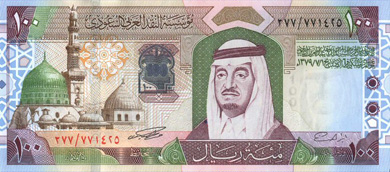
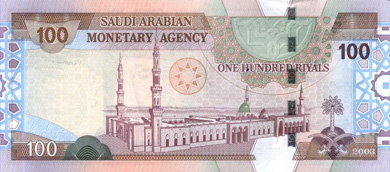
- Saudi Riyal (SAR)
- GDP — official exchange rate
- $264,000,000,000 (USD)
- GDP Real Growth Rate
- 6.1%
Banknotes
Budget & Public Finance
- Fiscal Year
- 1 March - 28 February
- Annual Budget
- $89,650,000,000 (USD)
- Public Debt (% of GDP)
- 41%
- External Debt
- $34,550,000,000 (USD)
- Investment (% of GDP)
- 16.3%
- Current Account Balance
- $87,100,000,000 (USD)
- Reserves of Foreign Exchange
- $2,147,483,647 (USD)
Labor, Industry & Trade
- Labor Force by Occupation
- agriculture 12%; industry 25%; services 63%
- Industries
- crude oil production, petroleum refining, basic petrochemicals, cement, construction, fertilizer, plastics
- Agriculture Products
- wheat, barley, tomatoes, melons, dates, citrus; mutton, chickens, eggs, milk
- Export Commodities
- petroleum and petroleum products 90%
- Export Partners
- US 18.9%, Japan 15.9%, South Korea 10.3%, Singapore 5.2%, China 4.7%
- Import Commodities
- machinery and equipment, foodstuffs, chemicals, motor vehicles, textiles
- Import Partners
- US 11.1%, Japan 8.7%, Germany 7.5%, UK 4.9%, France 4.8%, Italy 4%
Energy
- Oil Production
- 9,475,000 bbl/day
- Oil Consumption
- 1,775,000 bbl/day
- Oil Reserves
- 262,700,000 bbl/day
- Natural Gas Production
- 60,060,000,000 cu m
- Natural Gas Consumption
- 60,060,000,000 cu m
- Natural Gas Imports
- 0 cu m
- Natural Gas Exports
- 0 cu m
- Natural Gas Reserves
- 6,544,000,000,000 cu m
Communications
- Telephone System
- general assessment: modern system including a combination of extensive microwave radio relays, coaxial cables, and fiber-optic cables domestic: mobile-cellular subscribership has been increasing rapidly international: country code - 966; landing point for the international submarine cable Fiber-Optic Link Around the Globe (FLAG) and for both the SEA-ME-WE-3 and SEA-ME-WE-4 submarine cable networks providing connectivity to Asia, Middle East, Europe, and US; microwave radio relay to Bahrain, Jordan, Kuwait, Qatar, UAE, Yemen, and Sudan; coaxial cable to Kuwait and Jordan; satellite earth stations - 5 Intelsat (3 Atlantic Ocean and 2 Indian Ocean), 1 Arabsat, and 1 Inmarsat (Indian Ocean region)
- Internet Country Code
- .sa
News & Weather
News & Weather
Current Weather
Latest News
Yemen’s Houthis declare naval blockade on Saudi Arabia, widening threat to global oil supplies - NBC News
NBC News · 18h ago
Will the 2034 cup be in 2035? - Politico
Politico · 1d ago
University of New Haven alumnus gives $10 million to support new Saudi Arabia campus - CT Insider
CT Insider · 12h ago
Nuclear deal that would permit uranium enrichment by Saudi Arabia in limbo awaiting Trump admin sign-off - CNN
CNN · 2d ago
US greenlights Saudi nuclear enrichment without safeguards: Report - Middle East Eye
Middle East Eye · 15h ago
White House Ready To Authorize Saudi Arabia To Enrich Uranium - Report - i24NEWS
i24NEWS · 1d ago
Saudi Arabia launches new one-year, multiple-entry Umrah visa with 90-day stay - The Times of India
The Times of India · 19h ago
Saudi Arabia Cuts July Crude Prices for Asia As Demand Slows - WSJ
WSJ · 43d ago
News via Google News
Climate Overview
Riyadh’s climate has a greater difference between winter and summer temperatures than elsewhere in the Kingdom. Riyadh has practically no humidity, making summers especially dry and dusty. Annual rainfall averages 2 to 4 inches, usually concentrated in a few torrential rainfalls in early spring. Winters produce moderate daytime temperatures from November through February. Evenings are sometimes cool enough to require residential heating.
Jeddah, the commercial center, has a tropical climate — mild in winter and hot and very humid in summer. Summer lasts 8 to 10 months, with temperatures moderating in November. Relief from the heat often comes at sunset when sea breezes arrive. Except on the few occasions when it rains, the sun shines daily. Winter is comparable to the spring and summer seasons of resorts on the Mediterranean Sea.
Dhahran’s climate, like that of Jeddah, is very humid, 60% – 90%, with summer lasting from April through October. The average maximum shade temperature in July and August is 110 °F, with "in sun" temperatures up to 150 °F. From December to April, it is cooler and pleasant, with indoor heating required at times, especially in the areas north of Dhahran.
Rainfall in both Jeddah and Dhahran is sparse, about 3 – 4 inches a year concentrated in a few heavy showers during fall and spring.
Videos
Videos
2 curated YouTube videos.
Source: YouTube
Source: YouTube
Frequently Asked Questions
Frequently Asked Questions
What is the population of Saudi Arabia?
How do people greet each other in Saudi Arabia?
What are the dining customs in Saudi Arabia?
What etiquette should I know when visiting a Saudi home?
How should I dress in Saudi Arabia?
Are there gestures to avoid in Saudi Arabia?
What should I know about family and gender customs in Saudi Arabia?
What do people do for recreation in Saudi Arabia?
What is the capital of Saudi Arabia?
Where is Saudi Arabia located?
What countries border Saudi Arabia?
What religion is practiced in Saudi Arabia?
What is the currency of Saudi Arabia?
What language is spoken in Saudi Arabia?
What is Saudi Arabia's geography and terrain like?
What is Saudi Arabia known for?
Last reviewed 2026