
 English
 Español
 中文
中文 हिन्दी
 Français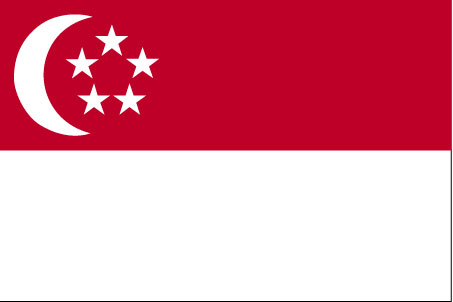
Singapore
Declare Your Relationship to Singapore
CountryReports Community
- Studying4
- From Singapore1
- Singapore heritage2
- Visited2
- Want to visit1
Customs and Culture
Customs and Culture
About the People
People in Singapore do not use first names except with close friends. They also do not talk openly about feelings and emotions. For Singaporeans, it is important not to “lose face” (to be embarrassed or shamed) in public.
Cultural Attributes
People in Singapore do not use first names except with close friends. They also do not talk openly about feelings and emotions. For Singaporeans, it is essential not to “lose face” (to be embarrassed or shamed) in public.

The Lion City's Garden of Prosperity
Greetings, Gestures & Visiting
Each ethnic group has its own style of greeting. One must not offer anything with the left hand to Muslims and Hindus.
Malays and Indians have their given names before their father's name but are addressed by their given names. For example:
Malay Man : Mohamed bin Ibraham
Address as : Encik (pronounced "enchee") Mohamed, ie Mr Mohamed
Malay Woman: Hasnah binte Abdullah
Address as : Cik (pronounced "chik") Hasnah if the woman is unmarried or Puan Hasnah for married women
Singaporean citizens of Indian descent frequently have long names. The name will often include the initials of the person's father, given in initials. For example:
Indian Person: Subramanian S.O. Manickavasagam
Address as : Mr Subramanian
Do not offer anything with your left hand when with Muslims. Pointing with the forefinger is considered rude. Pointing with the forefinger is used to point to animals. Pointing is best done with an open hand. Hugging and kissing are forbidden in public. It is acceptable for people of the same sex to show physical contact. Men may hold hands or even walk with their arms around each other as a gesture of friendship.
The elderly receive great respect, thus be sure to hold doors open for them, rise before they enter a room and give up your seat to them on public transportation. When seated, cross your legs at the knees so that the sole of your shoe is not displayed to other people. Littering is strictly forbidden in Singapore, and anyone caught violating this law is subject to heavy fines. This includes the throwing away of cigarettes.
Standard business attire is quite formal but can be tailored to suit Singapore's hot, tropical climate. Men should wear a shirt and tie, and women should wear a dress or skirt and blouse. Suits and coats should be worn to official functions. Younger people enjoy the latest fashions.
Diet
The food of Singapore reflects its multi ethnic society. Chinese, Malay, Peranakan and Indian food are all widely available and Western food is increasingly popular.
Peranakan food is a unique blend of Malay and Chinese cuisines. Otak-Otak is a popular Peranakan dish, made of fish mixed with spices and coconut milk, wrapped in coconut leaves and grilled over a charcoal fire.
When Singaporeans serve food at home, they usually place dishes in the center of the table at the beginning of a meal, so that everyone can help themselves throughout the meal. Chinese families usually eat together. They use chopsticks to eat. In Malay and Indian homes, which are more conservative, men usually eat first and the women eat later. Both the Malays and Indians eat with the fingers of their right hand.
The food of Singapore reflects its multi ethnic society. Chinese, Malay, Peranakan and Indian food are all widely available and Western food is increasingly popular.
Peranakan food is a unique blend of Malay and Chinese cuisines. Otak-Otak is a popular Peranakan dish, made of fish mixed with spices and coconut milk, wrapped in coconut leaves and grilled over a charcoal fire.
When Singaporeans serve food at home, they usually place dishes in the center of the table at the beginning of a meal, so that everyone can help themselves throughout the meal. Chinese families usually eat together. They use chopsticks to eat. In Malay and Indian homes, which are more conservative, men usually eat first and the women eat later. Both the Malays and Indians eat with the fingers of their right hand.

Family
Singapore is an urban society and most people live with their immediate families in apartments. Today, about 78% of families in Singapore are made up of parents and children only. The average household size is four persons. Most Singaporeans live in high-rise apartments or condominiums.
The traditional belief that a son must carry on the family name or business and take care of his parents when they are old is still strong. Although this attitude is beginning to change, the birth of a male child brings much happiness. Families who can afford it will celebrate with a feast.
Dating Customs
Arranged marriages are still common, especially among Indians and Malays. Young people may rely on parents or matchmakers to choose their future spouses. Most couples have a civil ceremony at the Registry of Marriages, followed by a traditional wedding ceremony. Many couples postpone their wedding until they can get an apartment to live in.
Recreation
There are sports facilities throughout Singapore. Regional sports and fitness centers promote Sport For Life, a national program encouraging everyone to enjoy the benefits of playing sports and keeping fit.
Soccer, cricket, and field hockey were introduced to Singapore by the British. Soccer is now considered the national sport. During the soccer season, Singapore plays in matches against various Malaysian states for the Malaysia Cup.
Sepak raga is a traditional sport. Sepak means “to kick,” and raga means “basket.” The game initially used a ball made of woven rattan. Today a plastic ball is used and the game is known as sepak takraw. Tai chi, qi gong, and si lat are forms of martial arts popular among Singaporeans.
Carom is an Indian game, somewhat like billiards. This game, however, does not use cues. Small disks are propelled across a smooth surface by flicking them with a finger and thumb. Players win when all the disks fall into corner pockets. Mahjong was initially played by the aristocracy in China. It is played with tiles engraved with Chinese symbols and characters. Xiang qi and wei qi (also known as Go) are games of strategy played on a board similar to a chessboard with pieces representing different military ranks.
The centuries-old pastime of kite flying is common in Singapore. Each year, teams from many nations come to Singapore to participate in the National Kite Flying Festival. Many Malays are also skilled at spinning large tops called gasing.
Holidays
Independence Day
8/9Independence Day
Christmas
12/25Christmas
Even though less than fifteen percent of the Singaporean population is Christian, Christmas in Singapore is a wonderland of lights and good cheer. Every shop window is decorated with overflowing western-style Christmas décor such as snowmen, Santa Claus, poinsettias, fake snowflakes, bells and ribbons.
Despite multicultural beliefs which characterize Singapore, Christmas preparations in Singapore begin around the twenty-fifth of November. Starting Christmas Eve, on December 24th, midnight services are held at all Singapore Anglican and Catholic Churches. Each church prepares a program where a nativity scene is performed and choirs sing Christmas carols. After church, many families enjoy a Christmas turkey dinner at home, which includes the very aromatic durian fruit. Other families opt to eat out at one of many Christmas buffets available at almost all good restaurants in Singapore. Families who plan to eat out after Midnight Mass need to book their tables weeks ahead in order to reserve a place.
Aside from the traditional turkey, Christmas food in Singapore consists of roti pratha (fried bread with a curry dip). Singapore’s Europe-Asian heritage celebrates Christmas with dishes cooked at home including Devil curry, Feng and Sugee cake. Feng , which only makes an appearance during Christmas, is made of a rich stew of pig innards, ground spices and a lot of garlic, shallots and ginger. Devil Curry is prepared using traditional Christmas meal leftovers like ham, roast turkey, sausages, roast pork as well as carrots, onions, tomatoes and cabbages. Sugee is a Singapore Christmas cake made with chopped almonds, semolina, butter, eggs and a touch of brandy.
Called Sheng Dan Lao Ren, pronounced ‘sheng -dahn-low-wren,’Santa Claus is dressed in a traditional red suit and white beard, even if Singapore is a tropical country. Tanglin Road is famous for its fake ‘snow’ display where a large snow machine spurts snow against a large Christmas backdrop.
Gifts are exchanged and opened on Christmas morning and Christmas brunch usually consists of the leftovers from Christmas dinner the night before. Christmas in Singapore ends on New Year’s Eve, where a fireworks display on Marina Bay occurs at 11:59 pm each December 31st.
Dates of Interest
- August 9th
While not a traditional holiday, the Singapore Food Festival is a notable annual event celebrating the country's diverse culinary heritage with food tastings, cooking demonstrations, and food-related events.
How do people greet and address each other in Singapore?
Each ethnic group has its own style of greeting, and people generally do not use first names except with close friends. Naming conventions differ among Malays, Indians, and others.
Do
- Address a Malay man as Encik (Mr) plus his given name, e.g., Encik Mohamed
- Address an unmarried Malay woman as Cik and a married woman as Puan, plus her given name
- Note that Malays and Indians are addressed by their given name, which comes before the father's name
Don’t
- Don't offer anything with your left hand to Muslims and Hindus
- Don't use first names except with close friends
Good to know
- Singaporeans of Indian descent often have long names that include the father's initials, e.g., address Subramanian S.O. Manickavasagam as Mr Subramanian
What are the dining customs in Singapore?
Singapore's food reflects its multi-ethnic society, with Chinese, Malay, Peranakan, Indian, and increasingly Western cuisine widely available. At home, dishes are usually placed in the center of the table for everyone to share throughout the meal.
Do
- Help yourself to shared dishes placed in the center of the table
- Use chopsticks in Chinese homes
- Eat with the fingers of your right hand in Malay and Indian homes
Good to know
- Try Otak-Otak, a popular Peranakan dish of fish with spices and coconut milk wrapped in coconut leaves and grilled
- In more conservative Malay and Indian homes, men usually eat first and women eat later
What etiquette should travelers know in Singapore?
Avoiding public embarrassment (not "losing face") is very important, and Singaporeans tend not to talk openly about feelings and emotions. Great respect is shown to the elderly.
Do
- Hold doors open for the elderly, rise before they enter a room, and give up your seat to them on public transportation
- When seated, cross your legs at the knees so the sole of your shoe is not shown
Don’t
- Don't cause someone to "lose face" or be embarrassed in public
- Don't litter, including throwing away cigarettes, as it is strictly forbidden and subject to heavy fines
- Don't display the sole of your shoe to others
How should I dress in Singapore?
Standard business attire is quite formal but adapted to the hot, tropical climate.
Do
- Men should wear a shirt and tie; women should wear a dress or skirt and blouse
- Wear suits and coats to official functions
Good to know
- Younger people enjoy the latest fashions
What gestures are polite or rude in Singapore?
Pointing with the forefinger is rude, and public displays like hugging and kissing are forbidden, though same-sex physical contact between friends is acceptable.
Do
- Point with an open hand rather than a forefinger
- Understand that men holding hands or walking arm-in-arm is a gesture of friendship
Don’t
- Don't offer anything with your left hand to Muslims
- Don't point with your forefinger, which is used for pointing at animals
- Don't hug or kiss in public
What is family life like in Singapore?
Singapore is an urban society where most people live with their immediate families in high-rise apartments or condominiums, with an average household of four.
Good to know
- About 78% of families consist of parents and children only
- The traditional belief that a son carries on the family name and cares for aging parents is still strong, and the birth of a male child is much celebrated
- Arranged marriages are still common, especially among Indians and Malays, sometimes using matchmakers
- Most couples have a civil ceremony at the Registry of Marriages followed by a traditional wedding
What do people do for recreation in Singapore?
Sports facilities are found throughout Singapore, with soccer considered the national sport and many traditional games and martial arts popular.
Good to know
- Soccer, cricket, and field hockey were introduced by the British; Singapore competes for the Malaysia Cup
- Try or watch sepak takraw (formerly sepak raga), a traditional kicking game
- Martial arts like tai chi, qi gong, and si lat are popular
- Board and tile games like carom, mahjong, xiang qi, and wei qi (Go), plus kite flying and top spinning (gasing), are common pastimes
Last updated: 2026-07-12 · Sources: CountryReports
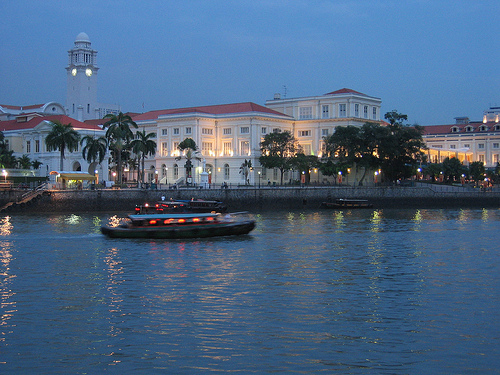
Photos of Singapore
Photos of Singapore


Travel and Tourism
Travel and Tourism
- Travel Alert Status
- Level 1: Exercise Normal Precautions
- Currency
- Singapore dollar (SGD)
- Time Difference
- UTC+8 (13 hours ahead of Washington, DC, during Standard Time)
- Climate
- Vegetation is lush and tropical. Seasons are nonexistent. In this "Land of Eternal Summer," the mean high temperature is 90ºF and varies little from month to month. Humidity is high (average 70%) and annual rainfall is about 96 inches. Wet and dry seasons are not distinct, but November through February is wetter and cooler than other months.
- Airports
- 9
Read the full travel guide — health, safety, vaccinations, disease risk, sanitation, and transit details.
View full travel guideRecipes
Recipes
Peanut Sauce for Satay
Side Dish
Main Dish
(Hainanese or Singapore Chicken Rice)
Main Dish
Laksa
Main Dish
Gai See Mee (Noodles with Chicken and Mushrooms)
Main Dish
(Singapore Satay)
Side Dish
Peanut Sauce for Satay
Soup
CHICKEN SOUP WITH LEMON AND GINGER (KAI TOM KHING)
Bread
PremiumRoti Prata (Indian Dough Bread)
History
History
Historical Eras
Early Settlements
300 – 1819
Known to mariners from at least the third century A.D., Singapore — then called Temasek — served as a trading outpost within successive maritime empires, including Srivijaya, Majapahit, and the Malacca and Johor sultanates. In 1299, Sang Nila Utama founded the city of Singapura ('lion city') on the island. Portuguese raiders burned its trading post in 1613, effectively ending the island's prominence for two centuries.
British Colonial Era
1819 – 1942
Sir Thomas Stamford Raffles of the British East India Company established a free-trade port on Singapore in 1819, rapidly transforming it into one of Asia's most prosperous entrepôts. By 1867 the Straits Settlements became a Crown Colony ruled directly from London, and the opening of the Suez Canal in 1869 further accelerated Singapore's commercial dominance. Ethnic Chinese, Malay, Indian, and Arab communities swelled the city's population, though deep social inequalities persisted into the twentieth century.
Japanese Occupation
1942 – 1945
Japan launched its assault on Singapore in December 1941, and British forces surrendered in February 1942 in what Winston Churchill called 'the worst disaster' in British military history. Renamed Syonan-to ('Light of the South'), Singapore endured brutal occupation marked by the Sook Ching massacre of Chinese civilians, forced labor, and widespread deprivation. Japan's defeat in August 1945 returned the island to British administration.
Road to Independence
1945 – 1965
Postwar Singapore was reconstituted as a separate Crown Colony in 1946, and growing nationalist sentiment propelled the People's Action Party, led by Lee Kuan Yew, to electoral victory in 1959, achieving full self-governance. Singapore merged with Malaya, Sabah, and Sarawak to form the Federation of Malaysia in 1963, but ethnic tensions and political conflict led to its expulsion from the federation on 9 August 1965, making Singapore a fully sovereign nation.
Nation-Building
1965 – 1990
Under Prime Minister Lee Kuan Yew, Singapore pursued rapid industrialization, export-led growth, and strict social policy, transforming within a generation from a developing port city into a high-income economy. The last British military forces departed in 1971, compelling Singapore to build its own defense forces. By the 1980s, per capita income had reached levels comparable to Western Europe, underpinned by one of the world's busiest ports and a globally competitive financial sector.
Modern Singapore
1990 – present
Goh Chok Tong succeeded Lee Kuan Yew as Prime Minister in 1990, beginning a gradual liberalization of public life, while Ong Teng Cheong became the country's first directly elected president in 1993. Singapore weathered the 1997–99 Asian financial crisis and subsequent global disruptions, continuously reinventing its economy around finance, biotechnology, and digital services. The city-state remains one of the world's most competitive and open economies, governed by the PAP with an emphasis on meritocracy, multiracialism, and long-term strategic planning.
Overview
Timeline of Key Events
1201 BCE – 1300
Century Sang Nila Utama renames the island Singa Pura.
Century Sang Nila Utama renames the island Singa Pura.
1819
Sir Stamford Raffles of British East India Company establishes trading post on Singapore island.
Sir Stamford Raffles of British East India Company establishes trading post on Singapore island.
1826
Singapore, Malacca and Penang become British colony of the Straits Settlements.
Singapore, Malacca and Penang become British colony of the Straits Settlements.
1832
Singapore becomes capital of Straits Settlements.
Singapore becomes capital of Straits Settlements. The port attracts thousands of migrants from China, India and other parts of Asia.
1867
Straits Settlements become crown colony of British Empire.
Straits Settlements become crown colony of British Empire.
1869
Suez Canal opens, trade booms.
Suez Canal opens, trade booms.
1941
World War II. Japan bombs Singapore.
World War II. Japan bombs Singapore.
Read the full history profile — narrative overview, defining eras, and the complete timeline in one place.
View expanded historyInteresting Facts
Interesting Facts
When a child loses a tooth they throw their lower teeth straight up to the roof so that the new teeth will grow straight up. They throw their lower teeth straight down to the grownd. IF they throw them slanted, the new tooth might grow in slanted.
Many beautiful orchids grow in Singapore. The Vanda Miss Joaquim, an indigenous hybrid, was first discovered in the Singapore garden of Miss Agnes Joaquim and was chosen in 1981 as the national flower of Singapore.
During the 20th century, Singaporeans have been British subjects, then Japanese subjects, then Malaysians, and finally Singaporeans.
The symbol of Singapore, the Merlion, is a mythical beast said to be half lion, half fish. The eight-metre high Merlion statue stands at the mouth of the Singapore River.
Forty days after the birth of a Chinese baby, the baby is dressed in the lucky colour red and shown off to relatives. Red-coloured hard-boiled eggs are distributed as symbols of life and energy.
The tallest buildings in Singapore are the Overseas Union Bank, built in 1986, and the United Overseas Bank, built in 1992. They are each 66 storeys high.
See every fact — trivia, oddities, and curious tidbits gathered from across the country.
View all interesting factsGeography and Environment
Geography and Environment
- Terrain
- lowland; gently undulating central plateau contains water catchment area and nature preserve
- Climate
- Vegetation is lush and tropical. Seasons are nonexistent. In this "Land of Eternal Summer," the mean high temperature is 90ºF and varies little from month to month. Humidity is high (average 70%) and annual rainfall is about 96 inches. Wet and dry seasons are not distinct, but November through February is wetter and cooler than other months.
- Natural Hazards
- NA
- Current Environmental Issues
- industrial pollution; limited natural fresh water resources; limited land availability presents waste disposal problems; seasonal smoke/haze resulting from forest fires in Indonesia
Read the full geography and environment profile — terrain, climate, natural resources, hazards, land use, and international agreements.
View full geographyPeople & Demographics
People & Demographics
Languages Spoken
Chinese (official), Malay (official and national), Tamil (official), English (official)
- Bahasa
- English
- Malay
- Tamil
Population
- Population
- 4,701,069
- Nationality Noun
- Singaporean(s)
- Ethnic Groups
- Chinese 76.7%, Malay 14%, Indian 7.9%, other 1.4%
Education
- Literacy Definition
- age 15 and over can read and write
Read the full people and society profile — demographics, health, education, religion, languages, and notable people.
View full people and societyGovernment & Politics
Government & Politics
Country Identity
- Country Name
- Singapore
- Full Country Name
- Republic of Singapore
Government Structure
- Government Type
- parliamentary republic
- Legal System
- based on English common law; has not accepted compulsory ICJ jurisdiction
- Executive Branch
- chief of state: President THARMAN Shanmugaratnam (since 14 September 2023) head of government: Prime Minister LAWRENCE Wong (since 15 May 2024); Deputy Prime Ministers GAN Kim Yong and HEng Swee Keat (both since 15 May 2024) cabinet: Cabinet appointed by president, responsible to Parliament elections: president elected by popular vote for six-year term; last election held on 1 September 2023 (next election to be held by September 2029); following legislative elections, the leader of the majority party or majority coalition is usually appointed prime minister by the president; deputy prime ministers appointed by the president election results: THARMAN Shanmugaratnam elected president on 1 September 2023; he won outright in a three-way contest, receiving approximately 70.4 percent of the vote; Ng Kok Song received approximately 15.7 percent and TAN Kin Lian received approximately 13.9 percent
- Legislative Branch
- unicameral Parliament (84 seats; members elected by popular vote to serve five-year terms); note - in addition, there are up to nine nominated members; the losing opposition candidate who came closest to winning a seat may be appointed as a “nonconstituency” member elections: last held 3 November 2001 (next to be held not later than 25 June 2007) thereby extending terms by several months election results: percent of vote by party - PAP 75.3% (in contested constituencies), other 24.7%; seats by party - PAP 82, WP 1, SPP 1
- Judicial Branch
- Supreme Court (chief justice is appointed by the president with the advice of the prime minister, other judges are appointed by the president with the advice of the chief justice); Court of Appeals
- Suffrage
- 21 years of age; universal and compulsory
- Constitution
- 3 June 1959, amended 1965 (based on preindependence State of Singapore Constitution)
- Independence
- 9 August 1965 (from Malaysian Federation)
- National Holiday
- Independence Day, 9 August (1965)
Capital City
- Capital Name
- Singapore
- Capital - geographic coordinate
- 1 17 N, 103 51 E
- Capital Time Difference
- UTC+8 (13 hours ahead of Washington, DC, during Standard Time)
name derives from the Sanskrit words simha (lion) and pura (city), thus creating the city's epithet "lion city"
Military
Branches: Singapore Armed Forces: Army, Navy, Air Force (includes Air Defense)
Embassy / Diplomatic Mission
The U.S. Embassy
27 Napier Road, Singapore 258508
Telephone: [65] 6476-9100
Facsimile: [65] 6476-9340
Emergency after-hours telephone: [65] 6476-9100.
Email: SingaporeACS@state.gov
Read the full government profile — flag symbolism, national anthem, and other national symbols.
View full government detailsEconomy
Economy
Singapore boasts a highly developed and successful free-market economy, characterized by an exceptionally open, transparent, and corruption-free business environment, stable prices, and one of the highest per capita GDPs in the world. The economy remains heavily reliant on exports, particularly in electronics, pharmaceuticals, chemicals, refined petroleum, and precision engineering, as well as on financial services and biomedical manufacturing. As a small, trade-dependent nation, Singapore is sensitive to global economic fluctuations, and growth has been tested in recent years by the COVID-19 pandemic, supply chain disruptions, and slowing demand from major trading partners such as China and the United States.
The government continues to diversify the economy and reduce vulnerability to external shocks by investing in advanced manufacturing, digital innovation, green economy initiatives, and sustainable finance. Singapore remains firmly positioned as Southeast Asia's premier financial, logistics, and high-tech hub, consistently ranking among the world's most competitive economies. After expanding by roughly 1.1 percent in 2023, GDP growth picked up in 2024 to around 4 percent, supported by recoveries in trade, tourism, and the semiconductor cycle. Looking ahead, structural strengths including a skilled workforce, strong rule of law, robust infrastructure, and prudent fiscal management are expected to underpin steady, if moderate, long-term growth.
Snapshot
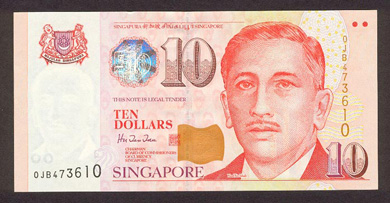
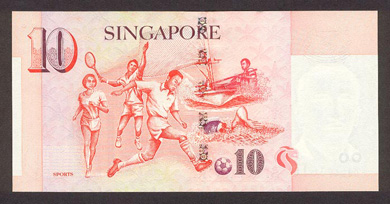
- Currency Name and Code
- Singapore Dollar (SGD)
- GDP — official exchange rate
- $110,600,000,000 (USD)
- GDP Real Growth Rate
- 6.4%
- Gini Index
- 42.5
Banknotes
Budget & Public Finance
- Fiscal Year
- 1 April - 31 March
- Annual Budget
- $18,210,000,000 (USD)
- Public Debt (% of GDP)
- 102%
- External Debt
- $24,670,000,000 (USD)
- Investment (% of GDP)
- 23%
- Reserves of Foreign Exchange
- $2,147,483,647 (USD)
Labor, Industry & Trade
- Labor Force by Occupation
- financial; business; and other services 49%; manufacturing 18%; construction 6%; transportation and communication 11%; other 16%
- Industries
- electronics, chemicals, financial services, oil drilling equipment, petroleum refining, rubber processing and rubber products, processed food and beverages, ship repair, offshore platform construction, life sciences, entrepot trade
- Agriculture Products
- rubber, copra, fruit, orchids, vegetables, poultry, eggs, fish, ornamental fish
- Export Commodities
- machinery and equipment (including electronics), consumer goods, chemicals, mineral fuels
- Export Partners
- Malaysia 17.4%, US 15.3%, Hong Kong 9.2%, Japan 7.1%, China 5.5%, Taiwan 4.9%, Thailand 4.6%, South Korea 4.2%
- Import Commodities
- machinery and equipment, mineral fuels, chemicals, foodstuffs
- Import Partners
- Malaysia 18.2%, US 14.3%, Japan 12.5%, China 7.6%, Thailand 4.6%, Taiwan 4.6%
Energy
- Oil Production
- 8,290 bbl/day
- Oil Consumption
- 800,000 bbl/day
- Oil Reserves
- 0 bbl/day
- Natural Gas Production
- 0 cu m
- Natural Gas Consumption
- 5,320,000,000 cu m
- Natural Gas Imports
- 2,500,000,000 cu m
- Natural Gas Exports
- 0 cu m
- Natural Gas Reserves
- 0 cu m
Communications
- Telephone System
- general assessment: excellent service domestic: excellent domestic facilities; launched 3G wireless service in February 2005; combined fixed-line and mobile-cellular teledensity more than 180 telephones per 100 persons; multiple providers of high-speed Internet connectivity and the government is close to completing an island-wide roll out of a high-speed fiber-optic broadband network international: country code - 65; numerous submarine cables provide links throughout Asia, Australia, the Middle East, Europe, and US; satellite earth stations - 4; supplemented by VSAT coverage
- Internet Country Code
- .sg
News & Weather
News & Weather
Current Weather
Latest News
Singapore minister resigns over 'interactions with a woman', Prime Minister's Office says - Reuters
Reuters · 1d ago
Why Singapore PM Wong moved swiftly on Faishal Ibrahim’s resignation - South China Morning Post
South China Morning Post · 19h ago
Singapore minister resigns over ‘interactions with a woman’, PM says - Al Jazeera
Al Jazeera · 1d ago
Nineteen found guilty of trafficking babies in Indonesia and Singapore - BBC
BBC · 1h ago
FCNR scheme: Withholding tax fear haunts US, Singapore NRIs - The Economic Times
The Economic Times · 2h ago
Singapore court rejects condo board's 'illegal kitchen' termite claim, orders payout - Yahoo
Yahoo · 2h ago
Singapore Mulls Lower Taxes, Easier Talent Entry for Hedge Funds - Bloomberg.com
Bloomberg.com · 21h ago
Flights Cancelled Over Asia As Thailand, Singapore, Hong Kong, Qatar, And More Cancel 339 And Delay 5,098, Grounding Cathay Pacific, Emirates, Air China, And Others - Travel And Tour World
Travel And Tour World · 9h ago
News via Google News
Climate Overview
Vegetation is lush and tropical. Seasons are nonexistent. In this "Land of Eternal Summer," the mean high temperature is 90ºF and varies little from month to month. Humidity is high (average 70%) and annual rainfall is about 96 inches. Wet and dry seasons are not distinct, but November through February is wetter and cooler than other months.
Videos
Videos
1 curated YouTube videos.
Source: YouTube
Frequently Asked Questions
Frequently Asked Questions
What is the population of Singapore?
How do people greet and address each other in Singapore?
What are the dining customs in Singapore?
What etiquette should travelers know in Singapore?
How should I dress in Singapore?
What gestures are polite or rude in Singapore?
What is family life like in Singapore?
What do people do for recreation in Singapore?
What is the capital of Singapore?
Where is Singapore located?
What bodies of water border Singapore?
What currency is used in Singapore?
What languages are spoken in Singapore?
What is the geography of Singapore like?
What languages are spoken in Singapore?
What is Singapore known for?
Last reviewed 2026