
 English
 Español
 中文
中文 हिन्दी
 Français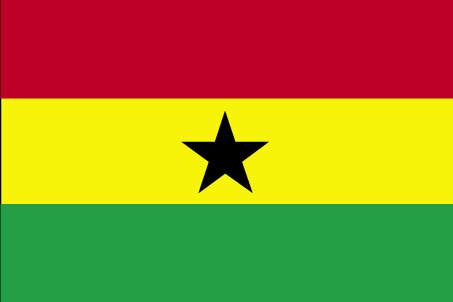
Ghana
Declare Your Relationship to Ghana
CountryReports Community
- Studying4
- From Ghana2
- Ghana heritage4
- Visited1
- Want to visit1
Customs and Culture
Customs and Culture
About the People
there are 9,500 Liberians, 2,000 Sierra Leoneans, and 1,000 Togolese refugees residing in Ghana (2002)
Ghanaians are a polite and open people. They live life at a relaxed pace. People are more important than schedules.
Cultural Attributes
Ghanaian's are a polite and open people. They live life at a relaxed pace. People are more important than schedules.

The Gold Coast Reborn
Greetings, Gestures & Visiting
Because of pronounced differences between ethnic groups, greetings vary area to area. English greetings and hand-shakes are common. Indeed, a handshake is important when greeting most people. Before conversing, a greeting such as “Good morning” or “Good afternoon” is done. Most greetings are in the dominant local language and are followed by questions about one’s health, family welfare, journey, and so forth. Titles and family names are used to address new acquaintances. Friends and family members often use given names.
Being courteous is important. When yawning or using a toothpick, a person covers the mouth. It is impolite to gesture with the left hand. It may be considered improper by some, especially Muslims, to pass or receive items with the left hand. Either the right hand or both hands should be used. Among Muslims, and some other groups used to sitting on the floor, it is improper to allow the sole of ones foot to point at another person. Generally, feet are not placed on chairs, desks, or tables-especially those being used by another person. It is common and appropriate for friends of the same sex to hold hands while walking or speaking. It does not signify anything beyond friendship.
Friends and relatives frequently visit and typically do not need an appointment to do so. Ghananian's work hard to accommodate their guests. Visiting often occurs at a home. It is polite to at least take a small gift for the children. Some hosts prefer that their guests remove their shoes when entering the home. Guests are nearly always served drinks and often other refreshments. It is impolite to refuse these offers. Visiting is most popular on Sunday, and many people like to dress up for the occasion. When a visit is completed, guests are accompanied to a local bus, taxi or are given a ride home.
Ghanaian dress is modest, neat, and generally conservative. Casual dress is the rule for most occasions, although a suit and tie, or dress are required for more formal occasions. Shorts are not acceptable public attire. Western dress is normal in urban areas, but officials often wear traditional kente cloth robes on ceremonial occasions. Women usually wear a long wraparound skirt, a separate top, and a head scarf. This traditional attire can be very elaborate and colorful.
Diet
Popular foods are yams, cassava (a starchy root), rice, plantain and maize. Eating fish is most common due to it being low in cost . Popular dishes include fufu (a dough like combination of plantain and cassava), ampesi (a green vegetable dish ), and palm or peanut oil soups and sauces. Ghana also produces a variety of tropical fruits and vegetables to supplement the diet. In Africa, there are light soups and there are dark soups. Light soups are made with meat, fish, or poultry for the basic stock. The soups are thickened with white beans or else with melon seeds which are prepared in the same manner but are ground to a paste called Egusi.
A bowl of water is provided at the beginning of the meal, in which each person washes the hands. Food is formed into a ball with the right hand before being eaten. Water is also passed around at the end of the meal for diners to wash their hands.
The diet consists mainly of yams, cassava (a starchy root), maize, plantain, and rice. Ghanaians enjoy hot and spicy food and most of their meals are accompanied by a pepper sauce made with meat, fish, or chicken. Fish is most common due to cost . Popular dishes include fufu (a dough like combination of plantain and cassava), ampesi (a green vegetable dish ), and palm or peanut oil soups and sauces.
Ghana also produces a variety of tropical fruits and vegetables to supplement the diet. In Africa, there are light soups and there are dark soups. Light soups are made with meat, fish, or poultry for the basic stock. The soups are thickened with white beans or else with melon seeds which are prepared in the same manner but are ground to a paste called Egusi.

Family
Family structures vary from one ethnic group to another. Some family groups have the chief responsibilities for the family with the women. Others have male-dominated structures. Polygamy (having more than one wife) is also practiced by some Ghanaian's. Respect for elderly family members is important and the elderly yield a great deal of influence on family decisions. Funerals are very important and last three days. For those people involved, everything else comes to a stop and all attention is directed toward funeral-related activities.
Dating Customs
Many marriages are arranged by families, although the children have the right to reject the arrangement. Marriage in rural areas (less common in urban) may follow tradition, which permits a man to have more than one wife. Tradition calls for the groom to pay the brides family a "bridal token"; to indicate responsibility for the new bride.
Recreation
The most popular sport is football (soccer). Basketball and tennis are the popular sports of the wealthy.
Student Life
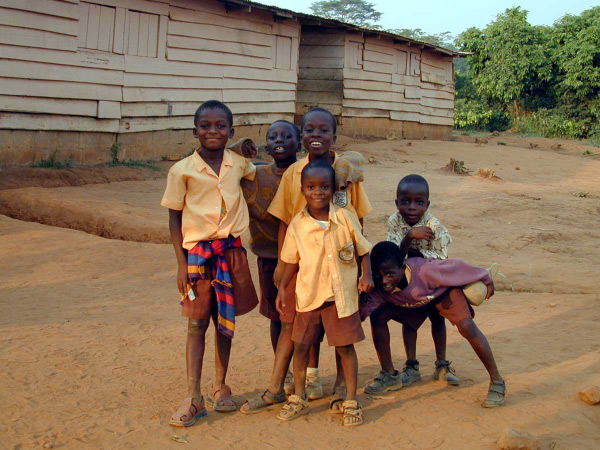
The life of a child in Ghana no matter which setting they live in urban or rural is very challenging. In the morning the child in an urban area must wake up very early: some wake up as early as 4 am in order to prepare for school. They have to get themselves ready very early in order to go through the heavy traffic that is characteristic of urban life in Ghana. Those children living in poor and deprived communities must help in looking for water for their families. There are other chores that are common for children both in urban and rural areas. This includes washing the dishes and looking for water either from the public tap or other sources. Most Ghanaian children don’t eat before going to school in the morning. They are given various sums of money to buy food at school. At school, the Ghanaian child may choose between foods like cooked rice, “kenkey” and fish, (kenkey is a local dish prepared from corn flour) and others depending on what are available in the locality. The average Ghanaian child goes to school by walking. In some cases, children have to walk over long distances, covering up to five kilometers or more to get to a school. In the urban areas, a good number of children join private commercial vehicles known locally as “trotro.” A few children from the emerging middle class and the upper class are lucky to be taken to school in their parents cars. There are some private schools that run their own transport system for parents who are willing to pay for it.
Most school buildings in Ghana are very old buildings; some of these buildings were constructed in the periods just after the country gain independence in 1957. There are a few that were constructed before independence. In some situations lessons are held in the open – under trees, and sheds constructed with palm branches. In the classroom, you are likely to find desks or tables and chairs supplied by the government or other NGOs. Textbooks and all other instructional material are also supplied by the government, but these are never adequate and will have to be managed in a way to make all children benefit from them. It is the duty of parents to provide writing material such as exercise books, pencils and pens. Only a few public schools in Ghana have a computer. Although, there are staffing problems, these are not as serious as the need for infrastructure and logistics. Most schools in Ghana are in need of textbooks, furniture, and above all computers which is fast taking over all aspects of life. The need for computers is very serious because the new educational policy has made IT a compulsory subject, but most schools don’t even have a broken down computer just for use as a specimen. There is a large percentage of teachers who do not have a PC and are not even able to use one.
Lessons or classes start at 8 a.m. and go until 2 p.m. The time is divided into instructional periods of 30 minutes for those in the lower primary and 35 minutes for those in the upper classes. There are usual two breaks during which children are allowed to buy food sold by women from the community. What most of the children eat at school can only be considered as breakfast. They will have to go home to eat lunch. On the average, a normal class is made up of about 40 children. This should be the national average because classes are very large in the urban areas – with some classes having more than 60 pupils. Lessons are mostly taught in local languages although English is supposed to be the main language of instruction in Ghana. This is because most children speak their local languages at home. English is taught as a subject in a transitional manner. It only becomes a medium of instruction in the upper levels of primary education. (this depends on whether the children are quick in acquiring enough vocabulary and skills to support the change). In the lower levels of primary education, the subjects taught are: English Language, Mathematics, Religious and Moral Education, Natural Science, Creative Art, Ghanaian Language and Culture, Information and Communication Technology and Physical Education. At the upper primary Natural Science is replace by Integrated Science and a new subject is added. This is Citizenship Education. At the Junior High School, Social Studies Replaces Citizenship Education, and Basic Design and Technology is studied instead of Creative Art. French is also taught at this level if the school has a French teacher. Entry into secondary school is very difficult in Ghana. The child must perform very well in the Basic Education Certificate Examination to be able to gain admission into secondary school. Not more than 30% of children who sit for the examination gain admission into secondary school. This is because there are not enough secondary schools to cater to the large number of candidates who sit for the examination each year. This makes admission very competitive. Due to inadequate logistics, most students don’t perform well in the Basic Education Certificate Examination. This also contributes to the low intake into secondary schools. Discipline is handled by the teachers in every school. The headmaster is the final authority in issues concerning discipline in a school. However, in serious cases, there are various administrative officials that help in resolving disciplinary issues. But, in most cases, disciplinary issues will end in the headmaster’s office as he enjoys enough respect and authority in the community. Teachers are allowed to handle minor disciplinary issue, but they have to consult the headmaster for direction especially in serious cases. Uniforms are very important for schools in Ghana. There are no schools in Ghana where children wear their own dresses. The uniforms are designed by the organization that has oversight responsibility over the school. Most of the schools are jointly owned by government and religious bodies. The uniform that is worn in a particular school shows the organization that owns the school. If a child goes to school without a uniform, he/she might be refused entry unless there is a tangible reason for not wearing one. At school children are supposed to greet all teachers in English; they could be punished if they do otherwise.
Most children in Ghana usually return home immediately after school. This is because they have to get home to eat lunch. They are also expected to help their parents in their work. It is only during the sports season that a few selected ones stay or return in the afternoon for practice and training. Only privileged children in the urban areas get the chance to take other lessons like playing musical instruments and other things associated with western lifestyle. The most common extra curricular activity in Ghana is sports and football(soccer) takes the major part of this. Athletics and other games do not enjoy much patronage in Ghanaian schools.
During weekends, Ghanaian children are expected to help their parents at home. In the rural areas, they must help on the farm or take care of younger ones in the absence of the parents. This is not considered as child labor because it also serves as a way of training into the traditional lifestyle of the community. Those children who will not make it to secondary school may have to take up their parent’s occupation. In the urban areas, some children help parents sell products in the markets. There are however some lucky ones who may get the chance to play with friend when they are not in school.
When a child gets back home after school, she/he eats lunch. After that they may rest a little and help in the preparation of the evening meal. Again, they must help look for water if there is no source of water in the home. After eating, they take their bath. Those who have homework do it. Where it is available, they watch TV for sometime and go to bed. Children usually go to be around 9 p.m. When a child gets home from school she/he is expected to greet the parents and any other adult around. Depending on the level of sophistication in the community, the greeting might be in English or in local language. But most people expect school children to greet in English to show that they are actually learning at school. The ability of the child to speak English correctly is seen as an indicator of how serious he/she is at school. The meal eaten in the evening depends on what is eaten locality. For example, people in the Akan areas and central Ghana will eat “fufu” a local dish prepared by pounding cassava and plantain, or yam served with soup. Those in the south-eastern parts will mostly eat “akple” or “banku” prepared from dough made with a mixture of corn flour and cassava also served with soup. Rice is also a very popular meal eaten in most Ghanaian homes.
Education plays various roles in the community and in the life of the individual. For example, it is not possible to learn a trade in Ghana unless you have received some level of basic education in Ghana. The respect accorded to an individual in the community is related to a large extent on his/her level of education. It is expected that educated people enjoy higher standards of living. Formal education plays a major role in teaching local values and customs into the lives of children. The community expects their schools to teach children local history, customs and traditions, and etiquettes. Apart from the preschool where some of the things taught are through music and dance, music plays a minor role in education in Ghana. However, children are taught songs; and on occasions like traditional festivals, they are encouraged to join in the celebration. Children are encouraged to play traditional musical instruments such as drums and xylophones.
Holidays
Independence Day
3/6Independence Day
Christmas
12/25Christmas
Christmas dinner consists of fowl, pork, goat, or sheep along with rice, fufu(yam paste) fruits, and soup consisting of eggs and meat, okra or beans. Festivities continue for eight days with processions of street bands and dancers; groups of children carol from house to house and receive gifts from the residents. Families decorate a fruit tree with colored paper ornaments and folklore holds that Father Christmas emerges from the jungles with gifts for the children.
Dates of Interest
- December 25th
Christmas dinner consists of fowl, pork, goat, or sheep along with rice, fufu(yam paste) fruits, and soup consisting of eggs and meat, okra or beans. Festivities continue for eight days with processions of street bands and dancers; groups of children carol from house to house and receive gifts from the residents. Families decorate a fruit tree with colored paper ornaments and folklore holds that Father Christmas emerges from the jungles with gifts for the children.
How do people greet each other in Ghana?
Greetings vary by ethnic group, but English greetings and handshakes are common, and it is important to greet someone before conversing.
Do
- Offer a handshake when greeting most people
- Begin with a greeting like "Good morning" or "Good afternoon" before talking
- Ask about the person's health, family welfare, and journey
- Use titles and family names for new acquaintances
Good to know
- Friends and family members often use given names
What are the dining customs in Ghana?
A bowl of water is provided to wash hands before and after the meal, and food is often formed into a ball with the right hand before eating.
Do
- Wash your hands in the bowl of water provided at the start and end of the meal
- Form food into a ball with your right hand before eating
Good to know
- Ghanaians enjoy hot and spicy food, and meals often come with a pepper sauce
- Popular dishes include fufu, ampesi, and palm or peanut oil soups
- Fish is the most common protein due to its low cost
What should I know about visiting a Ghanaian home?
Friends and relatives visit frequently without appointments, and hosts work hard to accommodate guests, nearly always serving drinks and refreshments.
Do
- Bring at least a small gift for the children
- Accept the drinks and refreshments offered
- Remove your shoes if the host prefers it
Don’t
- Don't refuse offers of drinks or refreshments, as it is impolite
Good to know
- Visiting is most popular on Sunday, and many people like to dress up
- Guests are usually accompanied to a bus, taxi, or given a ride home
How should I dress in Ghana?
Ghanaian dress is modest, neat, and generally conservative, with casual dress the rule for most occasions and formal attire required for formal events.
Do
- Wear a suit and tie or a dress for more formal occasions
- Dress modestly and neatly
Don’t
- Don't wear shorts as public attire
Good to know
- Western dress is normal in urban areas
- Officials often wear traditional kente cloth robes on ceremonial occasions
- Women often wear a long wraparound skirt, a separate top, and a head scarf
Which gestures are important in Ghana?
Being courteous is important, and the left hand should be avoided when gesturing or passing items.
Do
- Use your right hand or both hands to pass or receive items
- Cover your mouth when yawning or using a toothpick
Don’t
- Don't gesture with the left hand
- Don't point the sole of your foot at another person, especially among Muslims
- Don't place your feet on chairs, desks, or tables
Good to know
- Friends of the same sex holding hands while walking or talking signifies only friendship
What is family life like in Ghana?
Family structures vary by ethnic group, ranging from male-dominated to women-led, and respect for elderly members is very important.
Good to know
- The elderly hold great influence over family decisions
- Polygamy is practiced by some Ghanaians
- Funerals are very important, last three days, and take priority over everything else
What do people do for recreation in Ghana?
Football (soccer) is the most popular sport, while basketball and tennis are popular among the wealthy.
Good to know
- Football (soccer) is the most popular sport nationwide
Last updated: 2026-07-12 · Sources: CountryReports
Photos of Ghana
Photos of Ghana


Travel and Tourism
Travel and Tourism
- Travel Alert Status
- Level 2: Exercise Increased Caution
- Currency
- cedi (GHC)
- Time Difference
- UTC 0 (5 hours ahead of Washington, DC, during Standard Time)
- Climate
- Ghana's climate is tropical with temperatures between 21°C and 32°C (70°F and 90°F). Rainy seasons extend from April to July (heavy rains) and from September to November (light rains). Annual rainfall exceeds 200 centimeters on the coast, decreasing inland. Accra”™s annual rainfall averages about 76 centimeters, low for coastal West Africa. The southern part of the country is humid most of the year, but the north can be very dry. It is coolest from May until October. In December the harmattan, a dry dusty wind from the Sahara, covers the country, and lasts through February. The desert wind reduces humidity, and early mornings and nights are relatively cool. Visibility during the harmattan can be poor, as the air is filled with fine dust.
- Airports
- 12
Read the full travel guide — health, safety, vaccinations, disease risk, sanitation, and transit details.
View full travel guideRecipes
Recipes
Jollof Rice
Main Dish
Main Dish
Chicken Vegetable Soup
Main Dish
Jollof Rice
Main Dish
Smoked Fish Stew
Main Dish
Peanut Butter Soup
Main Dish
Hkatenkwan (Groundnut Stew)
Main Dish
Abenkwan (Palm Nut Soup)
Main Dish
PremiumKentumere (Fish and Spinach in Tomatoes)
Main Dish
PremiumAvocado with Smoked Fish
Main Dish
PremiumBraised Chicken with Chilies
History
History
Historical Eras
Pre-State & Early Kingdoms
10000 BCE – 1471
Human habitation in the region dates to at least 10,000 BCE, with Iron Age communities emerging by around 100 BCE. Guan-speaking peoples migrated down the Volta Basin from the thirteenth century onward, and the Akan kingdom of Bono was founded around 1298. Trade networks linking the forest zone to the western Sudan shaped early state formation well before European contact.
European Contact & Slave Trade
1471 – 1697
Portuguese navigators reached the coast in 1471, and the construction of Elmina Castle in 1482 inaugurated sustained European commercial presence. The Gold Coast's wealth in gold drew competing Portuguese, Dutch, Danish, and English traders. The transatlantic slave trade intensified dramatically through the sixteenth and seventeenth centuries, fueling warfare, displacement, and accelerated state-building among coastal and interior peoples.
Asante Empire
1697 – 1874
Osei Tutu unified the Asante confederation around 1697, establishing a powerful centralized state at Kumasi anchored by the sacred Golden Stool. The empire expanded through military conquest and control of gold and kola trade routes, dominating much of the interior for nearly two centuries. Repeated conflicts with coastal Fante states and British forces culminated in the Anglo-Asante War of 1873–74, after which British troops sacked Kumasi.
Gold Coast Colony
1874 – 1957
Britain formally established the Gold Coast Colony in 1874, extending protectorates over Asante in 1896 and the Northern Territories in 1902. Cocoa cultivation, introduced in 1878, became the economic backbone of the colony and gave rise to an educated African merchant and professional class. The United Gold Coast Convention (1947) and Kwame Nkrumah's mass-based Convention People's Party channeled rising nationalist sentiment into a successful independence movement.
Nkrumah & First Republic
1957 – 1966
Ghana became Africa's first sub-Saharan nation to gain independence on March 6, 1957, with Kwame Nkrumah as prime minister; a republic was declared in 1960. Nkrumah pursued pan-Africanism, socialist development, and ambitious industrialization projects while using the Preventive Detention Act to suppress political opposition and accumulate personal power. Mounting foreign debt, economic mismanagement, and authoritarian governance led the military to overthrow his government in February 1966.
Independence & Modern Ghana
1966 – present
Between 1966 and 1981 Ghana experienced seven changes of government, alternating between military juntas and short-lived civilian administrations. Flight Lieutenant Jerry Rawlings seized power in 1981, eventually steering the country toward economic reform under IMF structural adjustment and a return to multiparty democracy with the 1992 constitution. Since then Ghana has been regarded as one of West Africa's more stable democracies, with peaceful electoral transfers of power becoming an established norm.
Overview
Timeline of Key Events
1000 BCE
10,000 B.C. Earliest recorded probable human habitation within modern Ghana at site on Oti River.
ca. 10,000 B.C. Earliest recorded probable human habitation within modern Ghana at site on Oti River.
100 BCE
Early Iron Age at Tema.
Early Iron Age at Tema.
1200
Guan begin their migrations down Volta Basin from Gonja toward Gulf of Guinea.
Guan begin their migrations down Volta Basin from Gonja toward Gulf of Guinea.
1298
Akan kingdom of Bono (Brong) founded.
Akan kingdom of Bono (Brong) founded. Other states had arisen or were beginning to rise about this time.
1471 – 1482
First Europeans arrive. Portuguese build Elmina Castle.
First Europeans arrive. Portuguese build Elmina Castle.
1500 – 1807
Era of slave raids and wars and of intense state formation in Gold Coast.
Era of slave raids and wars and of intense state formation in Gold Coast.
1697 – 1745
Rise and consolidation of Asante Empire.
Rise and consolidation of Asante Empire.
Read the full history profile — narrative overview, defining eras, and the complete timeline in one place.
View expanded historyInteresting Facts
Interesting Facts
Ghana has national parks, game reserves, and wildlife sanctuaries, but the elephant, lion and leopard populations are diminishing.
Ghana was the first nation to gain its independence in Sub-Saharan Africa in 1957.
The consent of the two extended families is needed for a couple to marry, even if they are living overseas.
The richest deposit in the world of high quality gold is in Ghana's Ashanti gold fields.
In the rural villages Ghanaians usually learn trades by apprenticeship.
In the 1980s and 1990s, Ghana's Azuma Nelson, was the World Boxing Council's Featherweight and Super Featherweight champion.
See every fact — trivia, oddities, and curious tidbits gathered from across the country.
View all interesting factsGeography and Environment
Geography and Environment
- Terrain
- mostly low plains with dissected plateau in south-central area
- Climate
- Ghana’s climate is tropical with temperatures between 21ºC and 32ºC (70ºF and 90ºF). Rainy seasons extend from April to July (heavy rains) and from September to November (light rains). Annual rainfall exceeds 200 centimeters on the coast, decreasing inland. Accra’s annual rainfall averages about 76 centimeters, low for coastal West Africa. The southern part of the country is humid most of the year, but the north can be very dry. It is coolest from May until October. In December the harmattan, a dry dusty wind from the Sahara, covers the country, and lasts through February. The desert wind reduces humidity, and early mornings and nights are relatively cool. Visibility during the harmattan can be poor, as the air is filled with fine dust.
- Natural Hazards
- dry, dusty, northeastern harmattan winds occur from January to March; droughts
- Current Environmental Issues
- recurrent drought in north severely affects agricultural activities; deforestation; overgrazing; soil erosion; poaching and habitat destruction threatens wildlife populations; water pollution; inadequate supplies of potable water
Read the full geography and environment profile — terrain, climate, natural resources, hazards, land use, and international agreements.
View full geographyPeople & Demographics
People & Demographics
Religion
Languages Spoken
English (official), African languages (including Akan, Moshi-Dagomba, Ewe, and Ga)
- English
- Ewe
- Ga
Population
- Population
- 24,339,838
- Population in Major Urban Areas
- ACCRA (capital) 2.573 million; Kumasi 2.019 million
- Nationality Noun
- Ghanaian(s)
- Ethnic Groups
- Black African 98.5% (major tribes - Akan 44%, Moshi-Dagomba 16%, Ewe 13%, Ga 8%, Gurma 3%, Yoruba 1%), European and other 1.5%
- Language Note
- The official language of Ghana is English. There are movements to make several local languages official as well. The Twi dialect of Akan is the language most commonly used on a daily basis to communicate between ethnic groups. Most Ghanaians are at least bilingual.
Education
- Literacy Definition
- Age 15 and over can read and write
Most school buildings in Ghana are very old buildings; some of these buildings were constructed in the periods just after the country gain independence in 1957. There are a few that were constructed before independence. In some situations lessons are held in the open – under trees, and sheds constructed with palm branches.
In the classroom, you are likely to find desks or tables and chairs supplied by the government or other NGOs. Textbooks and all other instructional material are also supplied by the government, but these are never adequate and will have to be managed in a way to make all children benefit from them. It is the duty of parents to provide writing material such as exercise books, pencils and pens. Only a few public schools in Ghana have a computer.
Although, there are staffing problems, these are not as serious as the need for infrastructure and logistics. Most schools in Ghana are in need of textbooks, furniture, and above all computers which is fast taking over all aspects of life. The need for computers is very serious because the new educational policy has made IT a compulsory subject, but most schools don’t even have a broken down computer just for use as a specimen. There is a large percentage of teachers who do not have a PC and are not even able to use one.
Health Information
- Major Infectious Diseases — degree of risk
- very high
Read the full people and society profile — demographics, health, education, religion, languages, and notable people.
View full people and societyGovernment & Politics
Government & Politics
Country Identity
- Country Name
- Ghana
- Full Country Name
- Republic of Ghana
- Former Name
- Gold Coast
Government Structure
- Government Type
- constitutional democracy
- Legal System
- based on English common law and customary law; has not accepted compulsory ICJ jurisdiction
- Executive Branch
- chief of state: President John Dramani MAHAMA (since 7 January 2025); Vice President Jane NAANA OPOKU AGYEMANG (since 7 January 2025); note - the president is both the chief of state and head of government head of government: President John Dramani MAHAMA (since 7 January 2025); Vice President Jane NAANA OPOKU AGYEMANG (since 7 January 2025); note - the president is both the chief of state and head of government cabinet: Council of Ministers; president nominates members subject to approval by Parliament elections: president and vice president elected on the same ticket by popular vote for four-year terms; election last held 7 December 2024 (next to be held December 2028) election results: John Dramani MAHAMA elected president; percent of vote - John Dramani MAHAMA (NDC) 56.6%, Mahamudu BAWUMIA (NPP) 41.6%
- Legislative Branch
- unicameral Parliament (230 seats; note - increased from 200 seats in last election; members are elected by direct, popular vote to serve four-year terms) elections: last held 7 December 2004 (next to be held December 2008) election results: percent of vote by party - NA; seats by party - NPP 128, NDC 92, other 10
- Judicial Branch
- Supreme Court
- Suffrage
- 18 years of age; universal
- Constitution
- approved 28 April 1992
- Independence
- 6 March 1957 (from UK)
- National Holiday
- Independence Day, 6 March (1957)
Capital City
- Capital Name
- Accra
- Capital - geographic coordinate
- 5 33 N, 0 13 W
- Capital Time Difference
- UTC 0 (5 hours ahead of Washington, DC, during Standard Time)
The name derives from the Akan word "nkran" meaning "ants," and refers to the numerous anthills in the area around the capital
Military
Branches: Ghana Army, Ghana Navy, Ghana Air Force
Embassy / Diplomatic Mission
Embassy Accra
Address: The U.S. Embassy is located at No. 24 Fourth Circular Road, Cantonments, Accra.
Telephone: (233)-(030) 274-1000
Emergency after-hours telephone: (233)-(030) 274-1775
Facsimile: (233)-(030) 274-1362 or 274-1426
Read the full government profile — flag symbolism, national anthem, and other national symbols.
View full government detailsEconomy
Economy
Ghana has one of West Africa's most dynamic and diversified economies, classified as a lower-middle-income country since 2010. With a gross domestic product of approximately 76 billion US dollars in 2023, it ranks among the largest economies in the region. The country has historically been driven by the export of primary commodities, but recent decades have seen efforts to broaden its economic base through industrialization, services, and digital sectors.
Agriculture remains a cornerstone of the economy, employing roughly 30 percent of the labor force and contributing about 20 percent of GDP. Cocoa is the most iconic export, with Ghana ranking as the world's second-largest producer after neighboring Côte d'Ivoire. Other significant agricultural products include cassava, yams, maize, plantains, and oil palm. The fishing industry, centered along the Gulf of Guinea, also supports coastal communities.
Mining and natural resources play a pivotal role. Ghana is Africa's largest gold producer, having surpassed South Africa in 2019, and gold accounts for the single largest share of export earnings. The country also produces bauxite, manganese, and diamonds. Since the discovery of offshore oil at the Jubilee Field in 2007 and commercial production beginning in 2010, petroleum has become a major source of revenue, alongside natural gas.
The services sector, including telecommunications, banking, tourism, and information technology, contributes approximately 45 percent of GDP and is the fastest-growing segment of the economy. Accra has emerged as a regional financial and tech hub, attracting foreign investment and startup activity.
Despite strong growth averaging around 5 to 7 percent annually in the years preceding the COVID-19 pandemic, Ghana has faced significant challenges, including high public debt, inflation that surged above 50 percent in 2022 and 2023, and currency depreciation of the cedi. In 2023, Ghana reached a 3 billion US dollar Extended Credit Facility agreement with the International Monetary Fund to support fiscal stabilization and debt restructuring. Key trading partners include China, Switzerland, India, the United Arab Emirates, and the United States.
Snapshot
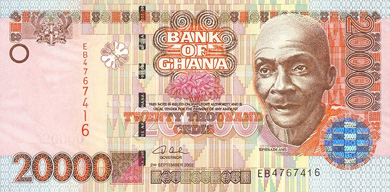
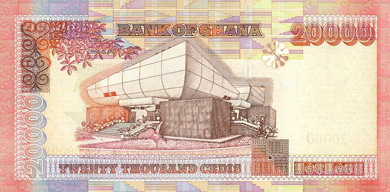
- Currency Name and Code
- Cedi (GHC)
- GDP — official exchange rate
- $9,413,000,000 (USD)
- GDP Real Growth Rate
- 4.3%
- Gini Index
- 30
Banknotes
Budget & Public Finance
- Fiscal Year
- calendar year
- Annual Budget
- $3,506,000,000 (USD)
- Public Debt (% of GDP)
- 80.1%
- External Debt
- $7,084,000,000 (USD)
- Investment (% of GDP)
- 24.6%
- Economic Aid
- $6,900,000,000 (USD)
- Current Account Balance
- $57,000,000 (USD)
- Reserves of Foreign Exchange
- $1,732,000,000 (USD)
Labor, Industry & Trade
- Labor Force by Occupation
- agriculture 60%; industry 15%; services 25%
- Household Income — highest 10%
- 30.1%
- Industries
- mining, lumbering, light manufacturing, aluminum smelting, food processing
- Agriculture Products
- cocoa, rice, coffee, cassava (tapioca), peanuts, corn, shea nuts, bananas; timber
- Export Commodities
- gold, cocoa, timber, tuna, bauxite, aluminum, manganese ore, diamonds
- Export Partners
- Netherlands 14.6%, UK 9.7%, US 6.9%, Germany 6.4%, France 5.7%, Nigeria 4.7%, Belgium 4.4%, Italy 4.1%
- Import Commodities
- capital equipment, petroleum, foodstuffs
- Import Partners
- Nigeria 20.8%, UK 7%, US 6.4%, China 6%, Italy 6%, Cote d'Ivoire 6%, Germany 4.6%
Energy
- Oil Production
- 7,433 bbl/day
- Oil Consumption
- 39,000 bbl/day
- Oil Reserves
- 8,255,000,000 bbl/day
- Natural Gas Production
- 0 cu m
- Natural Gas Consumption
- 0 cu m
- Natural Gas Imports
- 0 cu m
- Natural Gas Exports
- 0 cu m
- Natural Gas Reserves
- 23,790,000,000 cu m
Communications
- Telephone System
- General assessment: Primarily microwave radio relay; wireless local loop has been installed; outdated and unreliable fixed-line infrastructure heavily concentrated in Accra Domestic: Competition among multiple mobile-cellular providers has spurred growth with a subscribership of more than 80 per 100 persons and rising International: Country code - 233; landing point for the SAT-3/WASC, Main One, and GLO-1 fiber-optic submarine cables that provide connectivity to South Africa, Europe, and Asia; satellite earth stations - 4 Intelsat (Atlantic Ocean); microwave radio relay link to Panaftel system connects Ghana to its neighbors
- Internet Country Code
- .gh
News & Weather
News & Weather
Current Weather
Latest News
Girls for a Change stranded at JFK on way to Ghana cultural trip - WWBT
WWBT · 1d ago
Ghana Opposition Politician Jailed 20 Years for Illegal Mining - Bloomberg.com
Bloomberg.com · 17h ago
'Chairman Wontumi' jailed: Court jail Bernard Antwi Boasiako of Akonta mining for 20 years for illegal mining - BBC
BBC · 19h ago
Ghana court jails opposition party's regional chairman for illegal mining - africanews.com
africanews.com · 17h ago
After revoking Indian billionaire Mukesh Ambani-backed deal, Ghana opens 5G auction worth over $200 million - Business Insider Africa
Business Insider Africa · 17h ago
‘We are preserving a tradition’: how Ghana’s sensationalist film posters became collectible art - The Guardian
The Guardian · 1d ago
Nigeria and Ghana call on AU to address 'Afrophobic protests' in South Africa - africanews.com
africanews.com · 19h ago
Ghana Surpasses Nigeria, Liberia, Mali, Mauritania and Other Leading African Markets as South Africa Tourism Arrivals Rise in March 2026, With Five Hundred Twenty Eight Additional Visitors Driving Regional Travel Growth, Cross-Border Connections and St - Travel And Tour World
Travel And Tour World · 21h ago
News via Google News
Climate Overview
Ghana's climate is tropical with temperatures between 21°C and 32°C (70°F and 90°F). Rainy seasons extend from April to July (heavy rains) and from September to November (light rains). Annual rainfall exceeds 200 centimeters on the coast, decreasing inland. Accra”™s annual rainfall averages about 76 centimeters, low for coastal West Africa. The southern part of the country is humid most of the year, but the north can be very dry.
It is coolest from May until October. In December the harmattan, a dry dusty wind from the Sahara, covers the country, and lasts through February. The desert wind reduces humidity, and early mornings and nights are relatively cool. Visibility during the harmattan can be poor, as the air is filled with fine dust.
Frequently Asked Questions
Frequently Asked Questions
What is the population of Ghana?
How do people greet each other in Ghana?
What are the dining customs in Ghana?
What should I know about visiting a Ghanaian home?
How should I dress in Ghana?
Which gestures are important in Ghana?
What is family life like in Ghana?
What do people do for recreation in Ghana?
What is the capital of Ghana?
Where is Ghana located?
What countries border Ghana?
What religion is practiced in Ghana?
What is the currency of Ghana?
What language is spoken in Ghana?
What is Ghana known for?
Last reviewed 2026