
 English
 Español
 中文
中文 हिन्दी
 Français
Mozambique
Mocambique
Declare Your Relationship to Mozambique
CountryReports Community
- Studying1
- From Mozambique0
- Mozambique heritage0
- Visited1
- Want to visit0
Customs and Culture
Customs and Culture
About the People
Agriculture is the people's leading economic activity. Cashew trees and coconut palms grow throughout the country. Other farm products include cassava, cotton and sugar cane. While some use modern techniques most farming methods are simple and labor intensive. A slash and burn method of farming still exists. This involves cutting and burning trees to clear the land for planting. After a few years when the soil is no longer as fertile the farmers move on to a new plot of ground. While most Mozambicans are farmers some people catch fish or shrimp in the Indian Ocean.
About half the people practice traditional African religions, Many of the people are animist who believe that everything in nature has a soul.
Cultural Attributes
Agriculture is the people's leading economic activity. Cashew trees and coconut palms grow throughout the country. Other farm products include cassava, cotton and sugar cane. While some use modern techniques most farming methods are simple and labor intensive. A slash and burn method of farming still exists. This involves cutting and burning trees to clear the land for planting. After a few years when the soil is no longer as fertile the farmers move on to a new plot of ground. While most Mozambicans are farmers some people catch fish or shrimp in the Indian Ocean.
About half the people practice traditional African religions, Many of the people are animist who believe that everything in nature has a soul.

The Spice Coast of Africa
Greetings, Gestures & Visiting
It is important to be mindful of these cultural nuances to avoid unintentionally offending.
Pointing with the index finger: Pointing directly at someone with the index finger can be perceived as rude or aggressive. Instead, use an open hand or gesture with the whole hand if indicating something or someone.
Showing the sole of your foot or shoe: In Mozambican culture, showing the sole of your foot or shoe, especially towards someone, is considered disrespectful. Keep your feet firmly on the ground and avoid crossing your legs in a way that exposes the soles of your feet to others.
Using the left hand: In many cultures, including Mozambican culture, the left hand is considered unclean as it's traditionally used for personal hygiene. Avoid using your left hand for gestures, such as handing objects to others or gesturing during conversation.
Making negative gestures: Gestures such as thumbs down or shaking your head vigorously from side to side to indicate "no" can be considered offensive in Mozambique. Instead, use verbal communication to express disagreement or disapproval.
Touching someone's head: Touching someone's head, especially without permission, is considered disrespectful in Mozambican culture. The head is seen as sacred, and touching it can be perceived as invasive or disrespectful.
Pointing with the feet: Avoid pointing or gesturing with your feet, as this can be considered disrespectful. Keep your feet firmly planted on the ground and convey your message using hand gestures or verbal communication.
Making obscene gestures: Any obscene or vulgar gesture is universally offensive and should be avoided at all costs.
Crossing your fingers: While it may be a common gesture in some cultures to express hope or luck, it can be interpreted differently in Mozambique. It's best to avoid this gesture to prevent any misunderstandings.
Understanding and respecting local customs when visiting people in Mozambique can enhance your cultural experience and strengthen your connections with locals.
Greetings and Introductions: Mozambicans place great importance on greetings and introductions. When meeting someone for the first time or entering a home, it's customary to greet each person individually with a handshake, followed by a friendly exchange of pleasantries. Use titles such as "Senhor" (Mr.), "Senhora" (Mrs.), or "Dona" (Madam) followed by the person's last name as a sign of respect.
Respect for Elders: Respect for elders is deeply ingrained in Mozambican culture. When visiting someone's home, greet older family members first and address them with polite language and gestures. Allowing elders to speak first and defer to their opinions and preferences is also customary.
Dress Code: Dress modestly and conservatively, especially when visiting rural areas or more traditional communities. Avoid revealing clothing or overly casual attire, which may be considered disrespectful. When in doubt, opt for neat, modest clothing covering shoulders and knees.
Gift Giving: Giving gifts is a common practice when visiting someone's home in Mozambique and is seen as a gesture of appreciation and goodwill. Consider bringing a small gift such as flowers, chocolates, or a locally made handicraft. Avoid giving sharp objects or items associated with superstition, such as scissors or black-colored items.
Removal of Shoes: In many Mozambican households, removing your shoes is customary before entering the home. Look for cues from your host or hostess and follow their lead. If unsure, politely ask if you should remove your shoes upon entering.
Hospitality and Sharing: Mozambicans take great pride in their hospitality and generosity. Expect to be offered food and drinks during your visit, and accept with gratitude. It's customary to try a bit of everything offered and to compliment the cook on the deliciousness of the meal.
Conversation and Socializing: Be polite with your hosts, showing genuine interest in their lives, culture, and experiences. Avoid controversial topics such as politics or religion unless invited to discuss them. Remember to listen attentively and respectfully to what others have to say.
Expressing Gratitude: At the end of your visit, express your gratitude to your hosts for their hospitality and kindness. Thank them sincerely for inviting you into their home and for the wonderful experience. A follow-up thank-you note or gesture of appreciation is also a thoughtful touch.
In Mozambique, clothing style can vary depending on region, climate, and occasion. Traditional attire often reflects the country's cultural diversity, with influences from various ethnic groups such as the Makonde, Tsonga, and Shangaan.
In urban areas and for formal occasions, people may dress similarly to Western styles, wearing suits, dresses, and formal attire. However, traditional Mozambican garments like capulana (a colorful cloth worn by women as a wrap-around skirt or headscarf) are still commonly worn, especially for cultural events, weddings, or celebrations.
In rural areas and for everyday wear, clothing tends to be more practical and can include lightweight and loose-fitting garments suitable for the warm climate. Bright colors and patterns are often seen, reflecting the vibrant culture of Mozambique. Due to the hot weather, sandals or flip-flops are common footwear choices, while hats or head coverings may be worn for sun protection.
Mozambican attire blends traditional and modern influences, adapting to cultural practices and contemporary fashion trends.
Diet
Maize (corn) is the staple food. Pork and wild pig are favorite dishes and are usually prepared with sauces. Shell fish and shrimp are popular in the coastal regions.

Family
Mozambicans practice subsistence farming (farming that provides just enough for family needs). Men usually perform the initial plowing while women maintain the farm and gather the harvest. Women are also responsible for taking care of the children, food preparation and homemaking.
Recreation
In Mozambique, recreation and sports are diverse and often reflect the country's cultural heritage, as well as its natural resources and landscape. Here are some popular recreational activities and sports enjoyed in Mozambique:
Football (Soccer): Football is immensely popular in Mozambique, with many locals playing the sport informally in streets, parks, and organized leagues. The country has its national football team and various club teams.
Basketball: Basketball is also played and followed, especially in urban areas with facilities and leagues.
Capoeira: This Afro-Brazilian martial art form combines elements of dance, acrobatics, and music and is practiced in Mozambique. It's not only a physical activity but also a cultural expression.
Traditional Dancing: Traditional dances are essential to Mozambican culture and are often performed during celebrations and events. Participating in or watching these dances can be a recreational activity.
Beach Activities: With its long coastline along the Indian Ocean, Mozambique offers ample beach-related activities such as swimming, surfing, snorkeling, and fishing.
Water Sports: Besides beach activities, water sports such as sailing, kayaking, and windsurfing are enjoyed in Mozambique, particularly in areas like Maputo and the Bazaruto Archipelago.
Hiking and Nature Exploration: Mozambique's diverse landscapes, including national parks and nature reserves, offer opportunities for hiking, birdwatching, and wildlife safaris.
Cycling: Cycling is becoming increasingly popular in Mozambique, both as a recreational activity and a means of transportation, especially in urban areas.
Volleyball: Beach volleyball is often played on Mozambique's sandy shores, providing a fun and social activity for locals and visitors alike.
Traditional Games: Various traditional games are played in Mozambique, such as mbube (a board game), marimba (a type of xylophone), and mankala (a strategy game played with stones or seeds).
Holidays
Independence Day
6/25Independence Day
Dates of Interest
- September 25th
Celebrates Mozambique's traditional music and dance, particularly the Marrabenta genre, with performances, workshops, and cultural exhibitions.
How do people greet each other in Mozambique?
Greetings and introductions matter greatly; greet each person individually with a handshake and a friendly exchange of pleasantries, using respectful titles.
Do
- Greet each person individually with a handshake
- Use titles like 'Senhor', 'Senhora', or 'Dona' followed by the last name
- Greet older family members first
Good to know
- Respect for elders is deeply ingrained—let elders speak first and defer to their opinions
What are the dining customs in Mozambique?
Maize (corn) is the staple food, with pork and wild pig prepared in sauces and shellfish and shrimp popular in coastal regions; hosts take great pride in hospitality.
Do
- Accept offered food and drinks with gratitude
- Try a bit of everything offered
- Compliment the cook on the meal
What etiquette should I follow when visiting a home in Mozambique?
Mozambicans value hospitality, respect for elders, and gift-giving; be polite, modest, and follow your host's lead on customs like removing shoes.
Do
- Bring a small gift such as flowers, chocolates, or a local handicraft
- Remove your shoes before entering if that's the custom—ask if unsure
- Show genuine interest in your hosts' lives and listen attentively
- Express gratitude at the end of your visit, and consider a follow-up thank-you
Don’t
- Don't give sharp objects like scissors, or black-colored items
- Don't raise controversial topics such as politics or religion unless invited
How should I dress in Mozambique?
Dress modestly and conservatively, especially in rural or traditional areas; urban and formal settings may follow Western styles, while traditional garments like the capulana are common at cultural events.
Do
- Choose neat, modest clothing covering shoulders and knees
- Wear lightweight, loose-fitting clothes for the warm climate
- Consider sandals or flip-flops and a hat for sun protection
Don’t
- Avoid revealing clothing or overly casual attire in traditional communities
Which gestures should I avoid in Mozambique?
Several gestures can cause offense; be mindful of your hands, feet, and head-related etiquette.
Don’t
- Don't point with your index finger—use an open hand instead
- Don't show the sole of your foot or shoe toward someone
- Don't use your left hand for gestures or handing objects
- Don't touch someone's head, which is considered sacred
Good to know
- Avoid thumbs down or vigorous head shaking—express disagreement verbally
- Avoid crossing your fingers, as it may be misunderstood
- Avoid any obscene or vulgar gestures
What are family roles like in Mozambique?
Families practice subsistence farming with traditional gender roles: men do the initial plowing, while women maintain the farm, gather the harvest, and handle childcare and homemaking.
Good to know
- Women are responsible for childcare, food preparation, and homemaking
What do people do for recreation in Mozambique?
Recreation is diverse, with football hugely popular alongside basketball, capoeira, traditional dancing, beach and water sports, hiking, cycling, and traditional games.
Good to know
- Football (soccer) is immensely popular and played informally and in leagues
- Enjoy beach activities like swimming, surfing, snorkeling, and fishing along the Indian Ocean coast
- Watch or join traditional dances performed at celebrations
- Try traditional games like mbube, marimba, and mankala
Last updated: 2026-07-12 · Sources: CountryReports
Photos of Mozambique
Photos of Mozambique

Travel and Tourism
Travel and Tourism
- Travel Alert Status
- Level 2: Exercise Increased Caution
- Currency
- metical (MZM)
- Time Difference
- UTC+2 (7 hours ahead of Washington, DC, during Standard Time)
- Climate
- The climate in the plains and along the coast is warm and humid; the mountainous areas are cooler, although at times, equally wet. A hot, rainy season lasts from October to April. The rest of the year has a more moderate climate, with the coolest months in June and July. Rainfall is uneven and unpredictable; periodic droughts and floods occur. Mozambique experienced devastating floods in February and March 2000, causing loss of life and much destruction.
- Airports
- 158
Read the full travel guide — health, safety, vaccinations, disease risk, sanitation, and transit details.
View full travel guideRecipes
Recipes
History
History
Historical Eras
Early Settlements
1 – 1498
Mozambique's earliest inhabitants were San hunter-gatherers, later displaced or absorbed by waves of Bantu-speaking farmers and ironworkers migrating southward through the Zambezi River valley between the first and fourth centuries AD. By the medieval period, Swahili and Arab traders had established prosperous coastal settlements and island entrepôts, integrating the region into Indian Ocean commerce. Numerous independent kingdoms and chieftaincies defined the interior, with no unified political entity encompassing the territory.
Portuguese Contact & Early Colony
1498 – 1752
Vasco da Gama's arrival in 1498 opened the Mozambican coast to Portuguese penetration, and from around 1500 trading posts and fortified feitorias became regular stops on the route to India. Portuguese influence expanded slowly inland through individual settlers called prazeiros, granted extensive autonomous landholdings, while Lisbon prioritized the more lucrative Indian and Brazilian trade. Gold and slave trading drove deeper interior penetration, though effective Portuguese administrative control remained shallow and contested.
Colonial Consolidation
1752 – 1932
Portugal formally declared Mozambique a crown colony in 1752, inaugurating intensified administrative and commercial exploitation including the slave trade, which was nominally abolished only in 1869. Following the Berlin Conference of 1884–85, Portugal negotiated firm borders with Britain and leased vast territorial concessions to private chartered companies — largely British-financed — that built railways, extracted resources, and supplied forced African labor to South African mines. Lourenço Marques became the colonial capital in 1902, symbolizing the colony's growing role as a service economy for neighboring British territories.
Late Colonial & Liberation War
1932 – 1975
Portugal dissolved the chartered companies in 1932 and imposed direct authoritarian rule, intensifying settler immigration — particularly after World War II — while systematically neglecting African education, economic development, and political rights. FRELIMO, founded in 1962 under Eduardo Mondlane, launched an armed liberation struggle in September 1964 that continued for a decade despite Mondlane's assassination in 1969. The April 1974 coup in Lisbon finally ended Portuguese colonial resolve, and Mozambique achieved independence on June 25, 1975.
One-Party State & Civil War
1975 – 1992
FRELIMO under President Samora Machel rapidly established a Soviet-aligned Marxist single-party state, nationalizing industries, suppressing religious institutions, and eliminating traditional authorities while supporting ANC and ZANU liberation movements regionally. Rhodesia and later apartheid South Africa responded by sponsoring RENAMO, fueling a devastating civil war that killed an estimated one million people, displaced millions more, and rendered the government powerless outside major urban centers. By 1983 Machel acknowledged the failure of socialist economics, and after his death in 1986 his successor Joaquim Chissano pursued reform, culminating in a new multiparty constitution in 1990 and a UN-brokered peace accord in 1992.
Democratic & Modern Era
1992 – present
The 1992 Rome General Peace Accords ended the civil war and set Mozambique on a path of multiparty democracy, with FRELIMO winning successive elections against RENAMO in a fragile but functioning political system. Severe flooding in 1999–2000 tested reconstruction, yet sound macroeconomic policies and growing foreign investment produced some of Africa's highest GDP growth rates in the early 2000s. Periodic RENAMO insurgencies and, from the late 2010s, a jihadist insurgency in Cabo Delgado province amid major natural gas discoveries continue to challenge the country's stability and long-term development.
Overview
When Portuguese explorers reached Mozambique in 1498, Arab-trading settlements had existed along the coast and outlying islands for several centuries. From about 1500, Portuguese trading posts and forts became regular ports of call on the new route to the east. Later, traders and prospectors penetrated the interior regions seeking gold and slaves. Although Portuguese influence gradually expanded, its power was limited and exercised through individual settlers who were granted extensive autonomy. As a result, investment lagged while Lisbon devoted itself to the more lucrative trade with India and the Far East and to the colonization of Brazil.
By the early 20th century the Portuguese had shifted the administration of much of the country to large private companies, controlled and financed mostly by the British, which established railroad lines to neighboring countries and supplied cheap--often forced--African labor to the mines and plantations of the nearby British colonies and South Africa. Because policies were designed to benefit white settlers and the Portuguese homeland, little attention was paid to Mozambique’s national integration, its economic infrastructure, or the skills of its population.
After World War II, while many European nations were granting independence to their colonies, Portugal clung to the concept that Mozambique and other Portuguese possessions were overseas provinces of the mother country, and emigration to the colonies soared. Mozambique’s Portuguese population at the time of independence was about 250,000. The drive for Mozambican independence developed apace, and in 1962 several anti-colonial political groups formed the Front for the Liberation of Mozambique (FRELIMO), which initiated an armed campaign against Portuguese colonial rule in September 1964. After 10 years of sporadic warfare and major political changes in Portugal, Mozambique became independent on June 25, 1975.
The last 30 years of Mozambique’s history have reflected political developments elsewhere in the 20th century. Following the April 1974 coup in Lisbon, Portuguese colonialism collapsed. In Mozambique, the military decision to withdraw occurred within the context of a decade of armed anti-colonial struggle, initially led by American-educated Eduardo Mondlane, who was assassinated in 1969. When independence was achieved in 1975, the leaders of FRELIMO’s military campaign rapidly established a one-party state allied to the Soviet bloc and outlawed rival political activity. FRELIMO eliminated political pluralism, religious educational institutions, and the role of traditional authorities.
The new government gave shelter and support to South African (ANC) and Zimbabwean (ZANU) liberation movements while the governments of first Rhodesia and later apartheid South Africa fostered and financed an armed rebel movement in central Mozambique called the Mozambican National Resistance (RENAMO). Civil war, sabotage from neighboring states, and economic collapse characterized the first decade of Mozambican independence. Also marking this period were the mass exodus of Portuguese nationals, weak infrastructure, nationalization, and economic mismanagement. During most of the civil war, the government was unable to exercise effective control outside of urban areas, many of which were cut off from the capital. An estimated 1 million Mozambicans perished during the civil war, 1.7 million took refuge in neighboring states, and several million more were internally displaced. In the third FRELIMO party congress in 1983, President Samora Machel conceded the failure of socialism and the need for major political and economic reforms. He died, along with several advisers, in a suspicious 1986 plane crash.
His successor, Joaquim Chissano, continued the reforms and began peace talks with RENAMO. The new constitution enacted in 1990 provided for a multi-party political system, market-based economy, and free elections. The civil war ended in October 1992 with the Rome General Peace Accords. Under supervision of the ONUMOZ peacekeeping force of the United Nations, peace returned to Mozambique.
By mid-1995 the more than 1.7 million Mozambican refugees who had sought asylum in neighboring Malawi, Zimbabwe, Swaziland, Zambia, Tanzania, and South Africa as a result of war and drought had returned, as part of the largest repatriation witnessed in Sub-Saharan Africa. Additionally, a further estimated 4 million internally displaced returned to their areas of origin.
Timeline of Key Events
1 – 1000
Bantu-speaking people settle in Mozambique.
Bantu-speaking people settle in Mozambique.
1200 – 1400
Mozambique does not exist as a unified country, but as numerous kingdoms.
Mozambique does not exist as a unified country, but as numerous kingdoms. The region is divided with natural boundaries by the two great rivers: Zambezi and Limpopo. The area north of Zambezi river is dominated by the kingdoms of Makua, Yao, Maravi and others. These groups are again organised in several more or less integrated sub-groups. The Shona Empire rules between the two rivers and this area later again becomes known as the kingdom of Zimbabwe.
1498
Portuguese explorer Vasco da Gama reaches the shores of Mozambique with four ships.
Portuguese explorer Vasco da Gama reaches the shores of Mozambique with four ships.
1500
Vasco da Gama returns to Mozambique with more ships and weapons.
Vasco da Gama returns to Mozambique with more ships and weapons.
1506
Mozambique, Africa, was colonized by the Portuguese.
Mozambique, Africa, was colonized by the Portuguese.
1752
Portugal announces that Mozambique is now their colony. The slave trade starts.
Portugal announces that Mozambique is now their colony. The slave trade starts.
1869
Portugal officially abolishes slavery.
Portugal officially abolishes slavery, but the cruel trade with humans goes on in Mozambique until around 1900.
Read the full history profile — narrative overview, defining eras, and the complete timeline in one place.
View expanded historyInteresting Facts
Interesting Facts
Mozambique became a Portuguese center for the slave trade.
A birthday tradition in Mozambique is the child gets tapped on the arm for each birth year. Usually a big party which includes a formal dinner is held.
See every fact — trivia, oddities, and curious tidbits gathered from across the country.
View all interesting factsGeography and Environment
Geography and Environment
- Terrain
- mostly coastal lowlands, uplands in center, high plateaus in northwest, mountains in west
- Climate
- The climate in the plains and along the coast is warm and humid; the mountainous areas are cooler, although at times, equally wet. A hot, rainy season lasts from October to April. The rest of the year has a more moderate climate, with the coolest months in June and July. Rainfall is uneven and unpredictable; periodic droughts and floods occur. Mozambique experienced devastating floods in February and March 2000, causing loss of life and much destruction.
- Natural Hazards
- severe droughts; devastating cyclones and floods occur in central and southern provinces
- Current Environmental Issues
- a long civil war and recurrent drought in the hinterlands have resulted in increased migration of the population to urban and coastal areas with adverse environmental consequences; desertification; pollution of surface and coastal waters; elephant poaching for ivory is a problem
Read the full geography and environment profile — terrain, climate, natural resources, hazards, land use, and international agreements.
View full geographyPeople & Demographics
People & Demographics
Religion
Languages Spoken
Portuguese (official), indigenous dialects
- Portuguese
Population
- Population
- 22,061,451
- Population in Major Urban Areas
- MAPUTO (capital) 1.15 million; Matola 790,000
- Nationality Noun
- Mozambican(s)
- Ethnic Groups
- indigenous tribal groups 99.66% (Shangaan, Chokwe, Manyika, Sena, Makua, and others), Europeans 0.06%, Euro-Africans 0.2%, Indians 0.08%
Education
- Literacy Definition
- age 15 and over can read and write
Health Information
- Major Infectious Diseases — degree of risk
- very high
Read the full people and society profile — demographics, health, education, religion, languages, and notable people.
View full people and societyGovernment & Politics
Government & Politics
Country Identity
- Country Name
- Mozambique
- Full Country Name
- Republic of Mozambique
- Local - Long
- Republica de Mocambique
- Local - Short
- Mocambique
- Former Name
- Portuguese East Africa
Government Structure
- Government Type
- republic
- Legal System
- based on Portuguese civil law system and customary law
- Executive Branch
- chief of state: President Daniel CHAPO (since 15 January 2025) head of government: Prime Minister Benvinda LEVY (since 2025) cabinet: Council of Ministers appointed by the president elections: president elected by popular vote for a five-year term; election last held on 9 October 2024 (next to be held in 2029); prime minister appointed by the president election results: Daniel CHAPO elected president; percent of vote - Daniel CHAPO (FRELIMO) 65.2%, Venancio MONDLANE (Independent) 24.2%, Ossufo MOMADE (RENAMO) 3.2%
- Legislative Branch
- unicameral Assembly of the Republic or Assembleia da Republica (250 seats; members are directly elected by popular vote on a secret ballot to serve five-year terms) elections: last held 1-2 December 2004 (next to be held December 2009) election results: percent of vote by party - FRELIMO 62%, RENAMO 29.7%; seats by party - FRELIMO 160, RENAMO 90
- Judicial Branch
- Supreme Court (the court of final appeal; some of its professional judges are appointed by the president and some are elected by the Assembly); other courts include an Administrative Court, customs courts, maritime courts, courts marshal, labor courts note: although the constitution provides for a separate Constitutional Court, one has never been established; in its absence the Supreme Court reviews constitutional cases
- Suffrage
- 18 years of age; universal
- Constitution
- 30-Nov-90
- Independence
- 25 June 1975 (from Portugal)
- National Holiday
- Independence Day, 25 June (1975)
Capital City
- Capital Name
- Maputo
- Capital - geographic coordinate
- 25 57 S, 32 35 E
- Capital Time Difference
- UTC+2 (7 hours ahead of Washington, DC, during Standard Time)
reputedly named after the Maputo River, which drains into Maputo Bay south of the city
Military
Branches: Mozambique Armed Defense Forces (Forcas Armadas de Defesa de Mocambique, FADM): Mozambique Army, Mozambique Navy (Marinha de Guerra de Mocambique, MGM), Mozambique Air Force (Forca Aerea de Mocambique, FAM)
Embassy / Diplomatic Mission
U.S. Embassy Maputo
Avenida Kenneth Kaunda, 193
Maputo, Mozambique
Telephone: 258 21 49 2797
Emergency after-hours telephone: 258 21 49 0723
Facsimile: 258 21 49 0448
Read the full government profile — flag symbolism, national anthem, and other national symbols.
View full government detailsEconomy
Economy
At independence in 1975, Mozambique was one of the world's poorest countries. Socialist mismanagement and a brutal civil war from 1977 to 1992 deepened its economic struggles. Beginning in 1987, the government undertook a series of macroeconomic reforms designed to stabilize the economy. These measures, combined with sustained donor assistance and the political stability that followed the multi-party elections of 1994, helped produce strong growth rates for nearly two decades. However, the economy was severely shaken in 2016 when the discovery of more than $2 billion in previously undisclosed government-backed loans triggered a debt crisis, the suspension of donor support, and a sharp currency depreciation.
Fiscal reforms, including the introduction of a value-added tax and modernization of the customs service, have strengthened government revenue collection. Despite these gains, Mozambique remains heavily dependent on foreign assistance, and a large share of the population continues to live below the poverty line. Subsistence agriculture still employs the majority of the country's workforce, while the formal economy is concentrated in extractive industries, energy, and services.
A persistent trade imbalance remains a structural challenge, although large-scale projects have boosted export earnings. The MOZAL aluminum smelter, long the country's flagship foreign investment, has been joined by major developments in coal mining, heavy sands, and most significantly, offshore natural gas. The vast Rovuma Basin gas reserves—being developed by TotalEnergies, ExxonMobil, and Eni—are expected to transform Mozambique into one of the world's largest LNG exporters, though the onshore TotalEnergies project has been delayed since 2021 due to an Islamist insurgency in Cabo Delgado province. The Coral Sul floating LNG facility began exports in 2022.
Mozambique's economy grew by roughly 5 percent in 2023, supported by LNG exports and extractive industries, though growth slowed in 2024 amid post-election unrest. Inflation has moderated from the double-digit highs of 2016–17. Public debt remains elevated, and the country continues to negotiate restructuring with creditors following the "hidden debt" scandal. Climate vulnerability is another significant concern, with devastating cyclones in recent years—including Idai (2019), Kenneth (2019), and Freddy (2023)—causing widespread destruction and setting back development gains.
Snapshot
- Currency Name and Code
- Mozambican Metical (MZM)
- GDP — official exchange rate
- $5,727,000,000 (USD)
- GDP Real Growth Rate
- 7%
- Gini Index
- 39.6
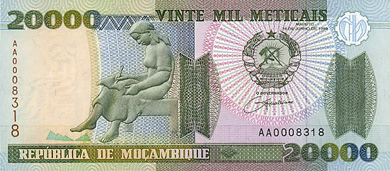
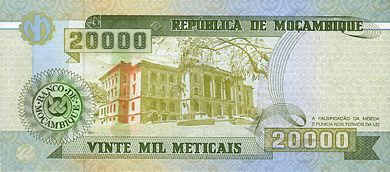
Banknotes
Budget & Public Finance
- Fiscal Year
- calendar year
- Annual Budget
- $1,930,000,000 (USD)
- External Debt
- $966,000,000 (USD)
- Investment (% of GDP)
- 44.8%
- Economic Aid
- $632,800,000 (USD)
- Current Account Balance
- -$530,900,000 (USD)
- Reserves of Foreign Exchange
- $1,227,000,000 (USD)
Labor, Industry & Trade
- Labor Force by Occupation
- agriculture 81%; industry 6%; services 13%
- Household Income — highest 10%
- 31.7%
- Industries
- food, beverages, chemicals (fertilizer, soap, paints), aluminum, petroleum products, textiles, cement, glass, asbestos, tobacco
- Agriculture Products
- cotton, cashew nuts, sugarcane, tea, cassava (tapioca), corn, coconuts, sisal, citrus and tropical fruits, potatoes, sunflowers; beef, poultry
- Export Commodities
- aluminum, prawns, cashews, cotton, sugar, citrus, timber; bulk electricity
- Export Partners
- Belgium 42.4%, South Africa 17.6%, Zimbabwe 5.7%, Spain 5.4%, Portugal 4.4%
- Import Commodities
- machinery and equipment, vehicles, fuel, chemicals, metal products, foodstuffs, textiles
- Import Partners
- South Africa 30.4%, Portugal 6.1%, US 5.2%, India 4.2%, Australia 4.1%
Energy
- Oil Production
- 0 bbl/day
- Oil Consumption
- 11,000 bbl/day
- Oil Reserves
- 0 bbl/day
- Natural Gas Production
- 60,000,000 cu m
- Natural Gas Consumption
- 60,000,000 cu m
- Natural Gas Imports
- 0 cu m
- Natural Gas Exports
- 0 cu m
- Natural Gas Reserves
- 127,400,000,000 cu m
Communications
- Telephone System
- general assessment: a fair telecommunications system that is shackled with a heavy state presence, lack of competition, and high operating costs and charges domestic: stagnation in the fixed-line network contrasts with rapid growth in the mobile-cellular network; mobile-cellular coverage now includes all the main cities and key roads, including those from Maputo to the South African and Swaziland borders, the national highway through Gaza and Inhambane provinces, the Beira corridor, and from Nampula to Nacala; extremely low fixed-line teledensity; despite significant growth in mobile-cellular services, teledensity remains low at about 35 per 100 persons international: country code - 258; landing point for the EASSy and SEACOM fiber-optic submarine cable systems; satellite earth stations - 5 Intelsat (2 Atlantic Ocean and 3 Indian Ocean)
- Internet Country Code
- .mz
News & Weather
News & Weather
Current Weather
Latest News
Mozambique Enacts Revised Petroleum Law - Mayer Brown
Mayer Brown · 7h ago
…Peter Bofin, Mozambique expert at Acled - Table.Briefings
Table.Briefings · 4h ago
Mozambique: Community Feedback & Referral Analysis - April to June 2026 - ReliefWeb
ReliefWeb · 8h ago
Training the Trainers Course on Gender, Women, Peace and Security Begins - EEAS
EEAS · 16h ago
New stake created in Mozambique, 17 reorganized presidencies worldwide - Church News
Church News · 1d ago
Tax Squabbles Put African Gas Windfall in Jeopardy - Bloomberg.com
Bloomberg.com · 3d ago
Russia is ready to help Mozambique fight 'terrorist threat', TASS cites Lavrov - Reuters
Reuters · 12d ago
MOZAMBIQUE: RETURN JOURNALIST’S SEIZED WORK EQUIPMENT (70.26) - Amnesty International USA
Amnesty International USA · 5d ago
News via Google News
Climate Overview
The climate in the plains and along the coast is warm and humid; the mountainous areas are cooler, although at times, equally wet. A hot, rainy season lasts from October to April. The rest of the year has a more moderate climate, with the coolest months in June and July. Rainfall is uneven and unpredictable; periodic droughts and floods occur. Mozambique experienced devastating floods in February and March 2000, causing loss of life and much destruction.
Videos
Videos
1 curated YouTube videos.
Source: YouTube
Frequently Asked Questions
Frequently Asked Questions
What is the population of Mozambique?
How do people greet each other in Mozambique?
What are the dining customs in Mozambique?
What etiquette should I follow when visiting a home in Mozambique?
How should I dress in Mozambique?
Which gestures should I avoid in Mozambique?
What are family roles like in Mozambique?
What do people do for recreation in Mozambique?
What is the capital of Mozambique?
Where is Mozambique located?
What countries border Mozambique?
What religion is practiced in Mozambique?
What is the currency of Mozambique?
What language is spoken in Mozambique?
What is Mozambique known for?
What is the geography of Mozambique like?
Last reviewed 2026