
 English
 Español
 中文
中文 हिन्दी
 Français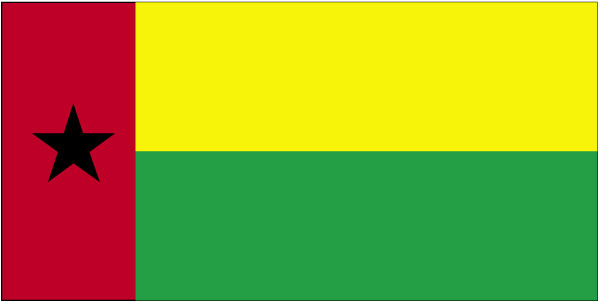
Guinea-Bissau
Guine-Bissau
Declare Your Relationship to Guinea-Bissau
CountryReports Community
- Studying0
- From Guinea-Bissau0
- Guinea-Bissau heritage1
- Visited0
- Want to visit0
Customs and Culture
Customs and Culture
Cultural Attributes
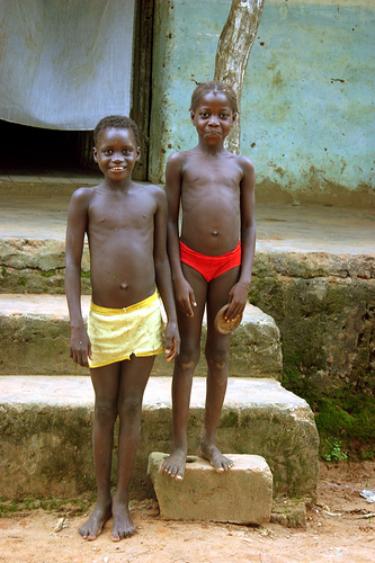
Guinea-Bissau's cultural identity is shaped by a remarkable diversity of ethnic groups, each contributing distinct traditions, languages, and customs to the national fabric. The country is home to more than 20 ethnic groups, with the Fula and Mandinka peoples predominant in the interior eastern regions, while the Balanta form the largest single group overall, primarily settled along the coastal and southern areas. The Papel, Manjaco, Mancanha, Bijago, and Felupe peoples further enrich this ethnic mosaic. Music and dance are central to social and ceremonial life across Guinea-Bissau. The country is particularly recognized for gumbe, a musical genre that blends traditional rhythms with influences from Cape Verde and Cuba, making it a defining sound of the nation's cultural expression. Percussion instruments, balafons, and koras feature prominently in traditional performances, which often accompany rites of passage, harvests, and community celebrations. The Bijago people, who inhabit the Bijagós Archipelago off the Atlantic coast, maintain especially distinctive cultural practices. Their society is notably matrilineal, and traditional initiation ceremonies mark the transition between life stages for both men and women. The Bijago also produce carved wooden masks and figures used in sacred rituals, which are recognized as important examples of West African artistic heritage. Oral tradition remains a vital medium for preserving history and cultural values. Griots — hereditary storytellers and musicians — serve as living archives of genealogical history, proverbs, and communal memory among many groups. Animist beliefs coexist alongside Islam and Christianity throughout the country. Roughly 45 percent of the population practices Islam, primarily among the Fula and Mandinka communities, while animist traditions remain deeply embedded across many groups, frequently practiced alongside or in parallel with monotheistic faiths. This spiritual plurality shapes festivals, burial customs, and daily household rituals. Portuguese Creole, known locally as Kriol, functions as the true lingua franca of cultural exchange, cutting across ethnic divisions and forming a shared communicative and cultural identity that distinguishes Guinea-Bissau from its neighbors.

Cashew Coast of West Africa

Holidays
Independence Day
9/24Independence Day
Dates of Interest
- September 24th
What social customs and traditions should I know in Guinea-Bissau?
Guinea-Bissau is home to more than 20 ethnic groups, each with distinct traditions, and oral tradition remains vital, with griots serving as hereditary storytellers preserving genealogical history, proverbs, and communal memory.
Good to know
- The Fula and Mandinka predominate in the interior eastern regions
- The Balanta are the largest single group, mainly along coastal and southern areas
- The Papel, Manjaco, Mancanha, Bijago, and Felupe peoples add to the ethnic mosaic
- Animist beliefs coexist alongside Islam and Christianity, often practiced in parallel
What is family and community life like in Guinea-Bissau?
Community and ceremonial life is central, and among the Bijago people of the Bijagós Archipelago, society is notably matrilineal, with traditional initiation ceremonies marking life-stage transitions for both men and women.
Good to know
- The Bijago produce carved wooden masks and figures used in sacred rituals
- Music and dance often accompany rites of passage, harvests, and community celebrations
What music and cultural activities define Guinea-Bissau?
Music and dance are central to social and ceremonial life, and the country is especially recognized for gumbe, a genre blending traditional rhythms with Cape Verdean and Cuban influences.
Good to know
- Percussion instruments, balafons, and koras feature in traditional performances
- Bijago carved wooden masks are recognized examples of West African artistic heritage
What should I know before visiting Guinea-Bissau?
Portuguese Creole, known locally as Kriol, is the true lingua franca that cuts across ethnic divisions and forms a shared cultural identity.
Good to know
- Roughly 45 percent of the population practices Islam, mainly among Fula and Mandinka communities
- Animist traditions remain deeply embedded and shape festivals, burial customs, and daily household rituals
- Learning some Kriol helps bridge ethnic and cultural divisions
Last updated: 2026-07-12 · Sources: CountryReports
Photos of Guinea-Bissau
Photos of Guinea-Bissau


Travel and Tourism
Travel and Tourism
- Travel Alert Status
- Level 3: Reconsider Travel
- Time Difference
- UTC 0 (5 hours ahead of Washington, DC, during Standard Time)
- Climate
- Tropical; generally hot and humid; monsoonal-type rainy season (June to November) with southwesterly winds; dry season (December to May) with northeasterly harmattan winds
- Airports
- 28
Read the full travel guide — health, safety, vaccinations, disease risk, sanitation, and transit details.
View full travel guideHistory
History
Historical Eras
Pre-Colonial Era
The territory of present-day Guinea-Bissau was inhabited by diverse peoples including the Balanta, Mandinka, Fula, and Bijago, organized into chieftaincies and small kingdoms engaged in agriculture, trade, and coastal fishing. These societies maintained distinct cultural and religious traditions, including animist practices, long before sustained contact with the outside world. The region's rivers and archipelagos shaped distinct political and economic communities across the landscape.
Portuguese Contact & Trade
1446 – 1630
Portuguese explorer Nuno Tristão reached the Guinea coast around 1446, initiating a period of coastal exploration and limited trading-post establishment. Portugal claimed Portuguese Guinea and, working alongside cooperative local tribes, became deeply involved in the Atlantic slave trade, using the settlement of Cacheu as a major transit hub. Full administrative consolidation remained elusive, with Portuguese presence largely confined to coastal and riverine outposts.
Colonial Consolidation
1630 – 1974
A captaincy-general was established in 1630 to formalize Portuguese administration, though conquest of the interior did not begin in earnest until the late 19th century. Bissau was founded in 1765 as a military and slave-trading center and eventually became the commercial and administrative capital. Portugal faced territorial disputes with France and Britain, subdued interior tribes before World War I, and in 1952 designated the colony an overseas province, resisting the global tide of decolonization until armed resistance forced change.
Independence Struggle
1956 – 1974
Amílcar Cabral and Raphael Barbosa founded the PAIGC in 1956, launching a guerrilla war against Portuguese forces in 1961 that steadily expanded until the movement controlled most of the country by 1968. Cabral was assassinated in Conakry in 1973, but the PAIGC declared independence on September 24, 1973, at Boé. Following Portugal's own democratic revolution in April 1974, Lisbon formally granted Guinea-Bissau independence on September 10, 1974, with Luís Cabral becoming the first president.
Single-Party & Coup Era
1974 – 1994
Independence brought a single-party state under the PAIGC and a command economy. In 1980, Prime Minister João Bernardo Vieira overthrew Luís Cabral in a largely bloodless coup, establishing a Revolutionary Council and eventually steering the country toward a market economy and multiparty reforms. Coup plots in 1983, 1985, and 1993 punctuated this turbulent period, and a new constitution was adopted in 1984 that reconstituted the National Popular Assembly.
Democracy & Instability
1994 – present
Guinea-Bissau held its first free elections in 1994, but a military uprising in 1998 sparked a devastating civil war that ousted Vieira in 1999. Subsequent leaders—including Kumba Yalá, removed in a bloodless coup in 2003, and interim president Henrique Rosa—struggled to stabilize a shattered economy and fragile democratic institutions. The country has remained vulnerable to repeated coups, political deadlock, and narco-trafficking influence, making durable democratic governance an ongoing challenge.
Overview
Portuguese conquest and consolidation of the interior did not begin until the latter half of the 19th century. Portugal lost part of Guinea to French West Africa, including the center of earlier Portuguese commercial interest, the Casamance River region. A dispute with Great Britain over the island of Bolama was settled in Portugal’s favor with the involvement of U.S. President Ulysses S. Grant.
Before World War I, Portuguese forces, with some assistance from the Muslim population, subdued animist tribes and eventually established the territory’s borders. The interior of Portuguese Guinea was brought under control after more than 30 years of fighting; final subjugation of the Bijagos Islands did not occur until 1936. The administrative capital was moved from Bolama to Bissau in 1941, and in 1952, by constitutional amendment, the colony of Portuguese Guinea became an overseas province of Portugal.
In 1956, Amilcar Cabral and Raphael Barbosa organized the African Party for the Independence of Guinea and Cape Verde (PAIGC) clandestinely. The PAIGC moved its headquarters to Conakry, Guinea, in 1960 and started an armed rebellion against the Portuguese in 1961. Despite the presence of Portuguese troops, which grew to more than 35,000, the PAIGC steadily expanded its influence until, by 1968, it controlled most of the country.
It established civilian rule in the territory under its control and held elections for a National Assembly. Portuguese forces and civilians increasingly were confined to their garrisons and larger towns. The Portuguese Governor and Commander in Chief from 1968 to 1973, Gen. Antonio de Spinola, returned to Portugal and led the movement that brought democracy to Portugal and independence for its colonies.
Amilcar Cabral was assassinated in Conakry in 1973, and party leadership fell to Aristides Pereira, who later became the first President of the Republic of Cape Verde. The PAIGC National Assembly met at Boe in the southeastern region and declared the independence of Guinea-Bissau on September 24, 1973. Following Portugal’s April 1974 revolution, it granted independence to Guinea-Bissau on September 10, 1974. The United States recognized the new nation that day. Luis Cabral, Amilcar Cabral’s half-brother, became President of Guinea-Bissau. In late 1980, the government was overthrown in a relatively bloodless coup led by Prime Minister and former armed forces commander Joao Bernardo Vieira.
From November 1980 to May 1984, power was held by a provisional government responsible to a Revolutionary Council headed by President Joao Bernardo Vieira. In 1984, the council was dissolved, and the National Popular Assembly (ANP) was reconstituted. The single-party assembly approved a new constitution, elected President Vieira to a new 5-year term, and elected a Council of State, which was the executive agent of the ANP. Under this system, the president presided over the Council of State and served as head of state and government. The president also was head of the PAIGC and commander in chief of the armed forces.
There were alleged coup plots against the Vieira government in 1983, 1985, and 1993. In 1986, first Vice President Paulo Correia and five others were executed for treason following a lengthy trial. In 1994, the country’s first multi-party legislative and presidential elections were held. An army uprising against the Vieira government in June 1998 triggered a bloody civil war that created hundreds of thousands of displaced persons. The President was ousted by a military junta in May 1999. An interim government turned over power in February 2000 when opposition leader Kumba Yala, founder of the Social Renovation Party (PRS), took office following two rounds of transparent presidential elections.
Despite the elections, democracy did not take root in the succeeding 3 years. President Yala neither vetoed nor promulgated the new constitution that was approved by the National Assembly in April 2001. The resulting ambiguity undermined the rule of law. Impulsive presidential interventions in ministerial operations hampered effective governance. On November 14, 2002, the President dism
Timeline of Key Events
1446
First Portuguese explorer reaches region.
First Portuguese explorer reaches region and lands near to what is now the city of Bissau -- Nuno Tristão was sent by the Portuguese Prince Henry the Navigator to the west coast of Africa.
1879
Guinea-Bissau becomes a separate colony.
Guinea-Bissau becomes a separate colony. Portuguese control of the interior is slow and sometimes violent, and not effectively achieved until 1915.
1951
Guinea-Bissau declared a province of Portugal.
Guinea-Bissau declared a province of Portugal.
1974
Portugal grants Guinea-Bissau independence.
Portugal grants Guinea-Bissau independence with Luis Cabral, Amilcar Cabral’s brother, as president.
1994
Guinea-Bissau held democratic elections.
Guinea-Bissau held democratic elections.
1998
In Guinea-Bissau the fighting intensified and thousands of people sought escape routes.
In Guinea-Bissau the fighting intensified and thousands of people sought escape routes.
2002
Guinea-Bissau Pres. Kumba Yala dissolved Parliament and delayed elections 3 times.
Guinea-Bissau Pres. Kumba Yala dissolved Parliament and delayed elections 3 times.
Read the full history profile — narrative overview, defining eras, and the complete timeline in one place.
View expanded historyInteresting Facts
Interesting Facts
Guinea-Bissau is one of the worlds most rural countries.
The land now known as Guinea-Bissau was once the kingdom of Gabú, which was part of the larger Mali empire
Guinea Bissau’s cashew crop is a vital source of income.
See every fact — trivia, oddities, and curious tidbits gathered from across the country.
View all interesting factsGeography and Environment
Geography and Environment
- Terrain
- mostly low coastal plain rising to savanna in east
- Climate
- tropical; generally hot and humid; monsoonal-type rainy season (June to November) with southwesterly winds; dry season (December to May) with northeasterly harmattan winds
- Natural Hazards
- hot, dry, dusty harmattan haze may reduce visibility during dry season; brush fires
- Current Environmental Issues
- deforestation; soil erosion; overgrazing; overfishing
Read the full geography and environment profile — terrain, climate, natural resources, hazards, land use, and international agreements.
View full geographyPeople & Demographics
People & Demographics
Religion
Languages Spoken
Portuguese (official), Crioulo, African languages
- Portuguese
Population
- Population
- 1,565,126
- Population in Major Urban Areas
- BISSAU (capital) 423,000
- Nationality Noun
- Guinean(s)
- Ethnic Groups
- African 99% (Balanta 30%, Fula 20%, Manjaca 14%, Mandinga 13%, Papel 7%), European and mulatto less than 1%
Education
- Literacy Definition
- Age 15 and over can read and write
Health Information
- Major Infectious Diseases — degree of risk
- very high
Read the full people and society profile — demographics, health, education, religion, languages, and notable people.
View full people and societyGovernment & Politics
Government & Politics
Country Identity
- Country Name
- GuineaBissau
- Full Country Name
- Republic of Guinea-Bissau
- Local - Long
- Republica da Guine-Bissau
- Local - Short
- Guine-Bissau
- Former Name
- Portuguese Guinea
Government Structure
- Government Type
- republic, multiparty since mid-1991
- Legal System
- NA
- Executive Branch
- chief of state: President Umaro Sissoco EMBALO (since 27 February 2020, reelected for a second term in November 2023) head of government: Prime Minister Rui Duarte DE BARROS (since 20 December 2023) cabinet: Cabinet of Ministers appointed by the president elections: president elected by popular vote for a five-year term; election last held on 24 November 2019, with a runoff on 29 December 2019 (next election held in November 2023); prime minister appointed by the president election results: Umaro Sissoco EMBALO elected president in the December 2019 runoff; percent of vote - Umaro Sissoco EMBALO 53.6%, Domingos Simoes PEREIRA 46.4%; reelected in November 2023 with approximately 53% of the vote in the first round
- Legislative Branch
- unicameral National People's Assembly or Assembleia Nacional Popular (100 seats; members are elected by popular vote to serve a maximum of four years) elections: last held 28 March 2004 (next to be held in 2008) election results: percent of vote by party - PAIGC 31.5%, PRS 24.8%, PUSD 16.1%, UE 4.1%, APU 1.3%, 13 other parties 22.2%; seats by party - PAIGC 45, PRS 35, PUSD 17, UE 2, APU 1
- Judicial Branch
- Supreme Court or Supremo Tribunal da Justica (consists of nine justices appointed by the president and serve at his pleasure; final court of appeals in criminal and civil cases); Regional Courts (one in each of nine regions; first court of appeals for Sectoral Court decisions; hear all felony cases and civil cases valued at over $1,000); 24 Sectoral Courts (judges are not necessarily trained lawyers; they hear civil cases under $1,000 and misdemeanor criminal cases)
- Suffrage
- 18 years of age; universal
- Constitution
- 16 May 1984, amended 4 May 1991, 4 December 1991, 26 February 1993, 9 June 1993, and 1996
- Independence
- 24 September 1973 (unilaterally declared by Guinea-Bissau); 10 September 1974 (recognized by Portugal)
- National Holiday
- Independence Day, 24 September (1973)
Capital City
- Capital Name
- Bissau
- Capital - geographic coordinate
- 11 51 N, 15 35 W
- Capital Time Difference
- UTC 0 (5 hours ahead of Washington, DC, during Standard Time)
The meaning of Bissau is uncertain, it might be an alternative name for the Papel people who live in the area of the city of Bissau
Military
Branches: People's Revolutionary Armed Force (FARP): Army, Navy, National Air Force (Forca Aerea Nacional); Presidential Guard
Embassy / Diplomatic Mission
U.S. Embassy Dakar
Route des Almadies – B.P. 49
Dakar, Senegal
Telephone: 221 33-879-4000
Emergency after-hours telephone: 221 33-879-4444
Regional Security Office: 221 33-879-4420
Facsimile: 221 33-879-4050
Read the full government profile — flag symbolism, national anthem, and other national symbols.
View full government detailsEconomy
Economy
Guinea-Bissau remains one of the world's poorest and most fragile economies, with a large share of its population living below the poverty line. The country depends heavily on agriculture and fishing, which together employ the majority of the workforce. Cashew nuts dominate the economy, accounting for the vast majority of export earnings and providing the primary source of income for most rural households. Guinea-Bissau is among the world's leading producers of raw cashews, though its heavy reliance on this single commodity leaves the economy highly vulnerable to fluctuations in global prices and demand, particularly from India and Vietnam, the main buyers.
Beyond cashews, the country exports fish, seafood, peanuts, palm kernels, and timber. Rice is the principal staple food, but domestic production falls short of demand, requiring significant imports. The fisheries sector holds considerable untapped potential, with licensing agreements—particularly with the European Union—providing an important source of government revenue.
Political instability has long undermined economic progress. A series of coups, attempted coups, and prolonged periods of governmental paralysis have discouraged investment and disrupted donor relations. The economy contracted sharply during the 1998–99 civil war and has experienced repeated setbacks since, though periods of relative stability have allowed for modest growth driven largely by strong cashew harvests and prices.
The development of petroleum, phosphate, bauxite, and other mineral resources remains constrained by high costs, weak infrastructure, and governance challenges, though offshore oil reserves could offer long-term revenue potential if exploited. Income inequality remains severe, and the country continues to rely on international donors, including the IMF, World Bank, and African Development Bank, for budget support and development financing. As a member of the West African Economic and Monetary Union, Guinea-Bissau uses the CFA franc, which provides a measure of monetary stability. Persistent challenges include weak institutions, corruption, limited access to electricity, and an underdeveloped private sector, all of which continue to constrain broader economic diversification and growth.
Snapshot
- Currency Name and Code
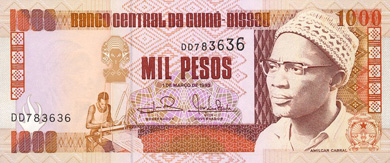
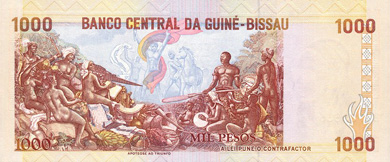
- Guinea-Bissau Peso (GWP) and CFA Franc BCEAO (XOF)
- GDP — official exchange rate
- $280,000,000 (USD)
- GDP Real Growth Rate
- 2.3%
Banknotes
Budget & Public Finance
- Fiscal Year
- calendar year
- External Debt
- $947,500,000 (USD)
- Economic Aid
- $115,400,000 (USD)
Labor, Industry & Trade
- Labor Force by Occupation
- agriculture 82% (2000 est.)
- Household Income — highest 10%
- 42.4%
- Industries
- agricultural products processing, beer, soft drinks
- Agriculture Products
- rice, corn, beans, cassava (tapioca), cashew nuts, peanuts, palm kernels, cotton; timber; fish
- Export Commodities
- cashew nuts, shrimp, peanuts, palm kernels, sawn lumber
- Export Partners
- India 50%, Thailand 19.2%, Uruguay 19.2%
- Import Commodities
- foodstuffs, machinery and transport equipment, petroleum products
- Import Partners
- Senegal 19.6%, Portugal 18.8%, India 15.2%
Energy
- Oil Production
- 0 bbl/day
- Oil Consumption
- 2,450 bbl/day
- Oil Reserves
- 0 bbl/day
- Natural Gas Production
- 0 cu m
- Natural Gas Consumption
- 0 cu m
- Natural Gas Imports
- 0 cu m
- Natural Gas Exports
- 0 cu m
- Natural Gas Reserves
- 0 cu m
Communications
- Telephone System
- General assessment: Small system including a combination of microwave radio relay, open-wire lines, radiotelephone, and mobile-cellular communications Domestic: Fixed-line teledensity less than 1 per 100 persons; mobile-cellular teledensity is roughly 50 per 100 persons International: country code - 245
- Internet Country Code
- .gw
News & Weather
News & Weather
Current Weather
Latest News
A Tide-Fueled Trove of Biodiversity in Guinea-Bissau - NASA Science (.gov)
NASA Science (.gov) · 4d ago
Africa Mpox: Guinea Bissau reports 1st case - Outbreak News Today
Outbreak News Today · 1d ago
Guinea-Bissau's opposition demands postponement of constitutional referendum - ConstitutionNet
ConstitutionNet · 1d ago
Russian strike on cargo ship in Black Sea kills 5, Kyiv says - Reuters
Reuters · 1d ago
WFP Guinea Bissau Country Brief, July 2026 - ReliefWeb
ReliefWeb · 4d ago
VIDEO | Ten killed in Russian missile attack on ship near Odessa - Baird Maritime
Baird Maritime · 13h ago
Guinea-Bissau to hold referendum on expanding presidential power - africanews.com
africanews.com · 14d ago
Now, Russia Attacks Ukraine as India and Guinea-Bissau Face Black Sea Travel Shock After Odesa Ship Missile Strike Kills International Crew, Ignites Maritime Security Crisis and Puts Global Shipping Routes Under Fresh Pressure - Travel And Tour World
Travel And Tour World · 5h ago
News via Google News
Climate Overview
Tropical; generally hot and humid; monsoonal-type rainy season (June to November) with southwesterly winds; dry season (December to May) with northeasterly harmattan winds
Frequently Asked Questions
Frequently Asked Questions
What is the population of Guinea-Bissau?
What social customs and traditions should I know in Guinea-Bissau?
What is family and community life like in Guinea-Bissau?
What music and cultural activities define Guinea-Bissau?
What should I know before visiting Guinea-Bissau?
What is the capital of Guinea-Bissau?
Where is Guinea-Bissau located?
What countries border Guinea-Bissau?
What religion is practiced in Guinea-Bissau?
What currency is used in Guinea-Bissau?
What language is spoken in Guinea-Bissau?
What is Guinea-Bissau known for?
Last reviewed 2026