English
 Español
 中文
中文 हिन्दी
 Français
Government and Politics
Government and Politics of Lithuania
Government structure, leadership, capital, military, and national symbols of Lithuania.
Government Structure
Constitutional foundations, branches, parties, and leadership.
- Government Type
- parliamentary democracy
- Administrative Divisions
- 10 counties (apskritys, singular - apskritis); Alytaus, Kauno, Klaipedos, Marijampoles, Panevezio, Siauliu, Taurages, Telsiu, Utenos, Vilniaus
- Legal System
- based on civil law system; legislative acts can be appealed to the constitutional court
- Suffrage
- 18 years of age; universal
- Citizenship
- citizenship by birth: no citizenship by descent only: at least one parent must be a citizen of Lithuania dual citizenship recognized: no residency requirement for naturalization: 10 years
- Executive Branch
- chief of state: President Gitanas NAUSĖDA (since 12 July 2019; reelected 26 May 2024) head of government: Prime Minister Gintautas PALUCKAS (since December 2024) cabinet: Council of Ministers appointed by the president on the nomination of the prime minister elections: president elected by popular vote for a five-year term; election last held 12 and 26 May 2024 (next to be held in 2029); prime minister appointed by the president on the approval of the Parliament (Seimas) election results: Gitanas NAUSĖDA reelected president; percent of vote in second round - Gitanas NAUSĖDA 74.6%, Ingrida ŠIMONYTĖ 24.0%
- Legislative Branch
- unicameral Parliament or Seimas (141 seats, 71 members are directly elected by popular vote, 70 are elected by proportional representation; members serve four-year terms) elections: last held 10 and 24 October 2004 (next to be held October 2008) election results: percent of vote by party - Labor 28.6%, Working for Lithuania (Social Democrats and Social Liberals) 20.7%, TS 14.6%, For Order and Justice (Liberal Democrats and Lithuanian People's Union) 11.4%, Liberal and Center Union 9.1%, Union of Farmers and New Democracy 6.6%, other 9%; seats by faction - Labor 39, Homeland Union 26, Social Democrats 22, Social Liberals 10, Liberal Political group 10, Union of Farmers and New Democracy Parties 11, Liberal Democrats 9, Liberal Center Political group 8, independents 6
- Judicial Branch
- Constitutional Court; Supreme Court; Court of Appeal; judges for all courts appointed by the President
- Political Parties
- Electoral Action of Lithuanian Poles [Valdemar TOMASZEVSKI, chairman]; Homeland Union/Conservative Party or TS [Andrius KUBILIUS, chairman]; Labor Party [Viktor USPASKICH, chairman]; Liberal Center Political group [Arturas ZUOKAS, chairman]; Liberal Democratic Party [Valentinas MAZURONIS, chairman]; Liberal Political group [leader NA]; Lithuanian Christian Democrats or LKD [Valentinas STUNDYS, chairman]; Lithuanian People's Union for a Fair Lithuania [leader NA]; Lithuanian Social Democratic Coalition [Algirdas BRAZAUSKAS, chairman] consists of the Lithuanian Democratic Labor Party or LDDP and the Lithuanian Social Democratic Party or LSDP; New Democracy and Farmer's Union or VNDPS [Kazimiera PRUNSKIENE, chairman]; Social Liberals (New Union) [Arturas PAULAUSKAS, chairman]; Social Union of Christian Conservatives [Gediminas VAGNORIUS, chairman]; Young Lithuania and New Nationalists [leader NA]
- Head of State
- President Dalia Grybauskaite
- Head of Government
- Prime Minister Andrius KUBILIUS
- Cabinet
- Council of Ministers appointed by the president on the nomination of the prime minister
- Elections
- president elected by popular vote for a five-year term (eligible for a second term); election last held on 17 May 2009 (next to be held in May 2014); prime minister appointed by the president on the approval of the Parliament
- Election Results
- Dalia GRYBAUSKAITE elected president; percent of vote - Dalia GRYBAUSKAITE 69.1%, Algirdas BUTKEVICIUS 11.8%, Valentinas MAZURONIS 6.2%, others 12.9%; Andrius KUBILIUS’ government approved by Parliament 83-40 with 5 abstentions
- Constitution
- adopted 25 October 1992
- Independence
- 11 March 1990 (independence declared from Soviet Union); 6 September 1991 (Soviet Union recognizes Lithuania's independence)
- National Holiday
- Independence Day, 16 February (1918); note - 16 February 1918 is the date Lithuania declared its independence from Soviet Russia and established its statehood; 11 March 1990 is the date it declared its independence from the Soviet Union
- International Organization Participation
- ACCT (observer), BIS, CBSS, CE, EAPC, EBRD, EU (new member), FAO, IAEA, IBRD, ICAO, ICC, ICCt, ICFTU, ICRM, IFC, IFRCS, ILO, IMF, IMO, Interpol, IOC, IOM, ISO (correspondent), ITU, OPCW, OSCE, PFP, UN, UNCTAD, UNESCO, UNIDO, UNMIK, UPU, WCL, WCO, WEU (associate partner), WHO, WIPO, WMO, WToO, WTrO
- Diplomatic Representation in the U.S.
- chief of mission: Ambassador Vygaudas USACKAS chancery: 4590 MacArthur Boulevard NW, Suite 200, Washington, DC 20007 telephone: [1] (202) 234-5860 FAX: [1] (202) 328-0466 consulate(s) general: Chicago, New York
- U.S. Diplomatic Representation
- chief of mission: Ambassador Stephen D. MULL embassy: 2600 Akmenu 6, Vilnius mailing address: American Embassy, Almeny gatve 6, Vilnius LT-03106 telephone: [370] (5) 266 5500 FAX: [370] (5) 266 5510
Capital City
Seat of government and political history.
- Capital City
- Vilnius
- Location
- 54 41 N, 25 19 E
- Time Difference
- UTC+2 (7 hours ahead of Washington, DC, during Standard Time)
- History
- named after the Vilnia River, which flows into the Neris River at Vilnius; the river name derives from the Lithuanian word "vilnis" meaning "a surge"
Embassy and Diplomatic Representation
Embassy location and contact details.
U.S. Embassy Vilnius Akmenu Gatve 6 Vilnius, Lithuania LT-03106. Telephone: (370) (5) 266-5500 Facsimile (370) (5) 266-5590 Email: ConSec@state.gov
Military
Branches, service obligations, expenditures, and manpower.
- Military Branches
- Lithuanian Armed Forces (Lietuvos Ginkluotosios Pajegos): Land Forces (Sausumos Pajegos), Naval Forces (Karines Juru Pajegos), Air Forces (Karines Oro Pajegos)
- Service Age and Obligation
- 18 years of age for voluntary military service; service obligation 1 year; Lithuania converted to a professional military in the fall of 2008, although the decision continues under judicial review
National Symbols
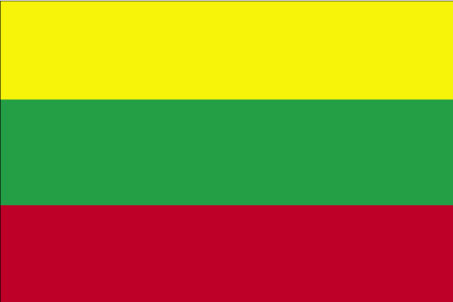
Flag, anthem, and other symbols of national identity.