English
 Español
 中文
中文 हिन्दी
 Français
Government and Politics
Government and Politics of Mali
Government structure, leadership, capital, military, and national symbols of Mali.
Government Structure
Constitutional foundations, branches, parties, and leadership.
- Government Type
- republic
- Administrative Divisions
- 8 regions (regions, singular - region); Gao, Kayes, Kidal, Koulikoro, Mopti, Segou, Sikasso, Tombouctou
- Legal System
- based on French civil law system and customary law; judicial review of legislative acts in Constitutional Court (which was formally established on 9 March 1994); has not accepted compulsory ICJ jurisdiction
- Suffrage
- 18 years of age; universal
- Citizenship
- citizenship by birth: no citizenship by descent only: at least one parent must be a citizen of Mali dual citizenship recognized: yes residency requirement for naturalization: 5 years
- Executive Branch
- chief of state: Transition President General Assimi GOITA (since 7 June 2021), following a military coup in May 2021 that ousted transitional President Bah N'DAW head of government: Prime Minister General Abdoulaye MAIGA (since 21 November 2022), appointed following the dismissal of Choguel Kokalla MAIGA cabinet: Council of Ministers appointed by the prime minister and approved by the transition president elections: Under the previous constitutional order, the president was elected by popular vote for a five-year term with a two-term limit, and the prime minister was appointed by the president. Mali has been under military-led transitional governance since the August 2020 coup. A new constitution was approved by referendum in June 2023, and a return to civilian rule has been repeatedly delayed; transitional authorities have indicated elections could be held in 2024 or later. election results: The most recent competitive presidential election was held in 2013, in which Ibrahim Boubacar KEITA won with approximately 77.6% of the vote in a runoff against Soumaila CISSE. KEITA was reelected in 2018 but was overthrown in a military coup in August 2020.
- Legislative Branch
- unicameral National Assembly or Assemblee Nationale (147 seats; members are elected by popular vote to serve five-year terms) elections: last held 14 and 28 July 2002 (next to be held July 2007) election results: percent of vote by party - NA%; seats by party - Hope 2002 coalition 66, ADEMA 51, other 30
- Judicial Branch
- Supreme Court or Cour Supreme
- Political Parties
- Alliance for Democracy or ADEMA [Diounconda TRAORE, party chairman]; Hope 2002, a coalition of CNID, MPR, RDT, and RPM [leader NA]; National Congress for Democratic Initiative or CNID [Mountaga TALL, chairman]; Party for Democracy and Progress or PDP [Me Idrissa TRAORE]; Party for National Renewal or PARENA [Tiebile DRAME, secretary general]; Patriotic Movement for Renewal or MPR [Choguel MAIGA]; Rally for Democracy and Labor or RDT [leader NA]; Rally for Mali or RPM [Ibrahim Boubacar KEITA, chairman]; Sudanese Union/African Democratic Rally or US/RDA [Mamadou Bamou TOURE, secretary general]; Union for Democracy and Development or UDD [Moussa Balla COULIBALY]; Union for Republic and Democracy or URD [Soumaila CISSE]
- Head of State
- President Amadou Toumani TOURE
- Head of Government
- Prime Minister Modibo SIDIBE
- Cabinet
- Council of Ministers appointed by the prime minister
- Elections
- president elected by popular vote for a five-year term (eligible for a second term); election last held on 29 April 2007 (next to be held in April 2012); prime minister appointed by the president
- Election Results
- Amadou Toumani TOURE reelected president; percent of vote - Amadou Toumani TOURE 71.2%, Ibrahim Boubacar KEITA 19.2%, other 9.6%
- Constitution
- adopted 12 January 1992
- Independence
- 22 September 1960 (from France)
- National Holiday
- Independence Day, 22 September (1960)
- International Organization Participation
- ACCT, ACP, AfDB, AU, ECOWAS, FAO, FZ, G-77, IAEA, IBRD, ICAO, ICCt, ICFTU, ICRM, IDA, IDB, IFAD, IFC, IFRCS, ILO, IMF, Interpol, IOC, IOM, ISO (subscriber), ITU, MICAH, MONUC, NAM, OIC, OPCW, UN, UNAMSIL, UNCTAD, UNESCO, UNIDO, UNMIL, UPU, WADB (regional), WAEMU, WCO, WFTU, WHO, WIPO, WMO, WToO, WTrO
- Diplomatic Representation in the U.S.
- chief of mission: Ambassador Abdoulaye DIOP chancery: 2130 R Street NW, Washington, DC 20008 telephone: [1] (202) 332-2249, 939-8950 FAX: [1] (202) 332-6603
- U.S. Diplomatic Representation
- chief of mission: Ambassador Vicki HUDDLESTONE embassy: Rue Rochester NY and Rue Mohamed V, Bamako mailing address: B. P. 34, Bamako telephone: [223] (2) 223-833 FAX: [223] (2) 223-712
Capital City
Seat of government and political history.
- Capital City
- Bamako
- Location
- 12 39 N, 8 00 W
- Time Difference
- UTC 0 (5 hours ahead of Washington, DC, during Standard Time)
- History
- the name in the Bambara language can mean either "crocodile tail" or "crocodile river" and three crocodiles appear on the city seal
Embassy and Diplomatic Representation
Embassy location and contact details.
U.S. Embassy Bamako ACI 2000, Rue 243 Porte 297, Bamako, Mali Telephone: (223) 20 70 23 00 Consular Section: (223) 20 70 25 05 Emergency after-hours telephone: (223) 20 70 23 01 or 20 70 23 02 Facsimile: (223) 20 70 23 40. Email address: consularbamako@state.gov
Military
Branches, service obligations, expenditures, and manpower.
- Military Branches
- Malian Armed Forces: Army (Armee de Terre), Republic of Mali Air Force (Force Aerienne de la Republique du Mali, FARM), National Guard (Garde National du Mali)
- Service Age and Obligation
- 18 years of age for selective compulsory and voluntary military service; conscript service obligation - 2 years
National Symbols
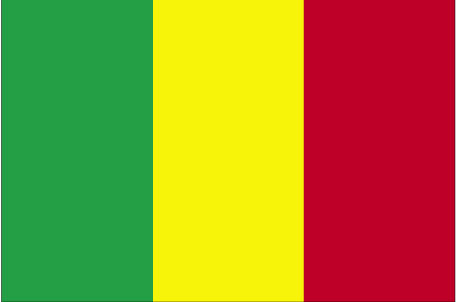
Flag, anthem, and other symbols of national identity.