English
 Español
 中文
中文 हिन्दी
 Français
Government and Politics
Government and Politics of Armenia
Government structure, leadership, capital, military, and national symbols of Armenia.
Government Structure
Constitutional foundations, branches, parties, and leadership.
- Government Type
- republic
- Administrative Divisions
- 11 provinces (marzer, singular - marz); Aragatsotn, Ararat, Armavir, Geghark'unik', Kotayk', Lorri, Shirak, Syunik', Tavush, Vayots' Dzor, Yerevan
- Legal System
- based on civil law system
- Suffrage
- 18 years of age; universal
- Citizenship
- citizenship by birth: no citizenship by descent only: at least one parent must be a citizen of Armenia dual citizenship recognized: yes residency requirement for naturalization: 3 years
- Executive Branch
- chief of state: President Vahagn KHACHATURYAN (since 13 March 2022) head of government: Prime Minister Nikol PASHINYAN (since 8 May 2018, reconfirmed following subsequent elections) cabinet: Council of Ministers appointed by the prime minister elections: president elected by the National Assembly for a seven-year term (eligible for a single term); election last held on 2 March 2022 (next to be held in 2029); prime minister nominated by the parliamentary majority and appointed by the president following National Assembly elections election results: Vahagn KHACHATURYAN elected president by the National Assembly; Nikol PASHINYAN's Civil Contract party won a majority in the June 2021 parliamentary elections, securing his continued tenure as prime minister
- Legislative Branch
- unicameral National Assembly (Parliament) or Azgayin Zhoghov (131 seats; members elected by popular vote to serve four-year terms; 90 members elected by party list, 41 by direct vote) elections: last held 25 May 2003 (next to be held in the spring of 2007) election results: percent of vote by party - Republican Party 23.5%, Justice Bloc 13.6%, Rule of Law 12.3%, ARF (Dashnak) 11.4%, National Unity Party 8.8%, United Labor Party 5.7%; seats by faction - Republican Party 39, Rule of Law 20, Justice Bloc 14, ARF (Dashnak) 11, National Unity 7, United Labor 6, People's Deputy Group 16, independent (not in faction or group) 18; note - as of 10 March 2006; voting blocs in the legislature are more properly termed factions and can be composed of members of several parties; seats by faction change frequently as deputies switch parties or announce themselves independent
- Judicial Branch
- Constitutional Court; Court of Cassation (Appeals Court)
- Political Parties
- Agro-Industrial Party [Vladimir BADALYAN]; Armenia Party [Myasnik MALKHASYAN]; Armenian National Movement or ANM [Alex ARZUMANYAN, chairman]; Armenian Ramkavar Liberal Party or HRAK [Harutyun MIRZAKHANYAN, chairman]; Armenian Revolutionary Federation (“Dashnak” Party) or ARF [Levon MKRTCHYAN]; Democratic Party [Aram SARKISYAN]; Justice Bloc (comprised of the Democratic Party, National Democratic Party, National Democratic Union, the People's Party, and the Republic Party) [Stepan DEMIRCHYAN]; National Democratic Party [Shavarsh KOCHARIAN]; National Democratic Union or NDU [Vazgen MANUKIAN]; National Revival Party [Albert BAZEYAN]; National Unity Party [Artashes GEGHAMYAN, chairman]; People's Party of Armenia [Stepan DEMIRCHYAN]; Republic Party [Aram SARKISYAN, chairman]; Republican Party or RPA [Andranik MARGARYAN]; Rule of Law Party [Samvel BALASANYAN]; Union of Constitutional Rights [Hrant KHACHATURYAN]; United Labor Party [Gurgen ARSENYAN]
- Head of State
- President Serzh SARGSIAN
- Head of Government
- Prime Minister Tigran SARGSIAN
- Cabinet
- Council of Ministers appointed by the prime minister
- Elections
- president elected by popular vote for a five-year term (eligible for a second term); election last held 19 February 2008 (next to be held February 2013); prime minister appointed by the president based on majority or plurality support in parliament; the prime minister and Council of Ministers must resign if the National Assembly refuses to accept their program
- Election Results
- Serzh SARGSIAN elected president; percent of vote - Serzh SARGSIAN 52.9%, Levon TER-PETROSSIAN 21.5%, Artur BAGHDASARIAN 16.7%
- Constitution
- adopted by nationwide referendum 5 July 1995
- Independence
- 21 September 1991 (from Soviet Union)
- National Holiday
- Independence Day, 21 September (1991)
- International Organization Participation
- BSEC, CE, CIS, EAPC, EBRD, FAO, IAEA, IBRD, ICAO, ICCt (signatory), ICRM, IDA, IFAD, IFC, IFRCS, ILO, IMF, Interpol, IOC, IOM, ISO, ITU, NAM (observer), OAS (observer), OPCW, OSCE, PFP, UN, UNCTAD, UNESCO, UNIDO, UPU, WCO, WFTU, WHO, WIPO, WMO, WToO, WTrO
- Diplomatic Representation in the U.S.
- chief of mission: Ambassador Tatoul MARKARIAN chancery: 2225 R Street NW, Washington, DC 20008 telephone: [1] (202) 319-1976 FAX: [1] (202) 319-2982 consulate(s) general: Los Angeles
- U.S. Diplomatic Representation
- chief of mission: Ambassador John M. EVANS embassy: 1 American Ave., Yerevan 375082 mailing address: American Embassy Yerevan, Department of State, 7020 Yerevan Place, Washington, DC 20521-7020 telephone: [374](10) 464-700 FAX: [374](10) 464-742
Capital City
Seat of government and political history.
- Capital City
- Yerevan
- Location
- 40 10 N, 44 30 E
- Time Difference
- UTC+4 (9 hours ahead of Washington, DC during Standard Time)
- History
- name likely derives from the ancient Urartian fortress of Erebuni established on the current site of Yerevan in 782 B.C. and whose impressive ruins still survive
Embassy and Diplomatic Representation
Embassy location and contact details.
U.S. Embassy Yerevan 1 American Avenue Embassy switchboard: 374 10 46 47 00 Emergency after-hours telephone: 374 10 49 44 44 Facsimile: 374 46 47 37
Military
Branches, service obligations, expenditures, and manpower.
- Military Branches
- Armenian Armed Forces: Ground Forces, Air Force, and Air Defense; "Nagorno-Karabakh Republic": Nagorno-Karabakh Self-Defense Force (NKSDF)
- Service Age and Obligation
- 18-27 years of age for voluntary or compulsory military service; 2-year conscript service obligation; 17-year-olds are eligible to become cadets at military higher education institutes, where they are classified as military personnel
National Symbols
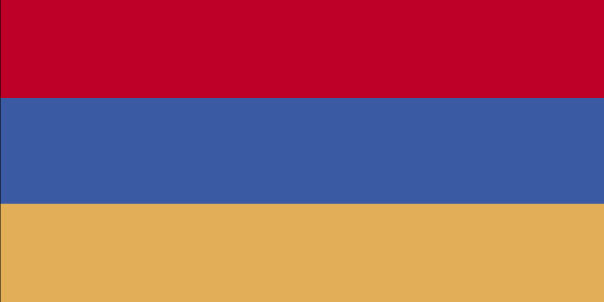
Flag, anthem, and other symbols of national identity.