English
 Español
 中文
中文 हिन्दी
 Français
Government and Politics
Government and Politics of South Africa
Government structure, leadership, capital, military, and national symbols of South Africa.
Government Structure
Constitutional foundations, branches, parties, and leadership.
- Government Type
- republic
- Administrative Divisions
- 9 provinces; Eastern Cape, Free State, Gauteng, KwaZulu-Natal, Limpopo, Mpumalanga, North-West, Northern Cape, Western Cape
- Legal System
- based on Roman-Dutch law and English common law; accepts compulsory ICJ jurisdiction, with reservations
- Suffrage
- 18 years of age; universal
- Citizenship
- citizenship by birth: no citizenship by descent only: at least one parent must be a citizen of South Africa dual citizenship recognized: yes, but requires prior permission of the government residency requirement for naturalization: 5 year
- Executive Branch
- chief of state: President Cyril RAMAPHOSA (since 15 February 2018); note - the president is both the chief of state and head of government head of government: President Cyril RAMAPHOSA (since 15 February 2018); note - the president is both the chief of state and head of government cabinet: Cabinet appointed by the president elections: president elected by the National Assembly for a five-year term; election last held 29 May 2024 (next to be held in 2029) election results: Cyril RAMAPHOSA reelected president by the National Assembly on 14 June 2024 following general elections in which the African National Congress (ANC) lost its parliamentary majority for the first time since the end of apartheid; RAMAPHOSA secured sufficient support through a coalition government arrangement
- Legislative Branch
- bicameral Parliament consisting of the National Assembly (400 seats; members are elected by popular vote under a system of proportional representation to serve five-year terms) and the National Council of Provinces (90 seats, 10 members elected by each of the nine provincial legislatures for five-year terms; has special powers to protect regional interests, including the safeguarding of cultural and linguistic traditions among ethnic minorities); note - following the implementation of the new constitution on 3 February 1997, the former Senate was disbanded and replaced by the National Council of Provinces with essentially no change in membership and party affiliations, although the new institution's responsibilities have been changed somewhat by the new constitution elections: National Assembly and National Council of Provinces - last held 14 April 2004 (next to be held NA 2009) election results: National Assembly - percent of vote by party - ANC 69.7%, DA 12.4%, IFP 7%, UDM 2.3%, NNP 1.7%, ACDP 1.6%, other 5.3%; seats by party - ANC 279, DA 50, IFP 28, UDM 9, NNP 7, ACDP 6, other 21; National Council of Provinces - percent of vote by party - NA%; seats by party - NA
- Judicial Branch
- Constitutional Court; Supreme Court of Appeals; High Courts; Magistrate Courts
- Political Parties
- African Christian Democratic Party or ACDP [Kenneth MESHOE, president]; African National Congress or ANC [Thabo MBEKI, president]; Democratic Alliance or DA (formed from the merger of the Democratic Party or DP and the Freedom Alliance or FA) [Anthony LEON]; Inkatha Freedom Party or IFP [Mangosuthu BUTHELEZI, president]; Pan-Africanist Congress or PAC [Stanley MOGOBA, president]; New National Party or NNP [leader NA]; United Democratic Movement or UDM [Bantu HOLOMISA]
- Head of State
- President Jacob Zuma
- Head of Government
- President Jacob Zuma
- Cabinet
- Cabinet appointed by the president
- Elections
- president elected by the National Assembly for a five-year term (eligible for a second term); election last held on 6 May 2009 (next to be held in 2014)
- Election Results
- Jacob ZUMA elected president; National Assembly vote - Jacob ZUMA 277, Mvume DANDALA 47, other 76
- Constitution
- 10 December 1996; this new constitution was certified by the Constitutional Court on 4 December 1996, was signed by then President MANDELA on 10 December 1996, and entered into effect on 3 February 1997; it is being implemented in phases
- Independence
- 31 May 1910 (from UK); note - South Africa became a republic in 1961 following an October 1960 referendum
- National Holiday
- Freedom Day, 27 April (1994)
- International Organization Participation
- ACP, AfDB, AU, BIS, C, FAO, G-24, G-77, IAEA, IBRD, ICAO, ICC, ICCt, ICFTU, ICRM, IDA, IFAD, IFC, IFRCS, IHO, ILO, IMF, IMO, Interpol, IOC, IOM, ISO, ITU, MONUC, NAM, NSG, OPCW, PCA, SACU, SADC, UN, UNCTAD, UNESCO, UNHCR, UNIDO, UNITAR, UNMEE, UNMIL, UPU, WCL, WCO, WFTU, WHO, WIPO, WMO, WToO, WTrO, ZC
- Diplomatic Representation in the U.S.
- chief of mission: Ambassador Barbara Joyce Mosima MASEKELA chancery: 3051 Massachusetts Avenue NW, Washington, DC 20008 telephone: [1] (202) 232-4400 FAX: [1] (202) 265-1607 consulate(s) general: Chicago, Los Angeles, New York
- U.S. Diplomatic Representation
- chief of mission: Ambassador Jendayi E. FRAZER embassy: 877 Pretorius Street, Pretoria mailing address: P. O. Box 9536, Pretoria 0001 telephone: [27] (12) 342-1048 FAX: [27] (12) 342-2244 consulate(s) general: Cape Town, Durban, Johannesburg
Capital City
Seat of government and political history.
- Capital City
- Pretoria (administrative capital); Cape Town (legislative capital); Bloemfontein (judicial capital)
- Location
- 25 42 S, 28 13 E
- Time Difference
- UTC+2 (7 hours ahead of Washington, DC, during Standard Time)
- History
- Pretoria is named in honor of Andries PRETORIUS, the father of voortrekker (pioneer) leader Marthinus PRETORIUS; Cape Town reflects its location on the Cape of Good Hope; Bloemfontein is a combination of the Dutch words bloem (flower) and fontein (fountain) meaning "fountain of flowers"
Embassy and Diplomatic Representation
Embassy location and contact details.
U.S. Embassy Pretoria 877 Pretorius Street, Arcadia, Pretoria Telephone: (27-12) 431-4000 (from within South Africa 012-431-4000) Fax: (27-12) 431-5504 (from within South Africa 012-431-5504) U.S. Consulate General Johannesburg 1 Sandton Drive (opposite Sandton City Mall just west of the intersection of Sandton Drive and Rivonia Road), Johannesburg Telephone: (27-11) 290-3000 (from South Africa 011-290-3000) Emergency after-hours telephone: 079-111-1684 (from outside South Africa: 27 79-111-1684) Fax: (27-11) 884-0396 (from within South Africa 011-884-0396) Consular jurisdiction: Pretoria area and Gauteng, Mpumalanga, Limpopo, North West, and Free State provinces. U.S. Consulate General Cape Town 2 Reddam Avenue, West Lake 7945, Cape Town Telephone: (27-21) 702-7300 (from South Africa 021-702-7300) Emergency after-hours telephone: 021-702-7411(from outside of Africa 27 21-702-7411) Fax (27-21) 702-7493 (from within South Africa 021-702-7493) Consular jurisdiction: Western Cape, Eastern Cape, and Northern Cape provinces. U.S. Consulate General Durban Located at: The Old Mutual Building, 31st floor, 303 Dr. Pixley KaSeme Street, Durban 4001 Telephone: (27-31) 305-7600 (from within South Africa 031-305-7600) Emergency after-hours telephone: 079-111-1445 (from outside South Africa: 27 79-111-1445) Fax: (27-31) 305-7691 (from within South Africa 031-305-7691) Consular jurisdiction: KwaZulu-Natal Province.
Military
Branches, service obligations, expenditures, and manpower.
- Military Branches
- South African National Defense Force (SANDF): South African Army, South African Navy (SAN), South African Air Force (SAAF), South African Military Health Services
- Service Age and Obligation
- 18 years of age for voluntary military service; women are eligible to serve in noncombat roles; 2-year service obligation
National Symbols
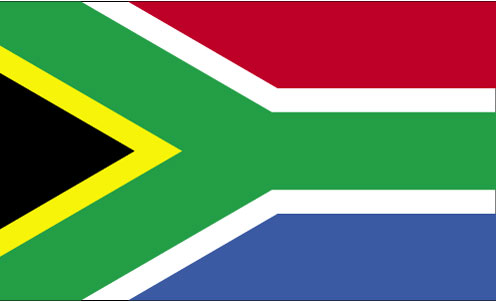
Flag, anthem, and other symbols of national identity.