English
 Español
 中文
中文 हिन्दी
 Français
Government and Politics
Government and Politics of Ethiopia
Government structure, leadership, capital, military, and national symbols of Ethiopia.
Government Structure
Constitutional foundations, branches, parties, and leadership.
- Government Type
- federal republic
- Administrative Divisions
- 9 ethnically-based states (kililoch, singular - kilil) and 2 self-governing administrations* (astedaderoch, singular - astedader); Adis Abeba* (Addis Ababa), Afar, Amara (Amhara), Binshangul Gumuz, Dire Dawa*, Gambela Hizboch (Gambela Peoples), Hareri Hizb (Harari People), Oromiya (Oromia), Sumale (Somali), Tigray, Ye Debub Biheroch Bihereseboch na Hizboch (Southern Nations, Nationalities and Peoples)
- Legal System
- currently transitional mix of national and regional courts
- Suffrage
- 18 years of age; universal
- Citizenship
- Citizenship by birth: No Citizenship by descent only: At least one parent must be a citizen of Ethiopia Dual citizenship recognized: No Residency requirement for naturalization: 4 years
- Executive Branch
- chief of state: President SAHLE-WORK Zewde (since 25 October 2018) head of government: Prime Minister ABIY Ahmed Ali (since 2 April 2018) cabinet: Council of Ministers as provided for in the December 1994 constitution; ministers are selected by the prime minister and approved by the House of People's Representatives elections: president elected by the House of People's Representatives for a six-year term; prime minister designated by the party in power following legislative elections election results: SAHLE-WORK Zewde elected president unanimously by the House of People's Representatives; she is the first woman to serve as head of state in Ethiopia and the only woman currently serving as a head of state in Africa
- Legislative Branch
- bicameral Parliament consists of the House of Federation or upper chamber (108 seats; members are chosen by state assemblies to serve five-year terms) and the House of People's Representatives or lower chamber (547 seats; members are directly elected by popular vote from single-member districts to serve five-year terms) elections: last held 15 May 2005 (next to be held in 2010) election results: percent of vote - NA%; seats by party - EPRDF 327, CUD 109, UEDF 52, SPDP 23, OFDM 11, BGPDUF 8, ANDP 8, independent 1, others 6, undeclared 2 note: irregularities at some polling stations necessitated the rescheduling of voting in certain constituencies
- Judicial Branch
- Federal Supreme Court (the president and vice president of the Federal Supreme Court are recommended by the prime minister and appointed by the House of People's Representatives; for other federal judges, the prime minister submits to the House of People's Representatives for appointment candidates selected by the Federal Judicial Administrative Council)
- Political Parties
- Afar National Democratic Party or ANDP [leader NA]; Benishangul Gumuz People's Democratic Unity Front or BGPDUF [Mulualem BESSE]; Coalition for Unity and Democracy or CUD [HAILU Shawel]; Ethiopian People's Revolutionary Democratic Front or EPRDF [MELES Zenawi] (an alliance of Amhara National Democratic Movement or ANDM, Oromo People's Democratic Organization or OPDO, the South Ethiopean People's Democratic Front or SEPDF, and TigrAyan Peoples' Liberation Front or TPLF); Gurage Nationalities' Democratic Movement or GNDM [leader NA]; Oromo Federalist Democratic Movement or OFDM [BULCHA Demeksa]; Somali People's Democratic Party or SPDP [leader NA]; United Ethopian Democratic Forces or UEDF [BEYENE Petros]; dozens of small parties
- Head of State
- President GIRMA Woldegiorgis
- Head of Government
- Prime Minister MELES Zenawi
- Cabinet
- Council of Ministers as provided for in the December 1994 constitution; ministers are selected by the prime minister and approved by the House of People’s Representatives
- Elections
- president elected by the House of People’s Representatives for a six-year term (eligible for a second term); election last held 9 October 2007 (next to be held in October 2013); prime minister designated by the party in power following legislative elections
- Election Results
- GIRMA Woldegiorgis elected president; percent of vote by the House of People’s Representatives - 79%
- Constitution
- ratified December 1994; effective 22 August 1995
- Independence
- oldest independent country in Africa and one of the oldest in the world - at least 2,000 years
- National Holiday
- National Day (defeat of MENGISTU regime), 28 May (1991)
- International Organization Participation
- ACP, AfDB, AU, FAO, G-24, G-77, IAEA, IBRD, ICAO, ICRM, IDA, IFAD, IFC, IFRCS, IGAD, ILO, IMF, IMO, Interpol, IOC, IOM (observer), ISO, ITU, NAM, OPCW, PCA, UN, UNCTAD, UNESCO, UNHCR, UNIDO, UNMIL, UPU, WCO, WFTU, WHO, WIPO, WMO, WToO, WTrO (observer)
- Diplomatic Representation in the U.S.
- chief of mission: Ambassador KASSAHUN Ayele chancery: 3506 International Drive NW, Washington, DC 20008 telephone: [1] (202) 364-1200 FAX: [1] (202) 686-9551 consulate(s) general: Los Angeles consulate(s): New York
- U.S. Diplomatic Representation
- chief of mission: Ambassador (vacant); Charge d'Affaires Vicki HUDDLESTON embassy: Entoto Street, Addis Ababa mailing address: P. O. Box 1014, Addis Ababa telephone: [251] (1) 517-4000 FAX: [251] (1) 517-4888
Capital City
Seat of government and political history.
- Capital City
- Addis Ababa
- Location
- 9 02 N, 38 42 E
- Time Difference
- UTC+3 (8 hours ahead of Washington, DC, during Standard Time)
- History
- The name in Amharic means "new flower" and was bestowed on the city in 1889, three years after its founding
Embassy and Diplomatic Representation
Embassy location and contact details.
U.S. Embassy Addis Ababa, Ethiopia Telephone: 251- 11 130-6000 Emergency after-hours telephone: 011 130-6000 Facsimile: 251- 11 124-2435and 251- 11 124-2419
Military
Branches, service obligations, expenditures, and manpower.
- Military Branches
- Ethiopian National Defense Force (ENDF): Ground Forces, Ethiopian Air Force (Ye Ityopya Ayer Hayl, ETAF)
- Service Age and Obligation
- 18 years of age for voluntary military service; no compulsory military service, but the military can conduct callups when necessary and compliance is compulsory
National Symbols
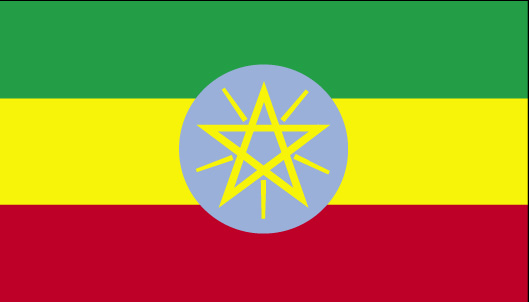
Flag, anthem, and other symbols of national identity.