English
 Español
 中文
中文 हिन्दी
 Français
Government and Politics
Government and Politics of Rwanda
Government structure, leadership, capital, military, and national symbols of Rwanda.
Government Structure
Constitutional foundations, branches, parties, and leadership.
- Government Type
- republic; presidential, multiparty system
- Administrative Divisions
- 12 prefectures (in French - prefectures, singular - prefecture; in Kinyarwanda - plural - NA, singular - prefegitura); Butare, Byumba, Cyangugu, Gikongoro, Gisenyi, Gitarama, Kibungo, Kibuye, Kigali Rurale, Kigali-ville, Umutara, Ruhengeri
- Legal System
- based on German and Belgian civil law systems and customary law; judicial review of legislative acts in the Supreme Court; has not accepted compulsory ICJ jurisdiction
- Suffrage
- 18 years of age; universal adult
- Citizenship
- citizenship by birth: no citizenship by descent only: the father must be a citizen of Rwanda; if the father is stateless or unknown, the mother must be a citizen dual citizenship recognized: no residency requirement for naturalization: 10 years
- Executive Branch
- chief of state: President Paul KAGAME (since 22 April 2000) head of government: Prime Minister Bernard MAKUZA (since 8 March 2000) cabinet: Council of Ministers appointed by the president elections: President elected by popular vote for a seven-year term; elections last held 25 August 2003 (next to be held NA 2008) election results: Paul KAGAME elected president in first direct popular vote; Paul KAGAME 95.05%, Faustin TWAGIRAMUNGU 3.62%, Jean-Nepomuscene NAYINZIRA 1.33%
- Legislative Branch
- bicameral Parliament consists of Senate (26 seats; 12 members elected local councils, 8 appointed by the president, 4 by the Political Organizations Forum, 2 represent institutions of higher learning, to serve eight-year terms) and Chamber of Deputies (80 seats; 53 members elected by popular vote, 24 women elected by local bodies, 3 selected by youth and disability organizations, to serve five-year terms) elections: Senate - last held NA, members appointed as part of the transitional government (next to be held in 2011); Chamber of Deputies - last held 29 September 2003 (next to be held in 2008) election results: seats by party under the 2003 Constitution - RPF 40, PSD 7, PL 6, additional 27 members indirectly elected
- Judicial Branch
- Supreme Court; High Courts of the Republic; Provincial Courts; District Courts; mediation committees
- Political Parties
- Centrist Democratic Party or PDC [Alfred MUKEZAMFURA]; Democratic Popular Union of Rwanda or UDPR [Adrien RANGIRA]; Democratic Republican Movement or MDR (officially banned) [Celestin KABANDA]; Islamic Democratic Party or PDI [Andre BUMAYA]; Liberal Party or PL [Prosper HIGIRO]; Party for Democratic Renewal (officially banned) [leader NA]; Rwandan Patriotic Front or RPF [Paul KAGAME]; Social Democratic Party or PSD [Vincent BIRUTA]
- Head of State
- Paul KAGAME
- Head of Government
- Bernard MAKUZA
- Cabinet
- Council of Ministers appointed by the president
- Elections
- President elected by popular vote for a seven-year term (eligible for a second term); elections last held 25 August 2003 (next to be held in 2010)
- Election Results
- Paul KAGAME elected president in first direct popular vote; Paul KAGAME 95.05%, Faustin TWAGIRAMUNGU 3.62%, Jean-Nepomuscene NAYINZIRA 1.33%
- Constitution
- on 5 May 1995, the Transitional National Assembly adopted as Fundamental Law the constitution of 18 June 1991, provisions of the 1993 Arusha peace accord, the July 1994 Declaration by the Rwanda Patriotic Front, and the November 1994 multiparty protocol of understanding
- Independence
- 1 July 1962 (from Belgium-administered UN trusteeship)
- National Holiday
- Independence Day, 1 July (1962)
- International Organization Participation
- ACCT, ACP, AfDB, AU, CEPGL, FAO, G-77, IBRD, ICAO, ICFTU, ICRM, IDA, IFAD, IFC, IFRCS, ILO, IMF, Interpol, IOC, IOM, ISO (correspondent), ITU, NAM, OPCW (signatory), UN, UNCTAD, UNESCO, UNIDO, UPU, WCL, WCO, WHO, WIPO, WMO, WToO, WTrO
- Diplomatic Representation in the U.S.
- chief of mission: Ambassador Zac NSENGA chancery: 1714 New Hampshire Avenue NW, Washington, DC 20009 telephone: [1] (202) 232-2882 FAX: [1] (202) 232-4544
- U.S. Diplomatic Representation
- chief of mission: Ambassador Michael ARIETTI embassy: 337 Boulevard de la Revolution, Kigali mailing address: B. P. 28, Kigali telephone: [250] 50 56 01 through 03 FAX: [250] 57 2128
Capital City
Seat of government and political history.
- Capital City
- Kigali
- Location
- 1 57 S, 30 03 E
- Time Difference
- UTC+2 (7 hours ahead of Washington, DC, during Standard Time)
- History
- the city takes its name from nearby Mount Kigali; the name "Kigali" is composed of the Bantu prefix ki and the Rwandan gali meaning "broad" and likely refers to the broad, sprawling hill that has been dignified with the title of "mount"
Embassy and Diplomatic Representation
Embassy location and contact details.
U.S. Embassy Kigali 2657 Avenue de la Gendarmerie Kigali, Rwanda Telephone: 250 (252) 596-400 Facsimile: 250 (252) 596-591 Mailing address: B.P. 28, Kigali, Rwanda Consular Section e-mail: consularkigali@state.gov. American Citizen Services hours: Tuesdays from 8:00 - 12:00 and Fridays from 8:00 - 12:00 by appointment. The Embassy is closed on U.S. and Rwandan holidays.
Military
Branches, service obligations, expenditures, and manpower.
- Military Branches
- Rwanda Defense Force (RDF): Rwanda Army (Rwanda Land Force), Rwanda Air Force (Force Aerienne Rwandaise, FAR)
- Service Age and Obligation
- 18 years of age for voluntary military service; no conscription; Rwandan citizenship is required, as is a 9th grade education for enlisted recruits and an A-level certificate for officer candidates; enlistment is either as contract (5-years, renewable twice) or career; retirement (for officers and senior NCOs) after 20 years of service or at 40-60 years of age
National Symbols
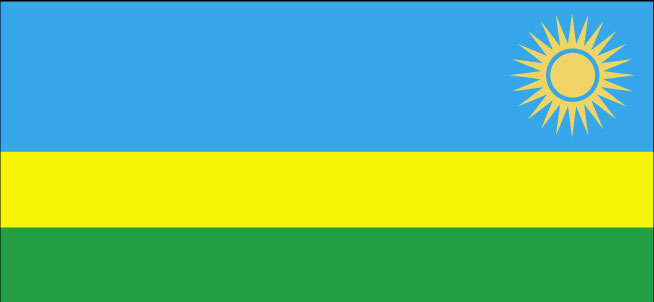
Flag, anthem, and other symbols of national identity.