English
 Español
 中文
中文 हिन्दी
 Français
Government and Politics
Government and Politics of Afghanistan
Government structure, leadership, capital, military, and national symbols of Afghanistan.
Government Structure
Constitutional foundations, branches, parties, and leadership.
- Government Type
- Islamic republic
- Administrative Divisions
- 32 provinces (velayat, singular - velayat); Badakhshan, Badghis, Baghlan, Balkh, Bamian, Farah, Faryab, Ghazni, Ghowr, Helmand, Herat, Jowzjan, Kabol, Kandahar, Kapisa, Khowst, Konar, Kondoz, Laghman, Lowgar, Nangarhar, Nimruz, Nurestan, Oruzgan, Paktia, Paktika, Parvan, Samangan, Sar-e Pol, Takhar, Vardak, and Zabol
- Legal System
- according to the new constitution, no law is contrary to Islam; the state is obliged to create a prosperous and progressive society based on social justice, protection of human dignity, protection of human rights, realization of democracy, and to ensure national unity and equality among all ethnic groups and tribes; the state shall abide by the UN charter, international treaties, international conventions that Afghanistan signed, and the Universal Declaration of Human Rights
- Suffrage
- 18 years of age; universal
- Citizenship
- citizenship by birth: no citizenship by descent only: at least one parent must have been born in - and continuously lived in - Afghanistan dual citizenship recognized: no residency requirement for naturalization: 5 years
- Executive Branch
- chief of state: President of the Islamic Republic of Afghanistan Hamid KARZAI (since 7 December 2004); note - the president is both the chief of state and head of government; former King ZAHIR Shah holds the honorific, “Father of the Country,” and presides symbolically over certain occasions, but lacks any governing authority; the honorific is not hereditary head of government: President of the Islamic Republic of Afghanistan Hamid KARZAI (since 7 December 2004); note - the president is both chief of state and head of government cabinet: 27 ministers; note - under the new constitution, ministers are appointed by the president and approved by the National Assembly elections: the president and two vice presidents are elected by direct vote for a five-year term; if no candidate receives 50% or more of the vote in the first round of voting, the two candidates with the most votes will participate in a second round; a president can only be elected for two terms; election last held 9 October 2004 (next to be held in 2009) election results: Hamid KARZAI elected president; percent of vote - Hamid KARZAI 55.4%, Yunus QANOONI 16.3%, Ustad Mohammad MOHAQQEQ 11.6%, Abdul Rashid DOSTAM 10.0%, Abdul Latif PEDRAM 1.4%, Masooda JALAL 1.2%
- Legislative Branch
- the bicameral National Assembly consists of the Wolesi Jirga or House of People (no more than 249 seats), directly elected for five-year terms, and the Meshrano Jirga or House of Elders (102 seats, one-third elected from provincial councils for four-year terms, one-third elected from local district councils for three-year terms - provincial councils elected temporary members to fill these seats until district councils are formed, and one-third presidential appointees for five-year terms; the presidential appointees will include 2 representatives of Kuchis and 2 representatives of the disabled; half of the presidential appointees will be women) note: on rare occasions the government may convene a Loya Jirga (Grand Council) on issues of independence, national sovereignty, and territorial integrity; it can amend the provisions of the constitution and prosecute the president; it is made up of members of the National Assembly and chairpersons of the provincial and district councils elections: last held 18 September 2005 (next to be held for the Wolesi Jirga by September 2009; next to be held for the provincial councils to the Meshrano Jirga by September 2008) election results: the single non-transferable vote (SNTV) system used in the election did not make use of political party slates; most candidates ran as independents
- Judicial Branch
- the new constitution establishes a nine-member Stera Mahkama or Supreme Court (its nine justices are appointed for 10-year terms by the president with approval of the Wolesi Jirga) and subordinate High Courts and Appeals Courts; there is also a Minister of Justice; a separate Afghan Independent Human Rights Commission established by the Bonn Agreement is charged with investigating human rights abuses and war crimes
- Political Parties
- note - includes only political parties approved by the Ministry of Justice: Afghan Millat [Anwarul Haq AHADI]; De Afghanistan De Solay Ghorzang Gond [Shahnawaz TANAI]; De Afghanistan De Solay Mili Islami Gond [Shah Mahmood Polal ZAI]; Harakat-e-Islami Afghanistan [Mohammad Asif MOHSINEE]; Hezb-e-Aarman-e-Mardum-e-Afghanistan [Iihaj Saraj-u-din ZAFAREE]; Hezb-e-Aazadee Afghanistan [Abdul MALIK]; Hezb-e-Adalat-e-Islami Afghanistan [Mohammad Kabeer MARZBAN]; Hezb-e-Afghanistan-e-Wahid [Mohammad Wasil RAHEEMEE]; Hezb-e-Afghan Watan Islami Gond [leader NA]; Hezb-e-Congra-e-Mili Afghanistan [Latif PEDRAM]; Hezb-e-Falah-e-Mardum-e-Afghanistan [Mohammad ZAREEF]; Hezb-e-Libral-e-Aazadee Khwa-e-Mardum-e-Afghanistan [Ajmal SOHAIL]; Hezb-e-Hambastagee Mili Jawanan-e-Afghanistan [Mohammad Jamil KARZAI]; Hezb-e-Hamnbatagee-e-Afghanistan [Abdul Khaleq NEMAT]; Hezb-e-Harakat-e-Mili Wahdat-e-Afghanistan [Mohammad Nadir AATASH]; Hezb-e-Harak-e-Islami Mardum-e-Afghanistan [Ilhaj Said Hssain ANWARY]; Hezb-e-Ifazat Az Uqoq-e-Bashar Wa Inkishaf-e-Afghanistan [Baryalai NASRATEE]; Hezb-e-Istiqlal-e-Afghanistan [Dr. Gh. Farooq NIJZRABEE]; Hezb-e-Jamhoree Khwahan [Sibghatullah SANJAR]; Hezb-e-Kar Wa Tawsiha-e-Afghanistan [Zulfiar OMID]; Hezb-e-Mili Afghanistan [Abdul Rasheed AARYAN]; Hezb-e-Mili Wahdat-e-Aqwam-e-Islami Afghanistan [Mohammad Shah KHOGYANEE]; Hezb-e-Nuhzhat-e-Mili Afghanistan [Ahmad Wali MASOUD]; Hezb-e-Paiwand-e-Mili Afghanistan [Said Mansoor NADIRI]; Hezb-e-Rastakhaiz-e-Islami Mardum-e-Afghanistan [Said ZAHIR]; Hezb-e-Refah-e-Mardum-e-Afghanistan [Mia Gul WASEEQ]; Hezb-e-Risalat-e-Mardum-e-Afghanistan [Noor Aqa ROEEN]; Hezb-e-Sahadat-e-Mardum-e-Afghanistan [Mohammad Zubair PAIROZ]; Hezb-e-Sahadat-e-Mili Wa Islami Afghanistan [Mohammad Usman SALIGZADA]; Hezb-e-Sulh-e-Mili Islami Aqwam-e-Afghanistan [Abdul Qahir SHARYATEE]; Hezb-e-Sulh Wa Wahdat-e-Mili Afghanistan [Abdul Qadir IMAMEE]; Hezb-e-Tafahum-e-Wa Democracy Afghanistan [Ahamad SHAHEEN]; Hezb-e-Wahdat-e-Islami Afghanistan [Mohammad Karim KHALILI]; Hezb-e-Wahdat-e-Islami Mardum-e-Afghanistan [Ustad Mohammad MOHAQQEQ]; Hezb-e-Wahdat-e-Mili Afghanistan [Abdul Rasheed Jalili]; Jamahat-ul-Dahwat ilal Qurhan-wa-Sunat-ul-Afghanistan [Mawlawee Samiullah NAJEEBEE]; Jombesh-e Milli [Abdul Rashid DOSTAM]; Mahaz-e-Mili Islami Afghanistan [Said Ahmad GAILANEE]; Majmah-e-Mili Fahaleen-e-Sulh-e-Afghanistan [Shams ul Haq Noor SHAMS]; Nuhzat-e-Aazadee Wa democracy Afghanistan [Abdul Raqeeb Jawid KUHISTANEE]; Nuhzat-e-Hambastagee Mili Afghanistan [Peer Said Ishaq GAILANEE]; Sazman-e-Islami Afghanistan-e-Jawan [Siad Jawad HUSSAINEE]; Tahreek Wahdat-e-Mili [Sultan Mahmood DHAZI] (30 Sep 2004)
- Head of State
- President Hamid Karzai
- Head of Government
- President Hamid Karzai
- Cabinet
- 25 ministers; note - under the new constitution, ministers are appointed by the president and approved by the National Assembly
- Elections
- the president and two vice presidents are elected by direct vote for a five-year term (eligible for a second term); if no candidate receives 50% or more of the vote in the first round of voting, the two candidates with the most votes will participate in a second round; a president can only be elected for two terms; election last held 9 October 2004 (next to be held in 2009)
- Election Results
- Hamid KARZAI reelected president; percent of vote - Hamid KARZAI 49.67%, Abdullah ABDULLAH 30.59%, Ramazan BASHARDOST 10.46%, Ashraf GHANI 2.94%; other 6.34%
- Constitution
- new constitution drafted 14 December 2003 - 4 January 2004; signed 16 January 2004
- Independence
- 19 August 1919 (from UK control over Afghan foreign affairs)
- National Holiday
- Coral Sea Islands
- International Organization Participation
- AsDB, CP, ECO, FAO, G-77, GUUAM, IAEA, IBRD, ICAO, ICCt, ICRM, IDA, IDB, IFAD, IFC, IFRCS, ILO, IMF, Interpol, IOC, IOM (observer), ITU, NAM, OIC, OPCW, OSCE, UN, UNCTAD, UNESCO, UNIDO, UPU, WFTU, WHO, WMO, WToO
- Diplomatic Representation in the U.S.
- chief of mission: Ambassador Said Tayeb JAWAD chancery: 2341 Wyoming Avenue NW, Washington, DC 20008 telephone: [1] 202-483-6410 FAX: [1] 202-483-6488 consulate(s) general: Los Angeles, New York
- U.S. Diplomatic Representation
- chief of mission: Ambassador Zalmay KHALILZAD embassy: The Great Masood Road, Kabul mailing address: 6180 Kabul Place, Dulles, VA 20189-6180 telephone: [00] (2) 230-0436 FAX: [0093] (2) 230-1364
Capital City
Seat of government and political history.
- Capital City
- Kabul
- Location
- 34 31 N, 69 11 E
- Time Difference
- UTC+4.5 (9.5 hours ahead of Washington, DC, during Standard Time)
- History
- named for the Kabul River, but the river's name is of unknown origin
Embassy and Diplomatic Representation
Embassy location and contact details.
The U.S. Embassy in Kabul Great Massoud (Airport) Road Telephone: 93 (0)700-108-001 or 93 (0)700-108-002 Emergency after-hours telephone: 93 (0)700-108-001 E-mail: KabulACS@state.gov
Military
Branches, service obligations, expenditures, and manpower.
- Military Branches
- Afghan Armed Forces: Afghan National Army (ANA, includes Afghan Air Force (AAF))
- Service Age and Obligation
- 18 is the legal minimum age for voluntary military service; no conscription
National Symbols
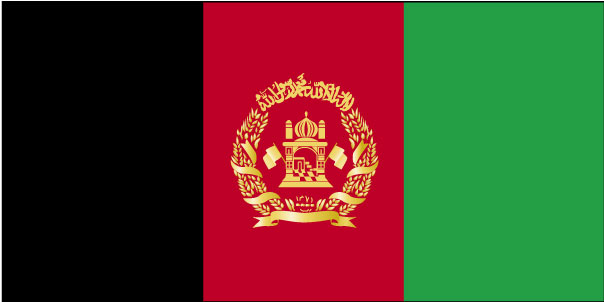
Flag, anthem, and other symbols of national identity.