English
 Español
 中文
中文 हिन्दी
 Français
Government and Politics
Government and Politics of Bhutan
Government structure, leadership, capital, military, and national symbols of Bhutan.
Government Structure
Constitutional foundations, branches, parties, and leadership.
- Government Type
- monarchy; special treaty relationship with India
- Administrative Divisions
- 18 districts (dzongkhag, singular and plural); Bumthang, Chhukha, Chirang, Dagana, Geylegphug, Ha, Lhuntshi, Mongar, Paro, Pemagatsel, Punakha, Samchi, Samdrup Jongkhar, Shemgang, Tashigang, Thimphu, Tongsa, Wangdi Phodrang
- Legal System
- based on Indian law and English common law; has not accepted compulsory ICJ jurisdiction
- Suffrage
- each family has one vote in village-level elections; note - in late 2003 Bhutan's legislature passed a new election law, though no elections have been held
- Citizenship
- citizenship by birth: no citizenship by descent only: the father must be a citizen of Bhutan dual citizenship recognized: no residency requirement for naturalization: 10 years
- Executive Branch
- chief of state: King Jigme Singye WANGCHUCK (since 24 July 1972) head of government: Chairman of the Council of Ministers Sangay NGEDUP (since 5 September 2005) cabinet: Council of Ministers (Lhengye Shungtsog) nominated by the monarch, approved by the National Assembly; members serve fixed, five-year terms; note - there is also a Royal Advisory Council (Lodoi Tsokde), members nominated by the monarch elections: none; the monarch is hereditary, but democratic reforms in July 1998 grant the National Assembly authority to remove the monarch with two-thirds vote
- Legislative Branch
- unicameral National Assembly or Tshogdu (150 seats; 105 elected from village constituencies, 10 represent religious bodies, and 35 are designated by the monarch to represent government and other secular interests; members serve three-year terms) elections: local elections last held August 2005 (next to be held in 2008) election results: NA
- Judicial Branch
- Supreme Court of Appeal (the monarch); High Court (judges appointed by the monarch)
- Political Parties
- no legal parties
- Head of State
- King Jigme Khesar Namgyel WANGCHUCK
- Head of Government
- Prime Minister Jigme THINLEY
- Cabinet
- Council of Ministers (Lhengye Shungtsog) nominated by the monarch, approved by the National Assembly; members serve fixed, five-year terms; note - there is also a Royal Advisory Council (Lodoi Tsokde), members nominated by the monarch
- Elections
- the monarch is hereditary, but democratic reforms in July 1998 grant the National Assembly authority to remove the monarch with two-thirds vote; election of a new National Assembly occurred in March 2008; the leader of the majority party is nominated as the prime minister
- Constitution
- no written constitution or bill of rights; note - in 2001 the King commissioned the drafting of a constitution, which is to become effective in 2005
- Independence
- 8 August 1949 (from India)
- National Holiday
- National Day (Ugyen WANGCHUCK became first hereditary king), 17 December (1907)
- International Organization Participation
- AsDB, CP, FAO, G-77, IBRD, ICAO, IDA, IFAD, IMF, IOC, IOM (observer), ITU, NAM, OPCW (signatory), SAARC, UN, UNCTAD, UNESCO, UNIDO, UPU, WCO, WHO, WIPO, WMO, WToO, WTrO (observer)
- Diplomatic Representation in the U.S.
- none; note - Bhutan has a Permanent Mission to the UN; address: 2 United Nations Plaza, 27th Floor, New York, NY 10017; telephone [1] (212) 826-1919; FAX [1] (212) 826-2998; the Bhutanese mission to the UN has consular jurisdiction in the US consulate(s) general: New York
- U.S. Diplomatic Representation
- the US and Bhutan have no formal diplomatic relations, although informal contact is maintained between the Bhutanese and US Embassy in New Delhi (India)
Capital City
Seat of government and political history.
- Capital City
- Thimphu
- Location
- 27 28 N, 89 38 E
- Time Difference
- UTC+6 (11 hours ahead of Washington, DC, during Standard Time)
- History
- the origins of the name are unclear; the traditional explanation, dating to the 14th century, is that thim means "dissolve" and phu denotes "high ground" to express the meaning of "dissolving high ground," in reference to a local deity that dissolved before a traveler's eyes, becoming a part of the rock on which the present city stands
Embassy and Diplomatic Representation
Embassy location and contact details.
There is no U.S. Embassy or Consulate in Bhutan. Although no formal diplomatic relations exist between the United States and Bhutan, engagement is maintained through the U.S. Embassy in New Delhi, India. Updated information on travel and security in Bhutan may be obtained at the U.S. Embassy in New Delhi. The U.S. Embassy in New Delhi is located on Shanti Path, Chanakya Puri, New Delhi 110 021, India, telephone (91)(11) 2419-8000, fax (91)(11) 2419-8407. In the case of an emergency involving a U.S. citizen, please call the 24-hour operator at (91)(11) 2419-8000 and ask for American Citizen Services.
Military
Branches, service obligations, expenditures, and manpower.
- Military Branches
- Royal Bhutan Army (includes Royal Bodyguard and Royal Bhutan Police)
- Service Age and Obligation
- 18 years of age for voluntary military service; no conscription; militia training is compulsory for males aged 20-25, over a 3-year period
National Symbols
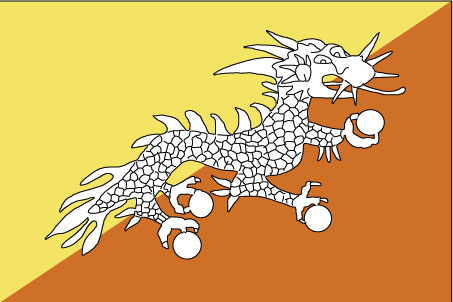
Flag, anthem, and other symbols of national identity.