English
 Español
 中文
中文 हिन्दी
 Français
Government and Politics
Government and Politics of Myanmar
Government structure, leadership, capital, military, and national symbols of Myanmar.
Government Structure
Constitutional foundations, branches, parties, and leadership.
- Government Type
- military regime
- Administrative Divisions
- 7 divisions* (taing-myar, singular - taing) and 7 states (pyi ne-myar, singular - pyi ne); Chin State, Ayeyarwady*, Bago*, Kachin State, Kayin State, Kayah State, Magway*, Mandalay*, Mon State, Rakhine State, Sagaing*, Shan State, Tanintharyi*, Yangon*
- Legal System
- has not accepted compulsory ICJ jurisdiction
- Suffrage
- 18 years of age; universal
- Citizenship
- citizenship by birth: no citizenship by descent only: both parents must be citizens of Burma dual citizenship recognized: no residency requirement for naturalization: none note: an applicant for naturalization must be the child or spouse of a citizen
- Executive Branch
- chief of state: Senior General MIN AUNG HLAING, Chairman of the State Administration Council (SAC), serving as both head of state and head of government following the military coup of February 1, 2021 (since August 1, 2021, when he assumed the role of Prime Minister in addition to SAC Chairman) head of government: Prime Minister Sr. Gen. MIN AUNG HLAING (since August 1, 2021); prior to the coup, State Counsellor AUNG SAN SUU KYI served as de facto head of government from 2016 until her detention on February 1, 2021 cabinet: The State Administration Council (SAC), established following the February 2021 military coup, serves as the ruling body; the SAC suspended the constitution, detained elected civilian leaders, and declared a state of emergency that has been repeatedly extended; the military, known as the Tatmadaw, previously ruled under the State Peace and Development Council (SPDC) from 1997 to 2011 elections: The SAC annulled the results of the November 2020 general elections, which the National League for Democracy (NLD) had won by a landslide; no credible national elections have been held since; the military has repeatedly postponed a promised return to democratic elections, and the political situation remains highly unstable amid ongoing armed conflict across the country
- Legislative Branch
- unicameral People's Assembly or Pyithu Hluttaw (485 seats; members elected by popular vote to serve four-year terms) elections: last held 27 May 1990, but Assembly never allowed by junta to convene election results: percent of vote by party - NA; seats by party - NLD 392 (opposition), SNLD 23 (opposition), NUP 10 (pro-government), other 60
- Judicial Branch
- remnants of the British-era legal system are in place, but there is no guarantee of a fair public trial; the judiciary is not independent of the executive
- Political Parties
- National League for Democracy or NLD [AUNG SHWE, chairman, AUNG SAN SUU KYI, general secretary]; National Unity Party or NUP (pro-regime) [THA KYAW] (at last report); Shan Nationalities League for Democracy or SNLD [HKUN HTUN OO]; and other smaller parties
- Head of State
- Chairman of the State Peace and Development Council (SPDC) Sr. Gen. THAN SHWE
- Head of Government
- Prime Minister, Lt. Gen THEIN SEIN
- Cabinet
- Cabinet is overseen by SPDC; military junta assumed power 18 September 1988 under name State Law and Order Restoration Council (SLORC)
- Constitution
- 3 January 1974 (suspended since 18 September 1988); national convention started on 9 January 1993 to draft a new constitution; progress has since been stalled
- Independence
- 4 January 1948 (from UK)
- National Holiday
- Independence Day, 4 January (1948)
- International Organization Participation
- ARF, AsDB, ASEAN, CP, FAO, G-77, IAEA, IBRD, ICAO, ICRM, IDA, IFAD, IFC, IFRCS, IHO, ILO, IMF, IMO, Interpol, IOC, ITU, NAM, OPCW (signatory), UN, UNCTAD, UNESCO, UNIDO, UPU, WCO, WHO, WIPO, WMO, WTrO
- Diplomatic Representation in the U.S.
- chief of mission: Ambassador (vacant); Charge d'Affaires MYINT LWIN chancery: 2300 S Street NW, Washington, DC 20008 telephone: [1] (202) 332-3344 FAX: [1] (202) 332-4351 consulate(s) general: New York
- U.S. Diplomatic Representation
- chief of mission: Ambassador (vacant); Charge d'Affaires Shari VILLAROSA embassy: 581 Merchant Street, Rangoon (GPO 521) mailing address: Box B, APO AP 96546 telephone: [95] (1) 379-880, 379-881 FAX: [95] (1) 256-018
Capital City
Seat of government and political history.
- Capital City
- Rangoon (aka Yangon, continues to be recognized as the primary Burmese capital by the US Government); Nay Pyi Taw is the administrative capital
- Location
- 16 48 N, 96 10 E
- Time Difference
- UTC+6.5 (11.5 hours ahead of Washington, DC, during Standard Time)
- History
- Rangoon/Yangon derives from the Burmese words yan and koun, which mean "danger" and "no more" respectively and provide the meaning of "end of strife"; Nay Pyi Taw translates as: "Abode of Royals" or "the capital city of a kingdom"
Embassy and Diplomatic Representation
Embassy location and contact details.
U.S. Embassy Rangoon 110 University Avenue Kamayut Township Rangoon, Burma The Consular Section is open from 8:00 am to 5:00 pm, with non-emergency American Citizens Services from 2:00 to 3:30 pm, Monday through Friday except on U.S. and Burmese holidays. Consular Section Telephone: (95-1) 536-509 ext. 4240 Email: consularrangoon@state.gov Website: www.burma.usembassy.gov After-hours Emergency Numbers: (95-1) 536-509 ext. 4014 or 09-512-4330
Military
Branches, service obligations, expenditures, and manpower.
- Military Branches
- Myanmar Armed Forces (Tatmadaw): Army (Tatmadaw Kyi), Navy (Tatmadaw Yay), Air Force (Tatmadaw Lay)
- Service Age and Obligation
- 18-35 years of age (men) and 18-27 years of age (women) for voluntary military service; no conscription (a 2010 law reintroducing conscription has not yet entered into force); service obligation 2 years; male (ages 18-45) and female (ages 18-35) professionals (including doctors, engineers, mechanics) serve up to 3 years; service terms may be stretched to 5 years in an officially declared emergency; Burma signed the Convention on the Rights of the Child (CRC) on 15 August 1991; on 27 June 2012, the regime signed a Joint Action Plan on prevention of child recruitment; in February 2013, the military formed a new task force to address forced child conscription, which reportedly continues
National Symbols
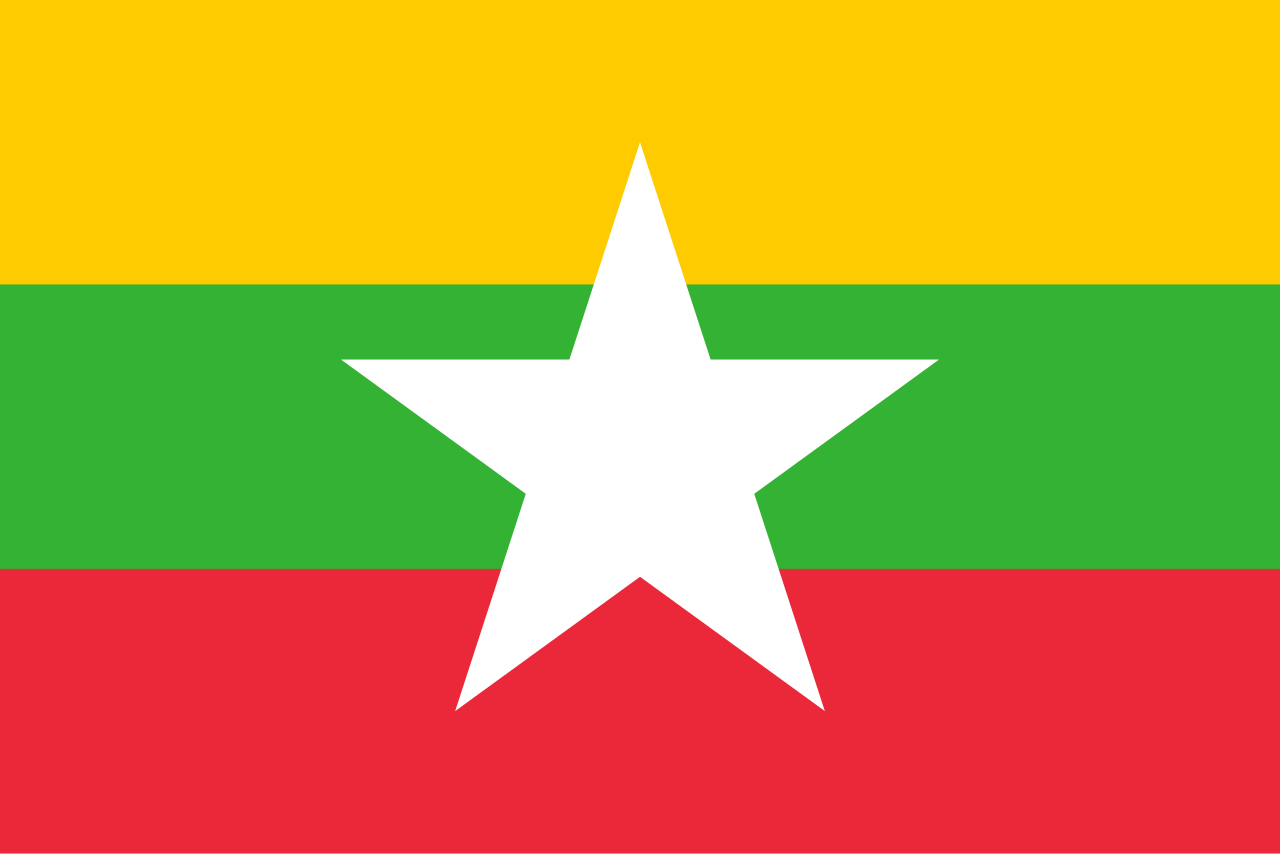
Flag, anthem, and other symbols of national identity.