English
 Español
 中文
中文 हिन्दी
 Français
Government and Politics
Government and Politics of Burundi
Government structure, leadership, capital, military, and national symbols of Burundi.
Government Structure
Constitutional foundations, branches, parties, and leadership.
- Government Type
- republic
- Administrative Divisions
- 16 provinces; Bubanza, Bujumbura, Bururi, Cankuzo, Cibitoke, Gitega, Karuzi, Kayanza, Kirundo, Makamba, Muramvya, Muyinga, Mwaro, Ngozi, Rutana, Ruyigi
- Legal System
- based on German and Belgian civil codes and customary law; has not accepted compulsory ICJ jurisdiction
- Suffrage
- NA years of age; universal adult
- Citizenship
- citizenship by birth: no citizenship by descent only: the father must be a citizen of Burundi dual citizenship recognized: no residency requirement for naturalization: 10 years
- Executive Branch
- chief of state: President Evariste NDAYISHIMIYE (since 18 June 2020); note - NDAYISHIMIYE won the May 2020 presidential election following the death of longtime President Pierre NKURUNZIZA, who died on 8 June 2020 before the official transfer of power head of government: President Evariste NDAYISHIMIYE (since 18 June 2020); First Vice President Prosper BAZOMBANZA (since 24 June 2020); Second Vice President Joseph BUTORE (since 24 June 2020) cabinet: Council of Ministers appointed by the president elections: the president is elected by popular vote to a seven-year term, renewable once; vice presidents nominated by the president and endorsed by parliament; the 2018 revised constitution extended the presidential term from five to seven years and reset term limits, allowing the incumbent to serve two additional terms under the new rules election results: Evariste NDAYISHIMIYE was elected president in the May 20, 2020 election with approximately 68% of the vote, defeating his closest rival Agathon RWASA of the CNL party, who received approximately 24% of the vote
- Legislative Branch
- bicameral Parliament or Parlement, consists of a National Assembly or Assemblee Nationale (minimum 100 seats - 60% Hutu and 40% Tutsi with at least 30% being women; additional seats appointed by a National Independent Electoral Commission to ensure ethnic representation; members are elected by popular vote to serve five-year terms) and a Senate (54 seats; 34 by indirect vote to serve five year terms, with remaining seats assigned to ethnic groups and former chiefs of state) elections: National Assembly - last held 4 July 2005 (next to be held in 2010); Senate - last held 29 July 2005 (next to be held in 2010) election results: National Assembly - percent of vote by party - CNDD-FDD 58.6%, FRODEBU 21.7%, UPRONA 7.2%, CNDD 4.1%, MRC-Rurenzangemero 2.1%, others 6.2%; seats by party - CNDD-FDD 59, FRODEBU 25, UPRONA 10, CNDD 4, MRC-Rurenzangemero 2; Senate - percent of vote by party - NA%; seats by party - CNDD-FDD 30, FRODEBU 3, CNDD 1
- Judicial Branch
- Supreme Court or Cour Supreme; Constitutional Court; Courts of Appeal (there are three in separate locations); Tribunals of First Instance (17 at the province level and 123 small local tribunals)
- Political Parties
- the three national, mainstream, governing parties are: Burundi Democratic Front or FRODEBU [Leonce NGENDAKUMANA, president]; National Council for the Defense of Democracy, Front for the Defense of Democracy or CNDD-FDD [Hussein RADJABU, president]; Unity for National Progress or UPRONA [Aloys RUBUKA, president] note: a multiparty system was introduced after 1998, included are: National Council for the Defense of Democracy or CNDD [leader NA]; National Resistance Movement for the Rehabilitation of the Citizen or MRC-Rurenzangemero [Epitace BANYAGANAKANDI]; Party for National Redress or PARENA [Jean-Baptiste BAGAZA]
- Head of State
- President Pierre NKURUNZIZA
- Head of Government
- President Pierre NKURUNZIZA
- Cabinet
- Council of Ministers appointed by president
- Elections
- the president elected by popular vote for a five-year term (eligible for a second term); note - the constitution adopted in February 2005 permits the post-transition president to be elected by a two-thirds majority of the parliament; next elections to be held on 28 June 2010; vice presidents nominated by the president, endorsed by parliament
- Election Results
- Pierre NKURUNZIZA was elected president by the parliament by a vote of 151 to 9; note - the constitution adopted in February 2005 permits the post-transition president to be elected by a two-thirds majority of the legislature
- Constitution
- 13 March 1992; provided for establishment of a plural political system; supplanted on 6 June 1998 by a Transitional Constitution which enlarged the National Assembly and created two vice presidents
- Independence
- 1 July 1962 (from UN trusteeship under Belgian administration)
- National Holiday
- Independence Day, 1 July (1962)
- International Organization Participation
- ACCT, ACP, AfDB, AU, CEPGL, FAO, G-77, IBRD, ICAO, ICCt (signatory), ICFTU, ICRM, IDA, IFAD, IFC, IFRCS, ILO, IMF, Interpol, IOC, IOM (observer), ISO (subscriber), ITU, NAM, OPCW, UN, UNCTAD, UNESCO, UNIDO, UPU, WCO, WHO, WIPO, WMO, WToO, WTrO
- Diplomatic Representation in the U.S.
- chief of mission: Ambassador Antoine NTAMOBWA chancery: Suite 212, 2233 Wisconsin Avenue NW, Washington, DC 20007 telephone: [1] (202) 342-2574 FAX: [1] (202) 342-2578
- U.S. Diplomatic Representation
- chief of mission: Ambassador Patricia Newton MOLLER embassy: Avenue des Etats-Unis, Bujumbura mailing address: B. P. 1720, Bujumbura telephone: [257] 223454 FAX: [257] 222926
Capital City
Seat of government and political history.
- Capital City
- Gitega (political capital), Bujumbura (commercial capital); note - in January 2019, the Burundian parliament voted to make Gitega the political capital of the country while Bujumbura would remain its economic capital; as of 2023, the government's move to Gitega remains incomplete
- Location
- 3 25 S, 29 55 E
- Time Difference
- UTC+2 (7 hours ahead of Washington, DC, during Standard Time)
- History
- the naming origins for both Gitega and Bujumbura are obscure; Bujumbura's name prior to independence in 1962 was Usumbura
Embassy and Diplomatic Representation
Embassy location and contact details.
U.S. Embassy Bujumbura Avenue des Etats-Unis Telephone: 257 22 20 7000 Emergency after-hours telephone: 257 79 938 841 Facsimile: 257 22 24 3467
Military
Branches, service obligations, expenditures, and manpower.
- Military Branches
- National Defense Forces (Forces de Defense Nationale, FDN): Army (includes maritime wing, Air Wing), National Gendarmerie
- Service Age and Obligation
- 18 years of age for voluntary military service; the armed forces law of 31 December 2004 did not specify a minimum age for enlistment, but the government claimed that no one younger than 18 was being recruited; mandatory retirement age 45 (enlisted), 50 (NCOs), and 55 (officers)
National Symbols
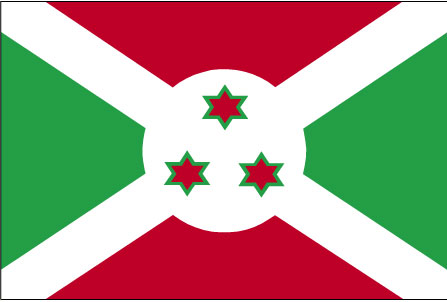
Flag, anthem, and other symbols of national identity.