English
 Español
 中文
中文 हिन्दी
 Français
Government and Politics
Government and Politics of Cambodia
Government structure, leadership, capital, military, and national symbols of Cambodia.
Government Structure
Constitutional foundations, branches, parties, and leadership.
- Government Type
- multiparty democracy under a constitutional monarchy established in September 1993
- Administrative Divisions
- 20 provinces (khaitt, singular and plural) and 4 municipalities* (krong, singular and plural); Banteay Mean Chey, Batdambang, Kampong Cham, Kampong Chhnang, Kampong Spoe, Kampong Thum, Kampot, Kandal, Koh Kong, Keb*, Kracheh, Mondol Kiri, Otdar Mean Chey, Pailin*, Phnom Penh*, Pouthisat, Preah Sihanouk (formerly Kompong Som)*, Preah Vihear, Prey Veng, Rotanakir, Siem Reab, Stoeng Treng, Svay Rieng, Takao
- Legal System
- primarily a civil law mixture of French-influenced codes from the United Nations Transitional Authority in Cambodia (UNTAC) period, royal decrees, and acts of the legislature, with influences of customary law and remnants of communist legal theory; increasing influence of common law in recent years
- Suffrage
- 18 years of age; universal
- Citizenship
- citizenship by birth: no citizenship by descent only: at least one parent must be a citizen of Cambodia dual citizenship recognized: yes residency requirement for naturalization: 7 years
- Executive Branch
- chief of state: King Norodom SIHAMONI (since 29 October 2004) head of government: Prime Minister HUN Manet (since 22 August 2023); Deputy Prime Ministers include SUN Chanthol, HOR Namhong, BUN Rany Hun Sen, TEA Banh, and others cabinet: Council of Ministers named by the prime minister and appointed by the monarch elections: none; the monarch is chosen by a Royal Throne Council from among eligible male members of the royal family; following legislative elections, a member of the majority party or majority coalition is nominated as prime minister by the Chairman of the National Assembly and appointed by the king; HUN Manet, son of long-serving former Prime Minister HUN Sen, assumed office following the Cambodian People's Party's sweeping victory in the July 2023 general elections
- Legislative Branch
- bicameral consists of the National Assembly (123 seats; members elected by popular vote to serve five-year terms) and the Senate (61 seats; two members appointed by the monarch, two elected by the National Assembly, and 57 elected by "functional constituencies"; members serve five-year terms) elections: National Assembly - last held 27 July 2003 (next to be held in July 2008); Senate - last held 2 March 1999 (scheduled to be held in 2004 but delayed) election results: National Assembly - percent of vote by party - CPP 47%, SRP 22%, FUNCINPEC 21%, other 10%; seats by party - CPP 73, FUNCINPEC 26, SRP 24; Senate - percent of vote by party - NA; seats by party - CPP 31, FUNCINPEC 21, SRP 7, other 2 (July 2003)
- Judicial Branch
- Supreme Council of the Magistracy (provided for in the constitution and formed in December 1997); Supreme Court (and lower courts) exercises judicial authority
- Political Parties
- Cambodian Pracheachon Party (Cambodian People's Party) or CPP [CHEA Sim]; National United Front for an Independent, Neutral, Peaceful, and Cooperative Cambodia or FUNCINPEC [Prince NORODOM Ranariddh]; Sam Rangsi Party or SRP [SAM Rangsi]
- Head of State
- King Norodom SIHAMONI
- Head of Government
- Prime Minister HUN SEN
- Cabinet
- Council of Ministers named by the prime minister and appointed by the monarch
- Elections
- the king is chosen by a Royal Throne Council from among all eligible males of royal descent; following legislative elections, a member of the majority party or majority coalition is named prime minister by the Chairman of the National Assembly and appointed by the king
- Constitution
- promulgated 21 September 1993
- Independence
- 9 November 1953 (from France)
- National Holiday
- Independence Day, 9 November (1953)
- International Organization Participation
- ACCT, ARF, AsDB, ASEAN, CP, FAO, G-77, IBRD, ICAO, ICCt, ICRM, IDA, IFAD, IFC, IFRCS, ILO, IMF, IMO, Interpol, IOC, IOM, ISO (subscriber), ITU, NAM, OPCW (signatory), PCA, UN, UNCTAD, UNESCO, UNIDO, UPU, WCO, WFTU, WHO, WIPO, WMO, WToO, WTrO (observer)
- Diplomatic Representation in the U.S.
- chief of mission: Ambassador ROLAND Eng chancery: 4530 16th Street NW, Washington, DC 20011 telephone: [1] (202) 726-7742 FAX: [1] (202) 726-8381
- U.S. Diplomatic Representation
- chief of mission: Ambassador Charles Aaron RAY embassy: 27 EO Street 240, Phnom Penh mailing address: Box P, APO AP 96546 telephone: [855] (23) 216-436/438 FAX: [855] (23) 216-437/811
Capital City
Seat of government and political history.
- Capital City
- Phnom Penh
- Location
- 11 33 N, 104 55 E
- Time Difference
- UTC+7 (12 hours ahead of Washington, DC, during Standard Time)
- History
- Phnom Penh translates as "Penh's Hill" in Khmer; the city takes its name from the present Wat Phnom (Hill Temple), the tallest religious structure in the city, whose establishment, according to legend, was inspired in the 14th century by a pious nun, Daun PENH
Embassy and Diplomatic Representation
Embassy location and contact details.
US Embassy Phnom Penh No. 1, Street 96 (near Wat Phnom), Phnom Penh, Cambodia Telephone: (855-23) 728-000 Fax: (855-23) 728-700
Military
Branches, service obligations, expenditures, and manpower.
- Military Branches
- Royal Cambodian Armed Forces: Royal Cambodian Army, Royal Khmer Navy, Royal Cambodian Air Force
- Service Age and Obligation
- 18 is the legal minimum age for compulsory and voluntary military service
National Symbols
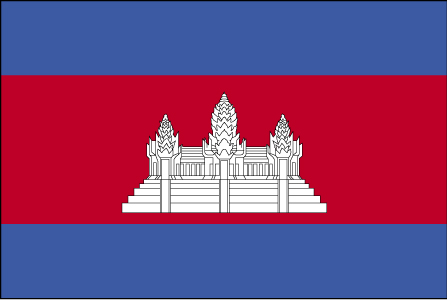
Flag, anthem, and other symbols of national identity.