English
 Español
 中文
中文 हिन्दी
 Français
Government and Politics
Government and Politics of Cuba
Government structure, leadership, capital, military, and national symbols of Cuba.
Government Structure
Constitutional foundations, branches, parties, and leadership.
- Government Type
- Communist state
- Administrative Divisions
- 14 provinces (provincias, singular - provincia) and 1 special municipality* (municipio especial); Camaguey, Ciego de Avila, Cienfuegos, Ciudad de La Habana, Granma, Guantanamo, Holguin, Isla de la Juventud*, La Habana, Las Tunas, Matanzas, Pinar del Rio, Sancti Spiritus, Santiago de Cuba, Villa Clara
- Legal System
- based on Spanish and American law, with large elements of Communist legal theory; has not accepted compulsory ICJ jurisdiction
- Suffrage
- 16 years of age; universal
- Citizenship
- Citizenship by birth: yes Citizenship by descent only: yes Dual citizenship recognized: no Residency requirement for naturalization: unknown
- Executive Branch
- chief of state: President of the Republic Miguel DIAZ-CANEL Bermudez (since 19 April 2018; reelected 21 October 2019 for a five-year term); note - the president is both the chief of state and head of government head of government: President of the Republic Miguel DIAZ-CANEL Bermudez (since 19 April 2018); Prime Minister Manuel MARRERO Cruz (since 21 December 2019); note - the office of Prime Minister was reinstated under the 2019 constitution, separating some executive responsibilities previously held solely by the president cabinet: Council of Ministers proposed by the president and ratified by the National Assembly of People's Power; a smaller Executive Committee of the Council of Ministers oversees day-to-day governance elections: president elected by the National Assembly of People's Power for a five-year term; under the 2019 constitution, a president is limited to two consecutive five-year terms; election last held 21 October 2019 (next to be held in 2024) election results: Miguel DIAZ-CANEL Bermudez reelected president; percent of legislative vote - 97.7%
- Legislative Branch
- unicameral National Assembly of People's Power or Asemblea Nacional del Poder Popular (609 seats, elected directly from slates approved by special candidacy commissions; members serve five-year terms) elections: last held 19 January 2003 (next to be held in 2008) election results: percent of vote - PCC 97.6%; seats - PCC 609
- Judicial Branch
- People's Supreme Court or Tribunal Supremo Popular (president, vice president, and other judges are elected by the National Assembly)
- Political Parties
- only party - Cuban Communist Party or PCC [Fidel CASTRO Ruz, first secretary]
- Head of State
- President of the Council of State and President of the Council of Ministers Gen. Raul CASTRO Ruz
- Head of Government
- President of the Council of State and President of the Council of Ministers Gen. Raul CASTRO Ruz
- Cabinet
- Council of Ministers proposed by the president of the Council of State and appointed by the National Assembly or the 31-member Council of State, elected by the Assembly to act on its behalf when it is not in session
- Elections
- president and vice presidents elected by the National Assembly for a term of five years; election last held 24 February 2008 (next to be held in 2013)
- Election Results
- Gen. Raul CASTRO Ruz elected president; percent of legislative vote - 100%; Gen. Jose Ramon MACHADO Ventura elected vice president; percent of legislative vote - 100%
- Constitution
- 24 February 1976, amended July 1992 and June 2002
- Independence
- 20 May 1902 (from Spain 10 December 1898; administered by the US from 1898 to 1902)
- National Holiday
- Independence Day, 10 December (1898); note - 10 December 1898 is the date of independence from Spain, 20 May 1902 is the date of independence from US administration; Rebellion Day, 26 July (1953)
- International Organization Participation
- FAO, G-77, IAEA, ICAO, ICC, ICRM, IFAD, IFRCS, IHO, ILO, IMO, Interpol, IOC, IOM (observer), ISO, ITU, LAES, LAIA, NAM, OAS (excluded from formal participation since 1962), OPANAL, OPCW, PCA, UN, UNCTAD, UNESCO, UNIDO, UPU, WCL, WCO, WFTU, WHO, WIPO, WMO, WToO, WTrO
- Diplomatic Representation in the U.S.
- none; note - Cuba has an Interests Section in the Swiss Embassy, headed by Principal Officer Bernardo GUANCHE Hernandez; address: Cuban Interests Section, Swiss Embassy, 2630 16th Street NW, Washington, DC 20009; telephone: [1] (202) 797-8518; FAX: [1] (202) 797-8521
- U.S. Diplomatic Representation
- none; note - the US has an Interests Section in the Swiss Embassy, headed by Principal Officer Michael E. PARMLY; address: USINT, Swiss Embassy, Calzada between L and M Streets, Vedado, Havana; telephone: [53] (7) 833-3551 through 3559 (operator assistance required); FAX: [53] (7) 833-3700; protecting power in Cuba is Switzerland
Capital City
Seat of government and political history.
- Capital City
- Havana
- Location
- 23 07 N, 82 21 W
- Time Difference
- UTC-5 (same time as Washington, DC during Standard Time)
- History
- The sites of Spanish colonial cities often retained their original Taino names; Habana, the Spanish name for the city, may be based on the name of a local Taino chief, HABAGUANEX
Embassy and Diplomatic Representation
Embassy location and contact details.
The United States does not maintain an embassy in Cuba. For current information on Cuban entry and customs requirements, travelers should contact: Cuban Interests Section (an office of the Cuban government) 2630 16th Street NW Washington, DC 20009 Telephone (202) 797-8518/8520 Fax (202) 797-8521 Consular Section (part of the Cuban Interests Section) 2639 16th Street NW Washington, DC 20009 Telephone (202) 797-8609/8610/8615 Fax (202) 986-7283
Military
Branches, service obligations, expenditures, and manpower.
- Military Branches
- Revolutionary Armed Forces (Fuerzas Armadas Revolucionarias, FAR): Revolutionary Army (Ejercito Revolucionario, ER, includes Territorial Militia Troops (Milicia de Tropas de Territoriales, MTT)); Revolutionary Navy (Marina de Guerra Revolucionaria, MGR, includes Marine Corps); Revolutionary Air and Air Defense Forces (Defensas Anti-Aereas y Fuerza Aerea Revolucionaria, DAAFAR), Youth Labor Army (Ejercito Juvenil del Trabajo, EJT)
- Service Age and Obligation
- 17-28 years of age for compulsory military service; 2-year service obligation; both sexes subject to military service
National Symbols
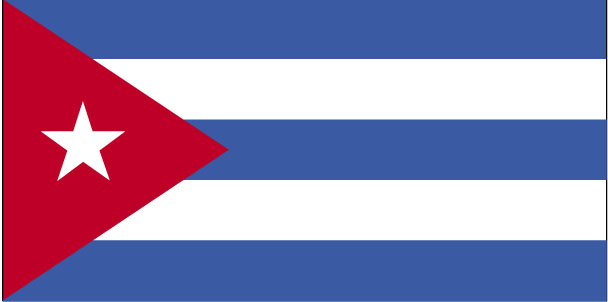
Flag, anthem, and other symbols of national identity.