English
 Español
 中文
中文 हिन्दी
 Français
Government and Politics
Government and Politics of Democratic Republic of the Congo
Government structure, leadership, capital, military, and national symbols of Democratic Republic of the Congo.
Government Structure
Constitutional foundations, branches, parties, and leadership.
- Citizenship
- Citizenship by birth: no Citizenship by descent only: at least one parent must be a citizen of the Democratic Republic of the Congo Dual citizenship recognized: no Residency requirement for naturalization: 5 years
- Executive Branch
- chief of state: President Felix TSHISEKEDI (since 24 January 2019); the president is both the chief of state and head of government head of government: President Felix TSHISEKEDI (since 24 January 2019); Prime Minister Jean-Michel SAMA LUKONDE resigned in May 2024 and was succeeded by Sylvestre ILUNGA ILUNKAMBA; note - the president appoints the prime minister cabinet: Council of Ministers appointed by the president elections: the president is elected by popular vote for a five-year term (eligible for a second term); election last held on 20 December 2023 (next to be held in December 2028); the prime minister is appointed by the president election results: Felix TSHISEKEDI reelected president in December 2023 with approximately 73% of the vote, defeating Martin FAYULU and other candidates in a broadly contested election; TSHISEKEDI had previously won the January 2019 election following the departure of Joseph KABILA, who had held the presidency since 2001 following the assassination of his father Laurent Desire KABILA note: Felix TSHISEKEDI, leader of the Union for Democracy and Social Progress (UDPS), took office in January 2019 in what was considered the Democratic Republic of the Congo's first peaceful transfer of power since independence; his reelection in 2023 was disputed by opposition candidates who cited irregularities, though he was inaugurated for a second term in January 2024
- Legislative Branch
- a 500-member National Assembly and a 120-seat Senate established in June 2003 elections: NA; members of the National Assembly were appointed by leaders in the factions integrated into the new government
- Judicial Branch
- Supreme Court or Cour Supreme
- Political Parties
- Democratic Social Christian Party or PDSC [Andre BO-BOLIKO]; Forces for Renovation for Union and Solidarity or FONUS [Joseph OLENGHANKOY]; National Congolese Lumumbist Movement or MNC [Francois LUMUMBA]; Popular Movement of the Revolution or MPR (three factions: MPR-Fait Prive [Catherine NZUZI wa Mbombo]; MPR/Vunduawe [Felix VUNDUAWE]; MPR/Mananga [MANANGA Dintoka Mpholo]); Unified Lumumbast Party or PALU [Antoine GIZENGA]; Union for Democracy and Social Progress or UDPS [Etienne TSHISEKEDI wa Mulumba]; Union of Federalists and Independent Republicans or UFERI (two factions: UFERI [Lokambo OMOKOKO]; UFERI/OR [Adolph Kishwe MAYA])
- Head of State
- President Joseph KABILA
- Head of Government
- Prime Minister Adolphe MUZITO
- Cabinet
- Ministers of State appointed by the president
- Elections
- under the new constitution the president is elected by popular vote for a five-year term (eligible for a second term); elections last held 30 July 2006 and 29 October 2006 (next to be held in 2011); prime minister appointed by the president
- Election Results
- Joseph KABILA elected president; percent of vote (second round) - Joseph KABILA 58%, Jean-Pierre BEMBA Gombo 42% note: Joseph KABILA succeeded his father, Laurent Desire KABILA, following the latter’s assassination in January 2001; negotiations with rebel leaders led to the establishment of a transitional government in July 2003 with free elections held on 30 July 2006 and 29 October 2006 confirming Joseph KABILA as president
- Diplomatic Representation in the U.S.
- chief of mission: Ambassador Faida MITIFU chancery: 1800 New Hampshire Avenue NW, Washington, DC 20009: note - Consular Office at 1726 M Street, NW, Washington, DC, 20036 telephone: [1] (202) 234-7690, 7691 FAX: [1] (202) 234-2609
- U.S. Diplomatic Representation
- chief of mission: Ambassador Roger MEECE embassy: 310 Avenue des Aviateurs, Kinshasa mailing address: Unit 31550, APO AE 09828 telephone: [243] (88) 43608 FAX: [243] (88) 43467
Capital City
Seat of government and political history.
- Capital City
- Kinshasa
- Location
- 4 19 S, 15 18 E
- Time Difference
- UTC+1 (6 hours ahead of Washington, DC, during Standard Time) Time zone note: the DRC has two time zones
- History
- Founded as a trading post in 1881 and named Leopoldville in honor of King LEOPOLD II of the Belgians, who controlled the Congo Free State, the vast central African territory that became the Democratic Republic of the Congo in 1960; in 1966, Leopoldville was renamed Kinshasa, after a village of that name that once stood near the site
Embassy and Diplomatic Representation
Embassy location and contact details.
U.S. Embassy in the Democratic Republic of the Congo 310 Avenue de Aviateurs Kinshasa Telephone: 243-081-5560151 (dial 243 815 560 151 when calling from abroad) Consular Section Avenue Dumi, opposite the Ste. Anne Residence Kinshasa Emergency after-hours telephone: 243-081-556-0151 (dial 243 815 560 151 when calling from abroad) Facsimile: 243-81-556-0169 Email: AEKinshasaConsular@state.gov
Military
Branches, service obligations, expenditures, and manpower.
- Military Branches
- Armed Forces of the Democratic Republic of the Congo (Forces d'Armees de la Republique Democratique du Congo, FARDC): Army, National Navy (La Marine Nationale), Congolese Air Force (Force Aerienne Congolaise, FAC)
- Service Age and Obligation
- 18-45 years of age for voluntary and compulsory military service
National Symbols
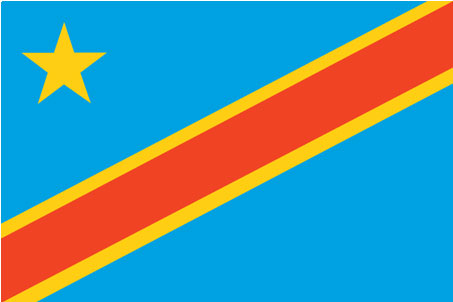
Flag, anthem, and other symbols of national identity.