English
 Español
 中文
中文 हिन्दी
 Français
Government and Politics
Government and Politics of Eritrea
Government structure, leadership, capital, military, and national symbols of Eritrea.
Government Structure
Constitutional foundations, branches, parties, and leadership.
- Government Type
- transitional government
- Administrative Divisions
- 6 regions (regions, singular - region); Central, Anelba, Southern Red Sea, Northern Red Sea, Southern, Gash-Barka
- Legal System
- primary basis is the Ethiopian legal code of 1957, with revisions; new civil, commercial, and penal codes have not yet been promulgated; also relies on customary and post-independence-enacted laws and, for civil cases involving Muslims, Sharia law
- Suffrage
- 18 years of age; universal
- Citizenship
- Citizenship by birth: No Citizenship by descent only: At least one parent must be a citizen of Eritrea Dual citizenship recognized: No Residency requirement for naturalization: 20 years
- Executive Branch
- chief of state: President ISAIAS Afwerki (since 8 June 1993); note - the president is both the chief of state and head of government and serves as head of the State Council and National Assembly head of government: President ISAIAS Afwerki (since 8 June 1993); note - the president is both the chief of state and head of government and serves as head of the State Council and National Assembly cabinet: State Council is the collective executive authority; members appointed by the president elections: the president is elected by the National Assembly; the last election was held on 8 June 1993, when Eritrea gained independence; no subsequent presidential elections have been held, and the National Assembly has been suspended since 2002, leaving ISAIAS Afwerki as the country's sole leader without a renewed electoral mandate election results: ISAIAS Afwerki elected president; percent of National Assembly vote - ISAIAS Afwerki 95%
- Legislative Branch
- unicameral National Assembly (150 seats; term limits not established) elections: in May 1997, following the adoption of the new constitution, 75 members of the PFDJ Central Committee (the old Central Committee of the EPLF), 60 members of the 527-member Constituent Assembly, that had been established in 1997 to discuss and ratify the new constitution, and 15 representatives of Eritreans living abroad were formed into a Transitional National Assembly to serve as the country's legislative body until countrywide elections to a National Assembly were held; although only 75 of 150 members of the Transitional National Assembly were elected, the constitution stipulates that once past the transition stage, all members of the National Assembly will be elected by secret ballot of all eligible voters; National Assembly elections scheduled for December 2001 were postponed indefinitely
- Judicial Branch
- High Court - regional, subregional, and village courts; also have military and special courts
- Political Parties
- People's Front for Democracy and Justice or PFDJ, the only party recognized by the government [ISAIAS Afworki]; note - a National Assembly committee drafted a law on political parties in January 2001, but the full National Assembly has not yet debated or voted on it
- Head of State
- President ISAIAS Afworki
- Head of Government
- President ISAIAS Afworki
- Cabinet
- State Council is the collective executive authority; members appointed by the president
- Elections
- president elected by the National Assembly for a five-year term (eligible for a second term); the most recent and only election held 8 June 1993 (next election date uncertain as the National Assembly did not hold a presidential election in December 2001 as anticipated
- Election Results
- ISAIAS Afworki elected president; percent of National Assembly vote - ISAIAS Afworki 95%, other 5%
- Constitution
- the transitional constitution, decreed on 19 May 1993, was replaced by a new constitution adopted on 23 May 1997, but not yet implemented
- Independence
- 24 May 1993
- National Holiday
- Independence Day, 24 May (1993)
- International Organization Participation
- ACP, AfDB, AU, FAO, G-77, IAEA, IBRD, ICAO, ICCt (signatory), ICFTU, IDA, IFAD, IFC, IFRCS, IGAD, ILO, IMF, IMO, Interpol, IOC, ISO (subscriber), ITU, NAM, OPCW, PCA, UN, UNCTAD, UNESCO, UNIDO, UPU, WCO, WFTU, WHO, WIPO, WMO, WToO
- Diplomatic Representation in the U.S.
- chief of mission: Ambassador GIRMA Asmerom chancery: 1708 New Hampshire Avenue NW, Washington, DC 20009 telephone: [1] (202) 319-1991 FAX: [1] (202) 319-1304 consulate(s) general: Oakland (California)
- U.S. Diplomatic Representation
- chief of mission: Ambassador Scott H. DELISI embassy: Franklin D. Roosevelt Street, Asmara mailing address: P. O. Box 211, Asmara telephone: [291] (1) 120004 FAX: [291] (1) 127584
Capital City
Seat of government and political history.
- Capital City
- Asmara
- Location
- 15 20 N, 38 56 E
- Time Difference
- UTC+3 (8 hours ahead of Washington, DC, during Standard Time)
- History
- The name means "they [women] made them unite," which according to Tigrinya oral tradition refers to the women of the four clans in the Asmara area who persuaded their menfolk to unite and defeat their common enemy; the name has also been translated as "live in peace"
Embassy and Diplomatic Representation
Embassy location and contact details.
U.S. Embassy Eritrea 179 Alaa Street, PO Box 211, Asmara Telephone: (291-1) 12-00-04 Facsimile: (291-1) 124-255 and (291-1) 127-584
Military
Branches, service obligations, expenditures, and manpower.
- Military Branches
- Eritrean Armed Forces: Eritrean Ground Forces, Eritrean Navy, Eritrean Air Force (includes Air Defense Force)
- Service Age and Obligation
- 18-40 years of age for male and female voluntary and compulsory military service; 16-month conscript service obligation
National Symbols
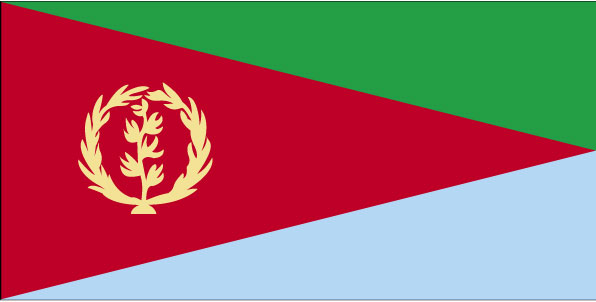
Flag, anthem, and other symbols of national identity.