English
 Español
 中文
中文 हिन्दी
 Français
Government and Politics
Government and Politics of Gabon
Government structure, leadership, capital, military, and national symbols of Gabon.
Government Structure
Constitutional foundations, branches, parties, and leadership.
- Government Type
- republic; multiparty presidential regime (opposition parties legalized in 1990)
- Administrative Divisions
- 9 provinces; Estuaire, Haut-Ogooue, Moyen-Ogooue, Ngounie, Nyanga, Ogooue-Ivindo, Ogooue-Lolo, Ogooue-Maritime, Woleu-Ntem
- Legal System
- based on French civil law system and customary law; judicial review of legislative acts in Constitutional Chamber of the Supreme Court; has not accepted compulsory ICJ jurisdiction
- Suffrage
- 21 years of age; universal
- Citizenship
- Ccitizenship by birth: No Citizenship by descent only: At least one parent must be a citizen of Gabon Dual citizenship recognized: No Residency requirement for naturalization: 10 years
- Executive Branch
- chief of state: President Brice Clotaire OLIGUI NGUEMA (since 30 August 2023, following a military coup that ousted President Ali BONGO Ondimba) head of government: Prime Minister Raymond NDONG SIMA (since 7 September 2023) cabinet: Transitional Council of Ministers appointed by the president following the dissolution of previous governmental structures after the August 2023 coup elections: Prior to the coup, the president was elected by popular vote for a seven-year term; the most recent presidential election was held on 26 August 2023, the results of which were disputed and led directly to the military intervention; future electoral arrangements are to be determined during the ongoing transitional period election results: The August 2023 election was annulled following the coup; the military-led Transition Committee for the Restoration of Institutions (CTRI) subsequently appointed Oligui Nguema as transitional president, suspending the constitution and dissolving existing governmental institutions
- Legislative Branch
- bicameral legislature consists of the Senate (91 seats; members elected by members of municipal councils and departmental assemblies) and the National Assembly or Assemblee Nationale (120 seats; members are elected by direct, popular vote to serve five-year terms) elections: Senate - last held 26 January and 9 February 2003 (next to be held by January 2009); National Assembly - last held 9 and 23 December 2001 (next to be held December 2006) election results: Senate - percent of vote by party - NA; seats by party - PDG 53, RNB 20, PGP 4, ADERE 3, RDP 1, CLR 1, independents 9; National Assembly - percent of vote by party - NA; seats by party - PDG 86, RNB-RPG 8, PGP 3, ADERE 3, CLR 2, PUP 1, PSD 1, independents 13, others 3
- Judicial Branch
- Supreme Court or Cour Supreme consisting of three chambers - Judicial, Administrative, and Accounts; Constitutional Court; Courts of Appeal; Court of State Security; County Courts
- Political Parties
- Circle of Liberal Reformers or CLR [General Jean Boniface ASSELE]; Congress for Democracy and Justice or CDJ [Jules Aristide Bourdes OGOULIGUENDE]; Democratic and Republican Alliance or ADERE [Divungui-di-Ndinge DIDJOB]; Gabonese Democratic Party or PDG, former sole party [Simplice Nguedet MANZELA]; Gabonese Party for Progress or PGP [Pierre-Louis AGONDJO-OKAWE]; National Rally of Woodcutters or RNB [leader NA]; National Rally of Woodcutters-Rally for Gabon or RNB-RPG (Bucherons) [Fr. Paul M'BA-ABESSOLE]; People's Unity Party or PUP [Louis Gaston MAYILA]; Rally for Democracy and Progress or RDP [Pierre EMBONI]; Social Democratic Party or PSD [Pierre Claver MAGANGA-MOUSSAVOU]; Union for Democracy and Social Integration or UDIS [leader NA]; Union of Gabonese People or UPG [Pierre MAMBOUNDOU]
- Head of State
- President Ali Ben Bongo Ondimba
- Head of Government
- Prime Minister Paul Biyoghe Mba
- Cabinet
- Council of Ministers appointed by the prime minister in consultation with the president
- Elections
- president elected by popular vote for a seven-year term (no term limits); election last held on 30 August 2009 (next to be held in 2016); prime minister appointed by the president
- Election Results
- President Ali Ben BONGO Ondimba elected; percent of vote - Ali Ben BONGO Ondimba 41.7%, Andre MBA OBAME 25.9%, Pierre MAMBOUNDOU 25.2%, Zacharie MYBOTO 3.9%, other 3.3%
- Constitution
- adopted 14 March 1991
- Independence
- 17 August 1960 (from France)
- National Holiday
- Founding of the Gabonese Democratic Party (PDG), 12 March (1968)
- International Organization Participation
- ACCT, ACP, AfDB, AU, BDEAC, CEMAC, FAO, FZ, G-24, G-77, IAEA, IBRD, ICAO, ICCt, ICFTU, IDA, IDB, IFAD, IFC, IFRCS, ILO, IMF, IMO, Interpol, IOC, ITU, NAM, OIC, OPCW, UN, UNCTAD, UNESCO, UNIDO, UPU, WCL, WCO, WHO, WIPO, WMO, WToO, WTrO
- Diplomatic Representation in the U.S.
- chief of mission: Ambassador Jules Marius OGOUEBANDJA chancery: Suite 200, 2034 20th Street NW, Washington, DC 20009 telephone: [1] (202) 797-1000 FAX: [1] (202) 332-0668 consulate(s): New York
- U.S. Diplomatic Representation
- chief of mission: Ambassador Barrie R. WALKLEY embassy: Boulevard du Bord de Mer, Libreville mailing address: Centre Ville, B. P. 4000, Libreville telephone: [241] 76 20 03 through 76 20 04, after hours - 74 34 92 FAX: [241] 74 55 07
Capital City
Seat of government and political history.
- Capital City
- Libreville
- Location
- 0 23 N, 9 27 E
- Time Difference
- UTC+1 (6 hours ahead of Washington, DC, during Standard Time)
- History
- Original site settled by freed slaves and the name means "free town" in French; named in imitation of Freetown, the capital of Sierra Leone
Embassy and Diplomatic Representation
Embassy location and contact details.
U.S. Embassy Libreville BP 4000 Sabliere Neighborhood Libreville, Gabon Telephone: 241-01-45-71-00 Emergency after-hours telephone: 241-07-38-01-71 Facsimile: 241-01-45-71-05 Email: LibrevilleACS@state.gov
Military
Branches, service obligations, expenditures, and manpower.
- Military Branches
- Gabonese Defense Forces (Forces de Defense Gabonaise): Land Force (Force Terrestre), Gabonese Navy (Marine Gabonaise), Gabonese Air Forces (Forces Aerienne Gabonaises, FAG)
- Service Age and Obligation
- 20 years of age for voluntary military service; no conscription
National Symbols
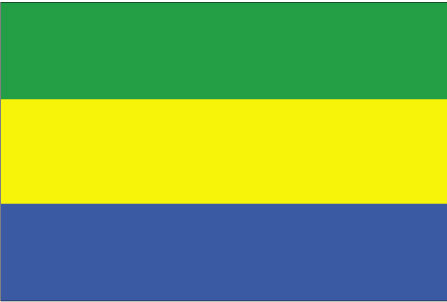
Flag, anthem, and other symbols of national identity.