English
 Español
 中文
中文 हिन्दी
 Français
Government and Politics
Government and Politics of Haiti
Government structure, leadership, capital, military, and national symbols of Haiti.
Government Structure
Constitutional foundations, branches, parties, and leadership.
- Government Type
- elected government
- Administrative Divisions
- 9 departments (departements, singular - departement); Artibonite, Centre, Grand 'Anse, Nord, Nord-Est, Nord-Ouest, Ouest, Sud, Sud-Est
- Legal System
- based on Roman civil law system; accepts compulsory ICJ jurisdiction
- Suffrage
- 18 years of age; universal
- Citizenship
- Citizenship by birth: No Citizenship by descent only: At least one parent must be a native-born citizen of Haiti Dual citizenship recognized: Yes Residency requirement for naturalization: 5 years
- Executive Branch
- chief of state: President (acting) Edgarnd GOUSSE (2024); note: Haiti has experienced prolonged political instability following the assassination of President Jovenel MOÏSE on 7 July 2021; Ariel HENRY served as prime minister and de facto head of state from July 2021 until his resignation in March 2024 amid a severe security crisis driven by gang violence; a transitional presidential council was subsequently established to guide the country toward new elections head of government: Prime Minister Garry CONILLE (since June 2024), appointed by the Transitional Presidential Council; note: Haiti's transitional governance structure was formed in 2024 with the support of the international community to restore stability and prepare conditions for democratic elections cabinet: Cabinet chosen by the prime minister in consultation with the transitional presidential council elections: Under the 1987 constitution, the president is elected by popular vote for a five-year term and is ineligible for a consecutive second term; no presidential elections have been held since 2016, when Jovenel MOÏSE was elected; elections remain suspended due to ongoing security and political instability; the prime minister is appointed by the president and must be ratified by the National Assembly election results: Jovenel MOÏSE was elected president in the November 2016 election with approximately 55.6% of the vote; he was assassinated in July 2021 before completing his term; Haiti has since operated under transitional governance arrangements
- Legislative Branch
- bicameral National Assembly or Assemblee Nationale consists of the Senate (27 seats; members elected by popular vote to serve six-year terms; one-third elected every two years) and the Chamber of Deputies (83 seats; members are elected by popular vote to serve four-year terms); note - the National Assembly stopped functioning in January 2004 when the terms of all deputies and two-thirds of sitting senators expired; no replacements have been elected; the president is currently ruling by decree elections: Senate - last held for two-thirds of seats 21 May 2000 with runoffs on 9 July boycotted by the opposition; seven seats still disputed; election for remaining one-third held on 26 November 2000 (next to be held in 2005); Chamber of Deputies - last held 21 May 2000 with runoffs on 30 July boycotted by the opposition; one vacant seat rerun 26 November 2000 (next to be held in November 2005) election results: Senate - percent of vote by party - NA; seats by party - FL 26, independent 1; Chamber of Deputies - percent of vote by party - NA; seats by party - FL 73, MOCHRENA 3, PLB 2, OPL 1, vacant 1, other minor parties and independents 3
- Judicial Branch
- Supreme Court or Cour de Cassation
- Political Parties
- Alliance for the Liberation and Advancement of Haiti or ALAH [Reynold GEORGES]; Assembly of Progressive National Democrats or RDNP [Leslie MANIGAT]; Ayiti Kapab [Ernst VERDIEU]; Convention for Democratic Unity or KID [Evans PAUL]; Democratic Movement for the Liberation of Haiti or MODELH [Francois LATORTUE]; Grand Center Right Front coalition (composed of MDN, MRN, and PDCH) [Hubert de RONCERAY, Jean BUTEAU, Osner FEVRY and Marie-Denise CLAUDE]; Haitian Christian Democratic Party or PDCH [Osner FEVRY and Marie-Denise CLAUDE]; Haitian Democratic and Reform Movement or MODEREH [Dany TOUSSAINT and Pierre Soncon PRINCE]; Haitian Democratic Party or PADEMH [Clark PARENT]; Heads Together [Dr. Gerard BLOT]; Lavalas Family or FL [leader NA]; Liberal Party of Haiti or PLH [Michael MADSEN]; Mobilization for National Development or MDN [Hubert DE RONCERAY]; Movement for National Reconstruction or MRN [Jean Henold BUTEAU]; Movement for the Installation of Democracy in Haiti or MIDH [Marc BAZIN]; National Congress of Democratic Movements or KONAKOM [Victor BENOIT]; National Front for the Reconstruction of Haiti or FRON [Guy PHILIPPE]; National Progressive Democratic Party or PNDPH [Turneb DELPE]; Nationalist Progressive Revolutionary Party or PANPRA [Serge GILLES]; New Christian Movement for a New Haiti or MOCHRENA [Luc MESADIEU]; Open the Gate Party (Parti Louvri Bayre) or PLB [leader NA]; Popular Party for the Renewal of Haiti, or Generation 2000 [Claude ROMAIN and Daniel SUPPLICE]; Struggling People's Organization or OPL [Edgard LEBLANC]; MNP28 [Dejean BELIZAIRE]; KOMBA [Evans LESCOUFLAIR]
- Head of State
- President Rene PREVAL
- Head of Government
- Prime Minister Jean-Max Bellerive
- Cabinet
- Cabinet chosen by the prime minister in consultation with the president
- Elections
- president elected by popular vote for a five-year term (may not serve consecutive terms); election last held 7 February 2006 (next to be held in 2011); prime minister appointed by the president, ratified by the National Assembly
- Election Results
- Rene PREVAL elected president; percent of vote - Rene PREVAL 51%
- Constitution
- approved March 1987; suspended June 1988 with most articles reinstated March 1989; in October 1991 government claimed to be observing the constitution; returned to constitutional rule in October 1994
- Independence
- 1 January 1804 (from France)
- National Holiday
- Independence Day, 1 January (1804)
- International Organization Participation
- ACCT, ACP, Caricom, FAO, G-77, IADB, IAEA, IBRD, ICAO, ICCt (signatory), ICRM, IDA, IFAD, IFC, IFRCS, ILO, IMF, IMO, Interpol, IOC, IOM, ITU, LAES, OAS, OPANAL, OPCW (signatory), PCA, UN, UNCTAD, UNESCO, UNIDO, UPU, WCL, WCO, WFTU, WHO, WIPO, WMO, WToO, WTrO
- Diplomatic Representation in the U.S.
- chief of mission: Charge d'Affaires Raymond JOSEPH (as of November 2004) chancery: 2311 Massachusetts Avenue NW, Washington, DC 20008 telephone: [1] (202) 332-4090 FAX: [1] (202) 745-7215 consulate(s) general: Boston, Chicago, Miami, New York, San Juan (Puerto Rico)
- U.S. Diplomatic Representation
- chief of mission: Ambassador Timothy M. CARNEY embassy: 5 Harry S Truman Boulevard, Port-au-Prince mailing address: P. O. Box 1761, Port-au-Prince telephone: [509] 222-0200 FAX: [509] 223-9038
Capital City
Seat of government and political history.
- Capital City
- Port-au-Prince
- Location
- 18 32 N, 72 20 W
- Time Difference
- UTC-5 (same time as Washington, DC, during Standard Time)
- History
- According to tradition, in 1706, a Captain de Saint-Andre named the bay and its surrounding area after his ship Le Prince; the name of the town that grew there means, "the Port of The Prince"
Embassy and Diplomatic Representation
Embassy location and contact details.
Embassy of the United States Port-au-Prince Haiti Boulevard du 15 October, Tabarre 41, Tabarre, Haiti Telephone: (509) (2) 229-8000 Facsimile: (509) (2) 229-8027 Email: acspap@state.gov After hours, weekend & holidays: Please call (509) (2) 229-8000. American Citizens Services Unit office hours are 7:00 a.m. to 3:30 p.m., Monday through Friday. The Consular Section is closed on U.S. and local holidays.
Military
Branches, service obligations, expenditures, and manpower.
- Military Branches
- No regular military forces - small Coast Guard; a Ministry of National Defense established May 2012; the regular Haitian Armed Forces (FAdH) - Army, Navy, and Air Force - have been demobilized but still exist on paper until or unless they are constitutionally abolished
National Symbols
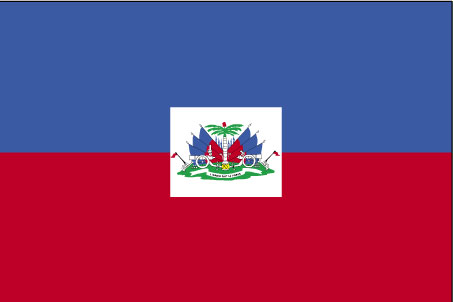
Flag, anthem, and other symbols of national identity.