English
 Español
 中文
中文 हिन्दी
 Français
Government and Politics
Government and Politics of Iran
Government structure, leadership, capital, military, and national symbols of Iran.
Government Structure
Constitutional foundations, branches, parties, and leadership.
- Government Type
- theocratic republic
- Administrative Divisions
- 28 provinces (ostanha, singular - ostan); Ardabil, Azarbayjan-e Gharbi, Azarbayjan-e Sharqi, Bushehr, Chahar Mahall va Bakhtiari, Esfahan, Fars, Gilan, Golestan, Hamadan, Hormozgan, Ilam, Kerman, Kermanshah, Khorasan, Khuzestan, Kohgiluyeh va Buyer Ahmad, Kordestan, Lorestan, Markazi, Mazandaran, Qazvin, Qom, Semnan, Sistan va Baluchestan, Tehran, Yazd, Zanjan
- Legal System
- the Constitution codifies Islamic principles of government
- Suffrage
- 15 years of age; universal
- Citizenship
- citizenship by birth: no citizenship by descent only: the father must be a citizen of Iran dual citizenship recognized: no residency requirement for naturalization: 5 years
- Executive Branch
- chief of state: Supreme Leader Ayatollah Ali Hoseini-KHAMENEI (since 4 June 1989) head of government: President Masoud PEZESHKIAN (since 30 July 2024); First Vice President Mohammad Reza AREF (since 30 July 2024) cabinet: Council of Ministers selected by the president with legislative approval; the Supreme Leader exercises significant influence over appointments to sensitive ministries, particularly those related to defense, intelligence, and foreign affairs elections: Supreme Leader of the Islamic Revolution appointed for life by the Assembly of Experts; president elected by popular vote for a four-year term; election last held on 28 June 2024, with a two-candidate runoff on 5 July 2024 election results: Masoud PEZESHKIAN elected president in runoff; percent of vote - Masoud PEZESHKIAN 54.8%, Saeed JALILI 44.3%; note - the election was called early following the death of President Ebrahim RAISI in a helicopter crash on 19 May 2024
- Legislative Branch
- unicameral Islamic Consultative Assembly or Majles-e-Shura-ye-Eslami (290 seats - formerly 270 seats; members elected by popular vote to serve four-year terms) elections: last held 20 February 2004 with a runoff held 7 in May 2004 (next to be held in February 2008) election results: percent of vote - NA; seats by party - conservatives/Islamists 190, reformers 50, independents 43, religious minorities 5, and 2 seats unaccounted for
- Judicial Branch
- Supreme Court - above a special clerical court, a revolutionary court, and a special administrative court
- Political Parties
- formal political parties are a relatively new phenomenon in Iran and most conservatives still prefer to work through political pressure groups rather than parties; a loose pro-reform coalition called the 2nd Khordad Front, which includes political parties as well as less formal pressure groups and organizations, achieved considerable success at elections to the sixth Majles in early 2000; groups in the coalition include: Islamic Iran Participation Front (IIPF), Executives of Construction Party (Kargozaran), Solidarity Party, Islamic Labor Party; Mardom Salari, Mojahedin of the Islamic Revolution Organization (MIRO), and Militant Clerics Society (Ruhaniyun); the coalition participated in the seventh Majles elections in early 2004; a new apparently conservative group, the Builders of Islamic Iran, took a leading position in the new Majles after winning a majority of the seats in February 2004
- Head of State
- Supreme Leader Ali Hoseini-KHAMENEI
- Head of Government
- President Mahmud AHMADI-NEJAD
- Cabinet
- Council of Ministers selected by the president with legislative approval; the Supreme Leader has some control over appointments to the more sensitive ministries note: also considered part of the Executive branch of government are three oversight bodies: 1) Assembly of Experts (Majles-Khebregan), a popularly elected body charged with determining the succession of the Supreme Leader, reviewing his performance, and deposing him if deemed necessary; 2) Expediency Council or the Council for the Discernment of Expediency (Majma-e-Tashkise-Maslahat-e-Nezam) exerts supervisory authority over the executive, judicial, and legislative branches and resolves legislative issues on which the Majles and the Council of Guardians disagree and since 1989 has been used to advise national religious leaders on matters of national policy; in 2005 the Council’s powers were expanded to act as a supervisory body for the government; 3) Council of Guardians of the Constitution or Council of Guardians or Guardians Council (Shora-ye Negaban-e Qanun-e Assassi) determines whether proposed legislation is both constitutional and faithful to Islamic law, vets candidates for suitability, and supervises national elections
- Elections
- Supreme Leader appointed for life by the Assembly of Experts; president elected by popular vote for a four-year term (eligible for a second term and third nonconsecutive term); election last held on 12 June 2009;(next presidential election slated for June 2013)
- Election Results
- Mahmud AHMADI-NEJAD reelected president; percent of vote - Mahmud AHMADI-NEJAD 62.6%, Mir-Hosein MUSAVI-Khamenei 33.8%, other 3.6%; voter turnout 85% (according to official figures published by the government)
- Constitution
- 2-3 December 1979; revised 1989 to expand powers of the presidency and eliminate the prime ministership
- Independence
- 1 April 1979 (Islamic Republic of Iran proclaimed)
- National Holiday
- Republic Day, 1 April (1979)
- International Organization Participation
- CP, ECO, FAO, G-24, G-77, IAEA, IBRD, ICAO, ICC, ICCt (signatory), ICRM, IDA, IDB, IFAD, IFC, IFRCS, IHO, ILO, IMF, IMO, Interpol, IOC, IOM, ISO, ITU, NAM, OIC, OPCW, OPEC, PCA, UN, UNCTAD, UNESCO, UNHCR, UNIDO, UPU, WCL, WCO, WFTU, WHO, WIPO, WMO, WToO
- Diplomatic Representation in the U.S.
- none; note - Iran has an Interests Section in the Pakistani Embassy; address: Iranian Interests Section, Pakistani Embassy, 2209 Wisconsin Avenue NW, Washington, DC 20007; telephone: [1] (202) 965-4990; FAX [1] (202) 965-1073
- U.S. Diplomatic Representation
- none; note - protecting power in Iran is Switzerland
Capital City
Seat of government and political history.
- Capital City
- Tehran
- Location
- 35 42 N, 51 25 E
- Time Difference
- UTC+3.5 (8.5 hours ahead of Washington, DC)
- History
- various explanations of the city's name have been proffered, but the most plausible states that it derives from the Persian words tah meaning "end or bottom" and ran meaning "[mountain] slope" to signify "bottom of the mountain slope"; Tehran lies at the bottom slope of the Elburz Mountains
Embassy and Diplomatic Representation
Embassy location and contact details.
The U.S. government does not have diplomatic or consular relations with the Islamic Republic of Iran and therefore cannot provide protection or routine consular services to U.S. citizens in Iran. The Swiss government, acting through its Embassy in Tehran, serves as protecting power for U.S. interests in Iran. If you are going to live in or visit Iran, please take the time to tell the Swiss Embassy about your trip. If you enroll in our Smart Traveler Enrollment Program, we can keep you up to date with important safety and security announcements. Local embassy information is available below and at the Department of State’s list of embassies and consulates. Embassy of Switzerland – U.S. Interests Section No. 39, Shahid Mousavi (Golestan 5th) Pasdaran Avenue Tehran, Iran Telephone: (98) (21) 2254-2178 and (98) (21) 2256-5273 Facsimile: (98) (21) 2258-0432 Contact via e-mail: tie.vertretung@eda.admin.ch The workweek is Sunday through Thursday. Public service hours are 8:00 am – 12:00 noon. The Interests Section does not issue U.S. visas or accept visa applications.
Military
Branches, service obligations, expenditures, and manpower.
- Military Branches
- Islamic Republic of Iran Regular Forces (Artesh): Ground Forces, Navy, Air Force (IRIAF), Khatemolanbia Air Defense Headquarters; Islamic Revolutionary Guard Corps (Sepah-e Pasdaran-e Enqelab-e Eslami, IRGC): Ground Resistance Forces, Navy, Aerospace Force, Quds Force (special operations); Law Enforcement Forces
- Service Age and Obligation
- 18 years of age for compulsory military service; 16 years of age for volunteers; 17 years of age for Law Enforcement Forces; 15 years of age for Basij Forces (Popular Mobilization Army); conscript military service obligation is 18 months; women exempt from military service
National Symbols
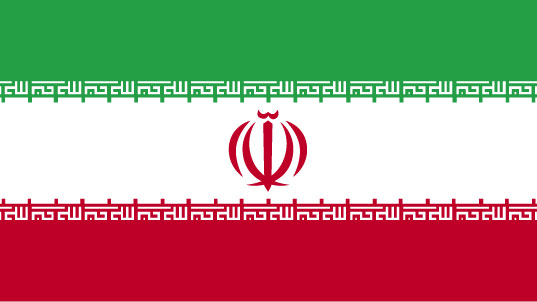
Flag, anthem, and other symbols of national identity.