English
 Español
 中文
中文 हिन्दी
 Français
Government and Politics
Government and Politics of Iraq
Government structure, leadership, capital, military, and national symbols of Iraq.
Government Structure
Constitutional foundations, branches, parties, and leadership.
- Government Type
- the Iraqi Interim Government (IG) was appointed on 1 June 2004
- Administrative Divisions
- 18 governorates (muhafazat, singular - muhafazah); Al Anbar, Al Basrah, Al Muthanna, Al Qadisiyah, An Najaf, Arbil, As Sulaymaniyah, At Ta'mim, Babil, Baghdad, Dahuk, Dhi Qar, Diyala, Karbala', Maysan, Ninawa, Salah ad Din, Wasit
- Legal System
- based on civil and Islamic law under the Iraqi Interim Government (IG) and Transitional Administrative Law (TAL)
- Suffrage
- formerly 18 years of age; universal; note - in transition following April 2003 defeat of SADDAM Husayn regime by US-led coalition
- Citizenship
- citizenship by birth: no citizenship by descent only: at least one parent must be a citizen of Iraq dual citizenship recognized: yes residency requirement for naturalization: 10 years
- Executive Branch
- chief of state: President Abdul Latif RASHID (since 13 October 2022); Vice Presidents Fuad HUSSEIN and Mohsen al-MANDALAWI (since 2022); note - the President serves as head of state with largely ceremonial powers under Iraq's parliamentary system head of government: Prime Minister Mohammed Shia' al-SUDANI (since 27 October 2022); Deputy Prime Ministers Fuad HUSSEIN, Mohammed Ali TAMIM, and others serving in the cabinet formed in late 2022 cabinet: Council of Ministers appointed by the Prime Minister and approved by the Council of Representatives; ministers represent a power-sharing arrangement among Iraq's major ethnic and sectarian communities elections: the Council of Representatives (parliament) consists of 329 seats; most recent elections held on 10 October 2021, with al-SUDANI's government formed following a prolonged period of coalition negotiations that concluded in October 2022
- Legislative Branch
- unicameral Council of Representatives or Mejlis Watani (consisting of 275 members elected by a closed-list, proportional-representation system) elections: held 15 December 2005 to elect a 275-member Council of Representatives that will finalize a permanent constitution election results: Council of Representatives - percent of vote by party - NA; number of seats by party - NA
- Judicial Branch
- Supreme Court appointed by the Prime Minister, confirmed by the Presidency Council
- Political Parties
- Al-Sadr Movement [Muqtada Al-SADR]; Assyrian Democratic Movement [Yunadim KANNA]; Conference of Iraqi People [Adnan al-DULAYMI]; Constitutional Monarchy Movement or CMM [Sharif Ali Bin al-HUSAYN]; Da'wa Party [Ibrahim al-JA'FARI]; Independent Iraqi Alliance or IIA [Falah al-NAQIB]; Iraqi Communist Party [Hamid al-MUSA]; Iraqi Hizballah [Karim Mahud al-MUHAMMADAWI]; Iraqi Independent Democrats or IID [Adnan PACHACHI, Mahdi al-HAFIZ]; Iraqi Islamic Party or IIP [Muhsin Abd al-HAMID, Hajim al-HASSANI]; Iraqi National Accord or INA [Ayad ALLAWI]; Iraqi National Congress or INC [Ahmad CHALABI]; Iraqi National Council for Dialogue or INCD [Khalaf Ulayan al-Khalifawi al-DULAYMI]; Iraqi National Unity Movement or INUM [Ahmad al-KUBAYSI, chairman]; Islamic Action Organization or IAO [Ayatollah Muhammad al-MUDARRISI]; Jama'at al Fadilah or JAF [Ayatollah Muhammad Ali al-YAQUBI]; Kurdistan Democratic Party or KDP [Masud BARZANI]; Muslim Ulama Council or MUC [Harith Sulayman al-DARI, secretary general]; National Iraqi Front [Salih al-MUTLAQ]; National Reconciliation and Liberation Party [Mishan al-JABBURI]; Patriotic Union of Kurdistan or PUK [Jalal TALABANI]; Supreme Council for the Islamic Revolution in Iraq or SCIRI [Abd al-Aziz al-HAKIM] note: the Kurdistan Alliance, Iraqi National List, Iraqi Consensus Front, Iraqi Front for National Dialogue, and United Iraqi Alliance were only electoral slates consisting of the representatives from the various Iraqi political parties
- Head of State
- President Jalal TALABANI
- Head of Government
- Prime Minister Nuri al-Maliki
- Cabinet
- 36 ministers appointed by the Presidency Council, plus Prime Minister Nuri al-MALIKI and Deputy Prime Ministers Barham SALIH and Rafi al-ISSAWI
- Elections
- held 15 December 2005 to elect a 275-member Council of Representatives
- Constitution
- interim constitution signed 8 March 2004; note - the Transitional Administrative Law (TAL) was enacted 8 March 2004 to govern the country until an elected Iraqi Government can draft and ratify a new constitution in 2005
- Independence
- 3 October 1932 (from League of Nations mandate under British administration); note - on 28 June 2004 the Coalition Provisional Authority transferred sovereignty to the Iraqi Interim Government
- National Holiday
- Revolution Day, 17 July (1968); note - this holiday was celebrated under the SADDAM Husayn regime but the Iraqi Interim Government has yet to declare a new national holiday
- International Organization Participation
- ABEDA, ACC, AFESD, AMF, CAEU, FAO, G-77, IAEA, IBRD, ICAO, ICRM, IDA, IDB, IFAD, IFC, IFRCS, ILO, IMF, IMO, Interpol, IOC, ISO, ITU, LAS, NAM, OAPEC, OIC, OPEC, PCA, UN, UNCTAD, UNESCO, UNIDO, UPU, WCO, WFTU, WHO, WIPO, WMO, WToO
- Diplomatic Representation in the U.S.
- chief of mission: Ambassador (vacant); Charge d'Affaires Said Shehab AHMED chancery: 1801 P Street, NW, Washington, DC 20036 telephone: [1] (202) 483-7500 FAX: [1] (202) 462-5066
- U.S. Diplomatic Representation
- chief of mission: Ambassador Zalmay KHALILZAD; Deputy Chief of Mission David M. SATTERFIELD embassy: Baghdad mailing address: APO AE 09316 telephone: 00-1-240-553-0584 ext. 5340 OR 5635; note - Consular Section FAX: NA
Capital City
Seat of government and political history.
- Capital City
- Baghdad
- Location
- 33 20 N, 44 24 E
- Time Difference
- UTC+3 (8 hours ahead of Washington, DC, during Standard Time)
- History
- although the origin of the name is disputed, it likely has compound Persian roots with bagh and dad meaning "god" and "given" respectively to create the meaning of "bestowed by God"
Embassy and Diplomatic Representation
Embassy location and contact details.
U.S. Embassy Baghdad Al-Kindi Street International Zone Baghdad, Iraq Telephone: 0760-030-3000 Telephone: 301.985.8841, ext. 4293 or 2413 (U.S. dial numbers that ring in Baghdad) U.S. Citizen Emergency After-hours telephone: 011-964-770-443-1286 from the U.S. or 0770-443-1286 from within Iraq Email: baghdadacs@state.gov U.S. Consulate General Erbil 413 Ishtar, Ankawa Erbil, Iraq Telephone: 0770-443-4396 E-mail: ErbilACS@state.gov U.S. Consulate General Basrah Basrah, Iraq (near Basrah International Airport) At this time, U.S. Consulate General Basrah does not provide non-emergency consular services; please contact the U.S. Embassy in Baghdad for assistance. U.S. Consulate Kirkuk At this time, U.S. Consulate Kirkuk does not provide non-emergency consular services please contactthe U.S. Embassy in Baghdad for assistance. The International Zone (IZ) is a restricted-access area. Iraqi authorities control access to the IZ. U.S. citizens seeking to enter the IZ to obtain consular services at the U.S. Embassy should email the American Citizens Services unit for IZ entry information.
Military
Branches, service obligations, expenditures, and manpower.
- Military Branches
- Counterterrorism Service Forces: Counterterrorism Command; Iraqi Special Operations Forces (ISOF); Ministry of Defense Forces: Iraqi Army (includes Army Aviation Directorate, former National Guard Iraqi Intervention Forces, and Strategic Infrastructure Battalions), Iraqi Navy (former Iraqi Coastal Defense Force, includes Iraq Marine Force), Iraqi Air Force (Al-Quwwat al-Jawwiya al-Iraqiya)
- Service Age and Obligation
- 18-40 years of age for voluntary military service; no conscription
National Symbols
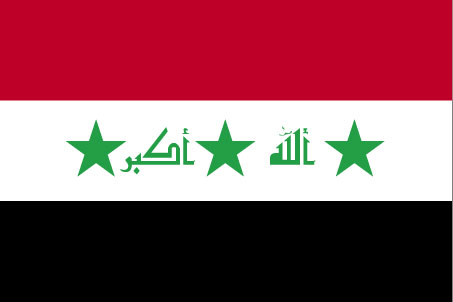
Flag, anthem, and other symbols of national identity.