English
 Español
 中文
中文 हिन्दी
 Français
Government and Politics
Government and Politics of Lebanon
Government structure, leadership, capital, military, and national symbols of Lebanon.
Government Structure
Constitutional foundations, branches, parties, and leadership.
- Government Type
- republic
- Administrative Divisions
- 6 governorates (mohafazat, singular - mohafazah); Beyrouth, Beqaa, Liban-Nord, Liban-Sud, Mont-Liban, Nabatiye
- Legal System
- mixture of Ottoman law, canon law, Napoleonic code, and civil law; no judicial review of legislative acts; has not accepted compulsory ICJ jurisdiction
- Suffrage
- 21 years of age; compulsory for all males; authorized for women at age 21 with elementary education
- Citizenship
- citizenship by birth: no citizenship by descent only: the father must be a citizen of Lebanon dual citizenship recognized: yes residency requirement for naturalization: unknown
- Executive Branch
- chief of state: President Joseph AOUN (since 9 January 2025) head of government: Prime Minister Nawaf SALAM (since 13 February 2025) cabinet: Cabinet chosen by the prime minister in consultation with the president and members of the National Assembly elections: president elected by the National Assembly for a six-year term; the prime minister and deputy prime minister appointed by the president in consultation with the National Assembly; by longstanding agreement, the president is a Maronite Christian, the prime minister is a Sunni Muslim, and the speaker of the National Assembly is a Shia Muslim election results: for 9 January 2025 election: Joseph AOUN elected president; National Assembly vote - 99 votes in favor out of 128 members present; Nawaf SALAM subsequently designated as prime minister following parliamentary consultations and was formally appointed on 8 February 2025, taking office on 13 February 2025
- Legislative Branch
- unicameral National Assembly or Majlis Alnuwab (Arabic) or Assemblee Nationale (French) (128 seats; members elected by popular vote on the basis of sectarian proportional representation to serve four-year terms) elections: last held in four rounds on 29 May, 5, 12, 19 June 2005 (next to be held 2009) election results: percent of vote by group - NA; seats by group - Future Movement Bloc 36; Democratic Gathering 15; Development and Resistance Bloc 15; Loyalty to the Resistance 14; Free Patriotic Movement 14; Lebanese Forces 6; Qornet Shewan 5; Popular Bloc 4; Tripoli Independent Bloc 3; Syrian National Socialist Party 2; Kataeb Reform Movement 2; Tachnaq Party 2; Democratic Renewal Movement 1; Democratic Left 1; Nasserite Popular Movement 1; Ba'th Party 1; Kataeb Party 1; independent 5
- Judicial Branch
- four Courts of Cassation (three courts for civil and commercial cases and one court for criminal cases); Constitutional Council (called for in Ta'if Accord - rules on constitutionality of laws); Supreme Council (hears charges against the president and prime minister as needed)
- Political Parties
- Ba'th Party [leader NA]; Democratic Gathering [Walid JUMBLATT]; Democratic Left [Ilyas ATALLAH]; Democratic Renewal Movement [Nassib LAHUD]; Development and Resistance Bloc [Nabih BERRI, Amal Movement leader/Speaker of the National Assembly]; Free Patriotic Movement [Michel AWN]; Future Movement Bloc [Sa'ad HARIRI]; Kataeb Party [Karim PAKRADONI]; Kataeb Reform Movement [Amine GEMAYAL]; Lebanese Forces [Samir JA'JA]; Loyalty to the Resistance [Mohammad RA'AD]; Metn Bloc [Michel MURR]; Nasserite Popular Movement [Ussama SAAD]; National Bloc [Carlos EDDE]; Popular Bloc [Elias SKAFF]; Qornet Shewan Gathering [a grouping with no individual leader]; Syrian National Socialist Party [Ali QANSU]; Tachnaq Party [leader NA]; Tripoli Independent Bloc [a grouping with no individual leader]
- Head of State
- President Michel SULAYMAN
- Head of Government
- Prime Minister Fuad SINIORA
- Cabinet
- Cabinet chosen by the prime minister in consultation with the president and members of the National Assembly
- Elections
- president elected by the National Assembly for a six-year term (may not serve consecutive terms); election last held 25 May 2008 (next to be held in 2014); the prime minister and deputy prime minister appointed by the president in consultation with the National Assembly
- Election Results
- Michel SULAYMAN elected president; National Assembly vote - 118 for, 6 abstentions, 3 invalidated
- Constitution
- 23 May 1926, amended a number of times, most recently Charter of Lebanese National Reconciliation (Ta'if Accord) of October 1989
- Independence
- 22 November 1943 (from League of Nations mandate under French administration)
- National Holiday
- Independence Day, 22 November (1943)
- International Organization Participation
- ABEDA, ACCT, AFESD, AMF, FAO, G-24, G-77, IAEA, IBRD, ICAO, ICC, ICFTU, ICRM, IDA, IDB, IFAD, IFC, IFRCS, ILO, IMF, IMO, Interpol, IOC, ISO (correspondent), ITU, LAS, NAM, OAS (observer), OIC, PCA, UN, UNCTAD, UNESCO, UNHCR, UNIDO, UNRWA, UPU, WCO, WFTU, WHO, WIPO, WMO, WToO, WTrO (observer)
- Diplomatic Representation in the U.S.
- chief of mission: Ambassador Dr. Farid ABBOUD chancery: 2560 28th Street NW, Washington, DC 20008 telephone: [1] (202) 939-6300 FAX: [1] (202) 939-6324 consulate(s) general: Detroit, New York, Los Angeles
- U.S. Diplomatic Representation
- chief of mission: Ambassador Jeffrey D. FELTMAN embassy: Awkar, Lebanon mailing address: P. O. Box 70-840, Antelias, Lebanon; PSC 815, Box 2, FPO AE 09836-0002; from US: Embassy Beirut, 6070 Beirut Place, Washington, DC 20521-6070 telephone: [961] (4) 542600, 543600 FAX: [961] (4) 544136
Capital City
Seat of government and political history.
- Capital City
- Beirut
- Location
- 33 52 N, 35 30 E
- Time Difference
- UTC+2 (7 hours ahead of Washington, DC, during Standard Time)
- History
- derived from the Canaanite or Phoenician word "ber'ot," meaning "the wells" or "fountain," which referred to the site's accessible water table
Embassy and Diplomatic Representation
Embassy location and contact details.
U.S. Embassy, Beirut Address: Awkar Facing the Municipality PO Box 70-840 Telephone: (961) 4 542600 - 543600 Facsimile: (961) 4 544209 Email: BeirutACS@state.gov U.S. citizens enrolled in STEP can receive updated information and emergency messages via e-mail by subscribing to our Message Service. U.S. citizens without Internet access may enroll directly with the U.S. Embassy in Beirut. Information on consular services and enrollment in STEP can also be found on the Embassy’s website, by contacting us via email, or by phone at the telephone numbers shown above between 2:00 p.m. and 4:00 p.m. Monday through Friday local time. Routine services, such as passport renewals, for U.S. citizens are available Monday through Thursday, 8:00 a.m. to 11:00 a.m. by appointment only. U.S. citizens who require urgent assistance outside these hours may contact the Embassy by telephone at any time.
Military
Branches, service obligations, expenditures, and manpower.
- Military Branches
- Lebanese Armed Forces (LAF): Lebanese Army ((Al Jaysh al Lubnani) includes Lebanese Navy (Al Quwwat al Bahiriyya al Lubnaniya), Lebanese Air Force (Al Quwwat al Jawwiya al Lubnaniya))
- Service Age and Obligation
- 17-30 years of age for voluntary military service; 18-24 years of age for officer candidates; no conscription
National Symbols
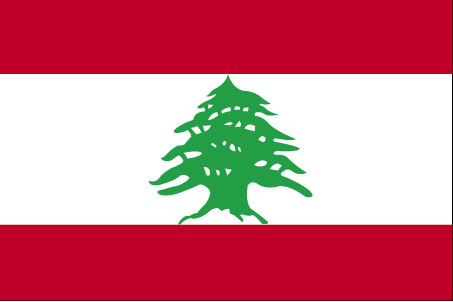
Flag, anthem, and other symbols of national identity.