English
 Español
 中文
中文 हिन्दी
 Français
Government and Politics
Government and Politics of Mauritania
Government structure, leadership, capital, military, and national symbols of Mauritania.
Government Structure
Constitutional foundations, branches, parties, and leadership.
- Government Type
- republic
- Administrative Divisions
- 12 regions (regions, singular - region) and 1 capital district*; Adrar, Assaba, Brakna, Dakhlet Nouadhibou, Gorgol, Guidimaka, Hodh Ech Chargui, Hodh El Gharbi, Inchiri, Nouakchott*, Tagant, Tiris Zemmour, Trarza
- Legal System
- a combination of Shari'a (Islamic law) and French civil law
- Suffrage
- 18 years of age; universal
- Citizenship
- citizenship by birth: no citizenship by descent only: at least one parent must be a citizen of Mauritania dual citizenship recognized: no residency requirement for naturalization: 5 years
- Executive Branch
- chief of state: President Mohamed Ould Cheikh El GHAZOUANI (since 1 August 2019); elected in the June 2019 presidential election with approximately 52% of the vote in the first round, marking the first peaceful democratic transfer of power in Mauritania's history head of government: Prime Minister Mokhtar Ould DJAY (since 6 August 2024) cabinet: Council of Ministers appointed by the president elections: president elected by absolute majority popular vote in two rounds if needed for a five-year term (eligible for a second term); last held on 29 June 2024; prime minister appointed by the president election results: President Mohamed Ould Cheikh El GHAZOUANI reelected in the first round with approximately 56.1% of the vote, defeating several challengers including opposition candidate Biram Dah ABEID who received around 22.1% of the vote
- Legislative Branch
- bicameral legislature consists of the Senate or Majlis al-Shuyukh (56 seats; a portion of seats up for election every two years; members elected by municipal leaders to serve six-year terms) and the National Assembly or Majlis al-Watani (81 seats; members elected by popular vote to serve five-year terms) elections: Senate - last held 9 and 16 April 2004 (next to be held NA); National Assembly - last held 19 and 26 October 2001 (next to be held November 2006) election results: Senate - percent of vote by party - NA; seats by party - NA; National Assembly - percent of vote by party - PRDS 79%, RDU 3.5%, UDP 3.5%, AC 5%, UFP 3.5%, FP 1.5%; seats by party - PRDS 64, UDP 3, RDU 3, AC 4, RFD 3, UFP 3, and FP 1
- Judicial Branch
- Supreme Court or Cour Supreme; Court of Appeals; lower courts
- Political Parties
- Action for Change or AC (no longer active) [Messoud Ould BOULKHEIR]; Alliance for Justice and Democracy or AJD [Cisse Amadou CHEIKHOU]; National Union for Democracy and Development or UNDD [Tidjane KOITA]; Party for Liberty, Equality, and Justice or PLEJ [Ba Mamdou ALASSANE]; Party of Democratic Convergence or PCD [Cheikh Ould HORMA]; Popular Front or FP [Ch'bih Ould CHEIKH MALAININE]; Popular Progressive Alliance or APP [Messoud Ould BOULKHEIR]; Progress Force Union or UFP (no longer active) [Mohamed Ould MAOULOUD]; Rally of Democratic Forces or RFD [Ahmed Ould DADDAH]; Rally for Democracy and Unity or RDU [Ahmed Ould SIDI BABA]; Republican Party for Democracy and Renewal or PRDR (formerly ruling Democratic and Social Republican Party or PRDS) [Boullah Ould MOGUEYA]; Right Way or SAWAB [Cheikh Ould Sidi Ould HANANA]; Union for Democracy and Progress or UDP [Naha Mint MOUKNASS]; Union of Forces of Progress or UFP [Mohamed Ould MAOULOUD] note: the Party of Democratic Convergence was banned in October 2005 because it was regarded as Islamist and therefore in breach of Mauritanian law
- Head of State
- President Mohamed Ould Abdel Aziz
- Head of Government
- Minister Moulaye Ould Mohamed LAGHDAF
- Cabinet
- Council of Ministers
- Elections
- following the August 2008 coup, the High State Council planned to hold a new presidential election in June 2009; the election was subsequently rescheduled to 18 July 2009 following the Dakar Accords, which brought Mauritania back to constitutional rule; under Mauritania’s constitution, the president elected by popular vote for a five-year term; election last held on 18 July 2009 (next to be held by 2014) election results: percent of vote - (second round) Sidi Ould Cheikh ABDELLAHI 52.8%, Ahmed Ould DADDAH 47.2%
- Election Results
- percent of vote - Mohamed Ould Abdel AZIZ 52.6%, Messaoud Ould BOULKHEIR 16.3%, Ahmed Ould DADDAH 13.7%, Other 17.4%
- Constitution
- 12-Jul-91
- Independence
- 28 November 1960 (from France)
- National Holiday
- Independence Day, 28 November (1960)
- International Organization Participation
- ABEDA, ACCT, ACP, AfDB, AFESD, AMF, AMU, AU, CAEU, ECOWAS, FAO, G-77, IBRD, ICAO, ICFTU, ICRM, IDA, IDB, IFAD, IFC, IFRCS, IHO (pending member), ILO, IMF, IMO, Interpol, IOC, IOM, ITU, LAS, NAM, OIC, OPCW, UN, UNCTAD, UNESCO, UNIDO, UPU, WCL, WCO, WHO, WIPO, WMO, WToO, WTrO
- Diplomatic Representation in the U.S.
- chief of mission: Ambassador Tijani Ould KERIM chancery: 2129 Leroy Place NW, Washington, DC 20008 telephone: [1] (202) 232-5700, 5701 FAX: [1] (202) 319-2623
- U.S. Diplomatic Representation
- chief of mission: Ambassador Joseph E. LEBARON embassy: 288 Rue Abdallaye (between Presidency building and Spanish Embassy), Nouakchott mailing address: BP 222, Nouakchott telephone: [222] 525-2660/525-2663 FAX: [222] 525-1592
Capital City
Seat of government and political history.
- Capital City
- Nouakchott
- Location
- 18 04 N, 15 58 W
- Time Difference
- UTC 0 (5 hours ahead of Washington, DC, during Standard Time)
- History
- may derive from the Berber "nawakshut" meaning "place of the winds"
Embassy and Diplomatic Representation
Embassy location and contact details.
Embassy Nouakchott Address: The U.S. Embassy is located between the Presidency building and the Spanish Embassy on Rue Abdallaye. The postal address is B.P. 222, Nouakchott, Mauritania. Telephone: (222) 4525-2660, 4525-2663, 4525-1145 or 4525-3288 Emergency after-hours telephone: (222) 3662-8163 Emergency Consular Recording (to relay messages during emergency situations): (222) 4525-3701 Facsimile: (222) 4525-1592
Military
Branches, service obligations, expenditures, and manpower.
- Military Branches
- Mauritanian Armed Forces: Army, Mauritanian Navy (Marine Mauritanienne; includes naval infantry), Islamic Republic of Mauritania Air Group (Groupement Aerienne Islamique de Mauritanie, GAIM)
- Service Age and Obligation
- 18 is the legal minimum age for voluntary military service; no conscription
National Symbols
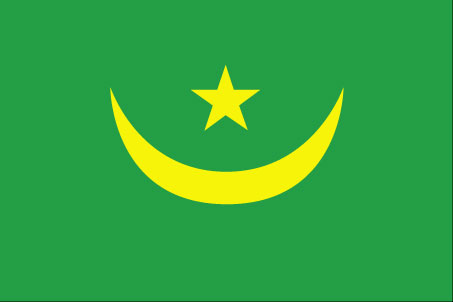
Flag, anthem, and other symbols of national identity.