English
 Español
 中文
中文 हिन्दी
 Français
Government and Politics
Government and Politics of Namibia
Government structure, leadership, capital, military, and national symbols of Namibia.
Government Structure
Constitutional foundations, branches, parties, and leadership.
- Government Type
- republic
- Administrative Divisions
- 13 regions; Caprivi, Erongo, Hardap, Karas, Khomas, Kunene, Ohangwena, Okavango, Omaheke, Omusati, Oshana, Oshikoto, Otjozondjupa
- Legal System
- based on Roman-Dutch law and 1990 constitution
- Suffrage
- 18 years of age; universal
- Citizenship
- citizenship by birth: no citizenship by descent only: at least one parent must be a citizen of Namibia dual citizenship recognized: no residency requirement for naturalization: 5 years
- Executive Branch
- chief of state: President Nangolo MBUMBA (since 4 February 2024); note - President Hage GEINGOB died in office on 4 February 2024, and Vice President Mbumba was sworn in to complete the remaining term; MBUMBA was subsequently elected president in the November 2024 general elections head of government: Prime Minister Elijah NGURARE (since March 2025); note - Saara KUUGONGELWA-AMADHILA served as Prime Minister from 2015 until 2025 cabinet: Cabinet appointed by the president from among the members of the National Assembly elections: President elected by popular vote for a five-year term; election last held on 27 November 2024 (next to be held in November 2029) election results: Nangolo MBUMBA elected president; percent of vote - Nangolo MBUMBA (SWAPO) 57.8%, Panduleni ITULA (IPC) 25.5%, McHenry VENAANI (PDM) 5.1%, other 11.6%
- Legislative Branch
- bicameral legislature consists of the National Council (26 seats; 2 members are chosen from each regional council to serve six-year terms) and the National Assembly (72 seats; members are elected by popular vote to serve five-year terms) elections: National Council - elections for regional councils, to determine members of the National Council, held 29-30 November 2004 (next to be held November 2010); National Assembly - last held 15-16 November 2004 (next to be held November 2009) election results: National Council - percent of vote by party - SWAPO 89.7%, UDF 4.7%, NUDO 2.8%, DTA 1.9%; seats by party - SWAPO 24, UDF 1, DTA 1; National Assembly - percent of vote by party - SWAPO 75.1%, COD 7.2%, DTA 5%, NUDO 4.1%, UDF 3.5%, RP 1.9%, MAG 0.8%; seats by party - SWAPO 55, COD 5, DTA 4, NUDO 3, UDF 3, RP 1, MAG 1 note: the National Council is primarily an advisory body
- Judicial Branch
- Supreme Court (judges appointed by the president on the recommendation of the Judicial Service Commission)
- Political Parties
- Congress of Democrats or COD [Ben ULENGA]; Democratic Turnhalle Alliance of Namibia or DTA [Katuutire KAURA, president]; Monitor Action Group or MAG [Jurie VILJOEN]; South West Africa People's Organization or SWAPO [Sam Shafishuna NUJOMA]; United Democratic Front or UDF [Justus GAROEB]; Republican Party or RP [Henk MUDGE]; National Unity Democratic Organization or NUDO [Kuaima RIRUAKO]
- Head of State
- President Hifikepunye POHAMBA
- Head of Government
- Prime Minister Nahas ANGULA
- Cabinet
- Cabinet appointed by the president from among the members of the National Assembly
- Elections
- Cabinet appointed by the president from among the members of the National Assembly elections: president elected by popular vote for a five-year term (eligible for a second term); election last held on 27-28 November 2009 (next to be held in 2014)
- Election Results
- Hifikepunye POHAMBA reelected president; percent of vote - Hifikepunye POHAMBA 76.4%, Hidipo HAMUTENYA 11.0%, Katuutire KAURA 3.0%, Kuaima RIRUAKO 2.9%, Justus GAROEB 2.4%, Ignatius SHIXWAMENI 1.3%, Hendrick MUDGE 1.2%, other 1.3%
- Constitution
- ratified 9 February 1990; effective 12 March 1990
- Independence
- 21 March 1990 (from South African mandate)
- National Holiday
- Independence Day, 21 March (1990)
- International Organization Participation
- ACP, AfDB, AU, C, FAO, G-77, IAEA, IBRD, ICAO, ICCt, ICFTU, ICRM, IFAD, IFC, IFRCS, ILO, IMF, IMO, Interpol, IOC, IOM (observer), ISO (correspondent), ITU, NAM, OPCW, SACU, SADC, UN, UNCTAD, UNESCO, UNHCR, UNIDO, UNMEE, UNMIL, UPU, WCL, WCO, WHO, WIPO, WMO, WToO, WTrO
- Diplomatic Representation in the U.S.
- chief of mission: Ambassador Hopelong Uushona IPINGE chancery: 1605 New Hampshire Avenue NW, Washington, DC 20009 telephone: [1] (202) 986-0540 FAX: [1] (202) 986-0443
- U.S. Diplomatic Representation
- chief of mission: Ambassador Joyce BARR embassy: Ausplan Building, 14 Lossen Street, Windhoek mailing address: Private Bag 12029 Ausspannplatz, Windhoek telephone: [264] (61) 221601 FAX: [264] (61) 229792
Capital City
Seat of government and political history.
- Capital City
- Windhoek
- Location
- 22 34 S, 17 05 E
- Time Difference
- UTC+1 (6 hours ahead of Washington, DC, during Standard Time)
- History
- may derive from the Afrikaans word "wind-hoek" meaning "windy corner"
Embassy and Diplomatic Representation
Embassy location and contact details.
The U.S. Embassy Windhoek Located at: 14 Lossen Street, Ausspannplatz, Windhoek Mailing address: Private Bag 12029, Ausspannplatz, Windhoek, Namibia Telephone: (264-61) 295-8500 Consular Section: (264-61) 295-8522 Fax: (264-61) 295-8603 After-hours emergency line: (264-81) 127-4384
Military
Branches, service obligations, expenditures, and manpower.
- Military Branches
- Namibian Defense Force (NDF): Army, Navy, Air Force
- Service Age and Obligation
- 18 years of age for voluntary military service; no conscription
National Symbols
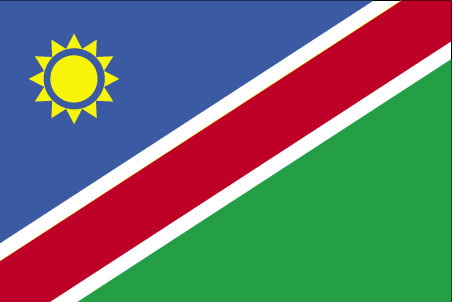
Flag, anthem, and other symbols of national identity.