English
 Español
 中文
中文 हिन्दी
 Français
Government and Politics
Government and Politics of Nepal
Government structure, leadership, capital, military, and national symbols of Nepal.
Government Structure
Constitutional foundations, branches, parties, and leadership.
- Government Type
- parliamentary democracy and constitutional monarchy
- Administrative Divisions
- 14 zones (anchal, singular and plural); Bagmati, Bheri, Dhawalagiri, Gandaki, Janakpur, Karnali, Kosi, Lumbini, Mahakali, Mechi, Narayani, Rapti, Sagarmatha, Seti
- Legal System
- based on Hindu legal concepts and English common law; has not accepted compulsory ICJ jurisdiction
- Suffrage
- 18 years of age; universal
- Citizenship
- citizenship by birth: yes citizenship by descent: yes dual citizenship recognized: no residency requirement for naturalization: 15 years
- Executive Branch
- chief of state: President RAM CHANDRA PAUDEL (took office 13 March 2023); Vice President PURNA BAHADUR KHAM (took office 20 March 2023) head of government: Prime Minister KP SHARMA OLI (took office 15 July 2024); Deputy Prime Ministers BISHNU PRASAD PAUDEL and RABI LAMICHHANE cabinet: Council of Ministers appointed by the president on the recommendation of the prime minister elections/appointments: president indirectly elected by an electoral college consisting of members of the federal parliament and the provincial assemblies for a five-year term (eligible for a second term); election last held on 9 March 2023; following legislative elections, the leader of the majority party or majority coalition is usually appointed prime minister by the president election results: RAM CHANDRA PAUDEL elected president; electoral college vote — RAM CHANDRA PAUDEL (NC) 33,802, SUBASH CHANDRA NEMBANG (CPN-UML) 15,518 note: Nepal was officially declared a federal democratic republic on 28 May 2008, formally abolishing the 240-year-old Shah monarchy. The transition ended the reign of King GYANENDRA Bir Bikram Shah, who had assumed direct executive control in February 2005 after dismissing the government. The royal palace massacre of 1 June 2001, in which King BIRENDRA Bir Bikram Shah Dev and most of the royal family were killed, had preceded this era of political upheaval; Crown Prince DIPENDRA is believed to have been responsible for the shootings before fatally wounding himself, and was briefly crowned king before dying three days later, after which GYANENDRA succeeded him.
- Legislative Branch
- bicameral Parliament consists of the National Council (60 seats; 35 appointed by the House of Representatives, 10 by the king, and 15 elected by an electoral college; one-third of the members elected every two years to serve six-year terms) and the House of Representatives (205 seats; members elected by popular vote to serve five-year terms) elections: House of Representatives - last held 3 and 17 May 1999 (elections have been postponed due to security concerns related to the Maoist insurgency); note - Nepal's Parliament was dissolved on 22 May 2002 election results: House of Representatives (for 1999 parliament) - percent of vote by party - NC 37.3%, CPN/UML 31.6%, NDP (RPP) 10.4%, NSP 3.2%, Rastriya Jana Morcha 1.4%, Samyukta Janmorcha Nepal 0.8%, NWPP 0.5%, others 14.8%; seats by party - NC 113, CPN/UML 69, NDP 11, NSP 5, Rastriya Jana Morcha 5, Samyukta Janmorcha Nepal 1, NWPP 1; note - NC, NSP, and NDP have since each split into two parties
- Judicial Branch
- Supreme Court or Sarbochha Adalat (chief justice is appointed by the monarch on recommendation of the Constitutional Council; the other judges are appointed by the monarch on the recommendation of the Judicial Council)
- Political Parties
- Communist Party of Nepal/United Marxist-Leninist or CPN/UML [Madhav Kumar NEPAL, general secretary]; National Democratic Party or NDP (also called Rastriya Prajantra Party or RPP) [Pashupati Shumsher RANA, chairman]; Nepali Congress-Democratic [Sher Bahadur DEUBA, president]; Nepali Congress or NC [Girija Prasad KOIRALA, party president, Sushil KOIRALA, vice president]; Nepal Sadbhavana (Goodwill) Party or NSP - Mandal [Bhadri Prasad MANDAL, party president]; Nepal Sadbhavana Party - Ananda Devi [Ananda DEVI, president]; Nepal Workers and Peasants Party or NWPP [Narayan Man BIJUKCHHE, party chairman]; People's Front Nepal (Rastriya Jana Morcha) [Amik SHERCHAN, chairman]; Rastriya Janashakti Party or RJP [Surya Bahadur THAPA, chairman]; note - split from RPP in March 2005; Samyukta Janmorcha Nepal [leader NA]; note - merged with People's Front Nepal or PFN in 2002
- Head of State
- President Ram Baran YADAV
- Head of Government
- Prime Minister Madhav Kumar Nepal
- Cabinet
- cabinet formed in August 2008 by a majority coalition made up of the Communist Party Nepal (Marxist), Communist Party Nepal-United Marxist-Leninist, and Mahdesi Jana Adhikar Forum
- Elections
- president elected by Parliament; term NA; election last held 21 July 2008
- Election Results
- Ram Baran YADAV elected president by the Constituent Assembly in a second round of voting on 21 July 2008; Ram Baran YADAV 308, Ram Jaja Prasad SINGH 282
- Constitution
- 9-Nov-90
- Independence
- 1768 (unified by Prithvi Narayan Shah)
- National Holiday
- Birthday of King GYANENDRA, 7 July (1946)
- International Organization Participation
- AsDB, CP, FAO, G-77, IBRD, ICAO, ICC, ICFTU, ICRM, IDA, IFAD, IFC, IFRCS, ILO, IMF, IMO, Interpol, IOC, IOM (observer), ISO (correspondent), ITU, MONUC, NAM, OPCW, SAARC, UN, UNAMSIL, UNCTAD, UNESCO, UNIDO, UNMEE, UNMIK, UNMIL, UNMISET, UNTSO, UPU, WCO, WFTU, WHO, WIPO, WMO, WToO, WTrO (observer)
- Diplomatic Representation in the U.S.
- chief of mission: Ambassador Kedar Bhakta SHRESTHA chancery: 2131 Leroy Place NW, Washington, DC 20008 telephone: [1] (202) 667-4550 FAX: [1] (202) 667-5534 consulate(s) general: New York
- U.S. Diplomatic Representation
- chief of mission: Ambassador James F. MORIARTY embassy: Pani Pokhari, Kathmandu mailing address: use embassy street address telephone: [977] (1) 411-1179 FAX: [977] (1) 441-9963
Capital City
Seat of government and political history.
- Capital City
- Kathmandu
- Location
- 27 43 N, 85 19 E
- Time Difference
- UTC+5.75 (10.75 hours ahead of Washington, DC, during Standard Time)
- History
- name derives from the Kasthamandap temple that stood in Durbar Square; in Sanskrit, kastha means "wood" and mandapa means "pavilion"; the three-story structure was made entirely of wood, without iron nails or supports, and dated to the late 16th century; it collapsed during a 2015 earthquake
Embassy and Diplomatic Representation
Embassy location and contact details.
The U.S. Embassy is located in the Maharajgunj neighborhood of Kathmandu, telephone 977-1-400-7200. (The “ ” sign refers to your international dialing prefix, which is “011” in the United States, and “00” in most other countries. Thus, to call the Embassy from the United States, dial 011-977-1-400-7200.) The Embassy’s website has information on the Embassy’s operating hours and holidays. The Embassy’s Consular Section can also be reached at the same telephone number, or via email. (Nepal local time is 9hours and 45 minutes ahead of Eastern Time during summer months, and 10 hours and 45 minutes ahead of Eastern Time in winter months.)
Military
Branches, service obligations, expenditures, and manpower.
- Military Branches
- Nepal Army
- Service Age and Obligation
- 18 years of age for voluntary military service; no conscription
National Symbols
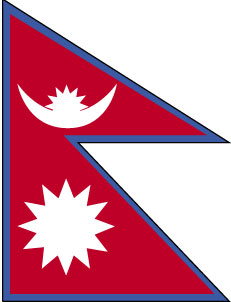
Flag, anthem, and other symbols of national identity.