English
 Español
 中文
中文 हिन्दी
 Français
Government and Politics
Government and Politics of Senegal
Government structure, leadership, capital, military, and national symbols of Senegal.
Government Structure
Constitutional foundations, branches, parties, and leadership.
- Government Type
- republic under multiparty democratic rule
- Administrative Divisions
- 11 regions (regions, singular - region); Dakar, Diourbel, Fatick, Kaolack, Kolda, Louga, Matam, Saint-Louis, Tambacounda, Thies, Ziguinchor
- Legal System
- based on French civil law system; judicial review of legislative acts in Constitutional Court; the Council of State audits the government's accounting office; has not accepted compulsory ICJ jurisdiction
- Suffrage
- 18 years of age; universal
- Citizenship
- citizenship by birth: no citizenship by descent only: at least one parent must be a citizen of Senegal dual citizenship recognized: no, but Senegalese citizens do not automatically lose their citizenship if they acquire citizenship in another state residency requirement for naturalization: 5 years
- Executive Branch
- chief of state: President Abdoulaye WADE (since 1 April 2000) head of government: Prime Minister Macky SALL (since 21 April 2004) cabinet: Council of Ministers appointed by the prime minister in consultation with the president elections: president elected by popular vote for a five-year term under new constitution; election last held under prior constitution (seven-year terms) 27 February and 19 March 2000 (next to be held February 2007); prime minister appointed by the president election results: Abdoulaye WADE elected president; percent of vote in the second round of voting - Abdoulaye WADE (PDS) 58.49%, Abdou DIOUF (PS) 41.51%
- Legislative Branch
- unicameral National Assembly or Assemblee Nationale (120 seats; members are elected by direct, popular vote to serve five-year terms) note: the former National Assembly, dissolved in the spring of 2001, had 140 seats elections: last held 29 April 2001 (next to be held in February 2007) note - the National Assembly in December 2005 voted to postpone legislative elections originally scheduled for 2006, they will now coincide with presidential elections in 2007 election results: percent of vote by party - NA%; seats by party - SOPI Coalition 89, AFP 11, PS 10, other 10
- Judicial Branch
- Constitutional Court; Council of State; Court of Final Appeals or Cour de Cassation; Court of Appeals
- Political Parties
- African Party for Democracy and Socialism or And Jef (also known as PADS/AJ) [Landing SAVANE, secretary general]; African Party of Independence [Majhemout DIOP]; Alliance of Forces of Progress or AFP [Moustapha NIASSE]; Democratic and Patriotic Convention or CDP (also known as Garab-Gi) [Dr. Iba Der THIAM]; Democratic League-Labor Party Movement or LD-MPT [Dr. Abdoulaye BATHILY]; Front for Socialism and Democracy or FSD [Cheikh Abdoulaye DIEYE]; Gainde Centrist Bloc or BGC [Jean-Paul DIAS]; Independence and Labor Party or PIT [Amath DANSOKHO]; National Democratic Rally or RND [Madier DIOUF]; Senegalese Democratic Party or PDS [Abdoulaye WADE]; Socialist Party or PS [Ousmane Tanor DIENG]; SOPI Coalition (a coalition led by the PDS) [Abdoulaye WADE]; Union for Democratic Renewal or URD [Djibo Leyti KA]; other small
- Head of State
- President Abdoulaye WADE
- Head of Government
- Prime Minister Soulayamane Ndene Ndiaye
- Cabinet
- Council of Ministers appointed by the prime minister in consultation with the president
- Elections
- president elected by popular vote for a five-year term (eligible for a second term) under new constitution; election last held on 25 February 2007 (next to be held in 2012); prime minister appointed by the president
- Election Results
- Abdoulaye WADE reelected president in the first round of voting; percent of vote - Abdoulaye WADE 55.9%, Idrissa SECK 14.9%, Ousmane Tanor DIENG 13.6%, Moustapha NIASSE 5.9%, other 9.7%
- Constitution
- a new constitution was adopted 7 January 2001
- Independence
- 4 April 1960 (from France); complete independence was achieved upon dissolution of federation with Mali on 20 August 1960
- National Holiday
- Independence Day, 4 April (1960)
- International Organization Participation
- ACCT, ACP, AfDB, AU, ECOWAS, FAO, FZ, G-15, G-77, IAEA, IBRD, ICAO, ICC, ICCt, ICFTU, ICRM, IDA, IDB, IFAD, IFC, IFRCS, ILO, IMF, IMO, Interpol, IOC, IOM, ISO (correspondent), ITU, MICAH, MONUC, NAM, OIC, OPCW, PCA, UN, UNCTAD, UNESCO, UNIDO, UNMIK, UNMIL, UNMOVIC, UPU, WADB (regional), WAEMU, WCL, WCO, WFTU, WHO, WIPO, WMO, WToO, WTrO
- Diplomatic Representation in the U.S.
- chief of mission: Ambassador Amadou Lamine BA chancery: 2112 Wyoming Avenue NW, Washington, DC 20008 telephone: [1] (202) 234-0540 FAX: [1] (202) 332-6315 consulate(s) general: New York
- U.S. Diplomatic Representation
- chief of mission: Ambassador (vacant); Charge d'Affaires Robert P. JACKSON embassy: Avenue Jean XXIII at the corner of Rue Kleber, Dakar mailing address: B. P. 49, Dakar telephone: [221] 823-4296 FAX: [221] 822-2991
Capital City
Seat of government and political history.
- Capital City
- Dakar
- Location
- 14 44 N, 17 38 W
- Time Difference
- UTC 0 (5 hours ahead of Washington, DC, during Standard Time)
- History
- the Atlantic coast trading settlement of Ndakaaru came to be called "Dakar" by French colonialists
Embassy and Diplomatic Representation
Embassy location and contact details.
U.S. Embassy Dakar Route des Almadies – B.P. 49 Dakar, Senegal Telephone: (221) 33-879-4000 Emergency after-hours telephone: (221) 33-879-4444. Facsimile: (221) 33-879-4050
Military
Branches, service obligations, expenditures, and manpower.
- Military Branches
- Senegalese Armed Forces: Army, Senegalese National Navy (Marine Senegalaise, MNS), Senegalese Air Force (Armee de l'Air du Senegal)
- Service Age and Obligation
- 18 years of age for voluntary military service; 20 years of age for selective conscript service; service obligation is 2 years; women have been accepted into military service since 2008
National Symbols
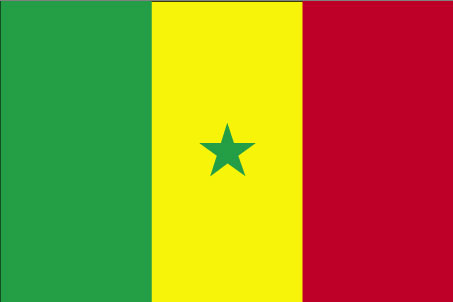
Flag, anthem, and other symbols of national identity.