English
 Español
 中文
中文 हिन्दी
 Français
Government and Politics
Government and Politics of Sudan
Government structure, leadership, capital, military, and national symbols of Sudan.
Government Structure
Constitutional foundations, branches, parties, and leadership.
- Government Type
- authoritarian regime - ruling military junta took power in 1989; government is run by an alliance of the military and the National Congress Party (NCP), formerly the National Islamic Front (NIF), which espouses an Islamist platform
- Administrative Divisions
- 26 states (wilayat, singular - wilayah); A'ali an Nil, Al Bahr al Ahmar, Al Buhayrat, Al Jazirah, Al Khartum, Al Qadarif, Al Wahdah, An Nil al Abyad, An Nil al Azraq, Ash Shamaliyah, Bahr al Jabal, Gharb al Istiwa'iyah, Gharb Bahr al Ghazal, Gharb Darfur, Gharb Kurdufan, Janub Darfur, Janub Kurdufan, Junqali, Kassala, Nahr an Nil, Shamal Bahr al Ghazal, Shamal Darfur, Shamal Kurdufan, Sharq al Istiwa'iyah, Sinnar, Warab
- Legal System
- based on English common law and Islamic law; as of 20 January 1991, the now defunct Revolutionary Command Council imposed Islamic law in the northern states; Islamic law applies to all residents of the northern states regardless of their religion; some separate religious courts; accepts compulsory ICJ jurisdiction, with reservations
- Suffrage
- 17 years of age; universal, but noncompulsory
- Citizenship
- citizenship by birth: no citizenship by descent only: the father must be a citizen of Sudan dual citizenship recognized: no residency requirement for naturalization: 10 years
- Executive Branch
- chief of state: President Field Marshal Umar Hassan Ahmad al-BASHIR (since 16 October 1993); First Vice President Salva KIIR (since 4 August 2005), Vice President Ali Osman TAHA (since 20 September 2005); note - the president is both the chief of state and head of government head of government: President Field Marshal Umar Hassan Ahmad al-BASHIR (since 16 October 1993); First Vice President Salva KIIR (since 4 August 2005), Vice President Ali Osman TAHA (since 20 September 2005); note - the president is both the chief of state and head of government cabinet: Council of Ministers appointed by the president; note - the National Congress Party or NCP (formerly the National Islamic Front or NIF) dominates al-BASHIR's cabinet elections: election last held 13-23 December 2000; next to be held no later than July 2009 under terms of the 2005 Comprehensive Peace Agreement election results: Field Marshall Umar Hassan Ahmad al-BASHIR reelected president; percent of vote - Umar Hassan Ahmad al-BASHIR 86.5%, Ja'afar Muhammed NUMAYRI 9.6%, three other candidates received a combined vote of 3.9%; election widely viewed as rigged; all popular opposition parties boycotted elections because of a lack of guarantees for a free and fair election note: al-BASHIR assumed power as chairman of Sudan's Revolutionary Command Council for National Salvation (RCC) in June 1989 and served concurrently as chief of state, chairman of the RCC, prime minister, and minister of defense until mid-October 1993 when he was appointed president by the RCC; he was elected president by popular vote for the first time in March 1996
- Legislative Branch
- bi-cameral body comprising the National Assembly and Council of States (replaced unicameral National Assembly of 360 seats); pending elections and National Election Law, the Presidency appointed 450 members to the National Assembly according to the provisions of the 2005 Comprehensive Peace Agreement: 52% NCP; 28% SPLM; 14% other Northerners; 6% other Southerners; 2 representatives from every state constitute the Council of States; terms in each chamber are five years following the first elections elections: last held 13-22 December 2000 (next to be held 2008-2009 timeframe) election results: NCP 355, others 5; note - replaced by appointments under the 2005 Comprehensive Peace Agreement
- Judicial Branch
- Constitutional Court of nine justices; National Supreme Court; National Courts of Appeal; other national courts; National Judicial Service Commission will undertake overall management of the National Judiciary
- Political Parties
- political parties in the Government of National Unity include: National Congress Party or NCP [Ibrahim Ahmed OMAR]; Sudan People's Liberation Movement or SPLM [Salva Mayardit KIIR]; and elements of the National Democratic Alliance or NDA including factions of the Democratic Union Party [Muhammad Uthman al-MIRGHANI] and Umma Party [SADIQ Siddiq al-Mahdi]
- Head of State
- Umar Hassan Ahmad al-BASHIR
- Head of Government
- Umar Hassan Ahmad al-BASHIR
- Cabinet
- Council of Ministers appointed by the president; note - the National Congress Party or NCP (formerly the National Islamic Front or NIF) dominates al-BASHIR’s cabinet
- Elections
- election last held 13-23 December 2000; next to be held no later than July 2009 under terms of the 2005 Comprehensive Peace Agreement
- Election Results
- Umar Hassan Ahmad al-BASHIR reelected president; percent of vote - Umar Hassan Ahmad al-BASHIR 86.5%, Ja’afar Muhammed NUMAYRI 9.6%, three other candidates received a combined vote of 3.9%; election widely viewed as rigged; all popular opposition parties boycotted elections because of a lack of guarantees for a free and fair election
- Constitution
- 12 April 1973, suspended following coup of 6 April 1985; interim constitution of 10 October 1985 suspended following coup of 30 June 1989; new constitution implemented on 30 June 1998 partially suspended 12 December 1999 by President BASHIR
- Independence
- 1 January 1956 (from Egypt and UK)
- National Holiday
- Independence Day, 1 January (1956)
- International Organization Participation
- ABEDA, ACP, AfDB, AFESD, AMF, AU, CAEU, FAO, G-77, IAEA, IBRD, ICAO, ICCt (signatory), ICRM, IDA, IDB, IFAD, IFC, IFRCS, IGAD, ILO, IMF, IMO, Interpol, IOC, IOM, ISO (correspondent), ITU, LAS, NAM, OIC, OPCW, PCA, UN, UNCTAD, UNESCO, UNHCR, UNIDO, UPU, WCO, WFTU, WHO, WIPO, WMO, WToO, WTrO (observer)
- Diplomatic Representation in the U.S.
- chief of mission: Ambassador (vacant); Charge d'Affaires, Ad Interim Khidir Haroun AHMED (since April 2001) chancery: 2210 Massachusetts Avenue NW, Washington, DC 20008 telephone: [1] (202) 338-8565 FAX: [1] (202) 667-2406
- U.S. Diplomatic Representation
- chief of mission: Ambassador Cameron HUME embassy: Sharia Ali Abdul Latif Avenue, Khartoum mailing address: P. O. Box 699, Khartoum; APO AE 09829 telephone: [249] (11) 774611 or 774700 FAX: [249] (11) 774137 note: US Consul in Cairo is providing backup service for Khartoum; consular services are being established in Juba (southern Sudan)
Capital City
Seat of government and political history.
- Capital City
- Khartoum
- Location
- 15 36 N, 32 32 E
- Time Difference
- UTC+3 (8 hours ahead of Washington, DC, during Standard Time)
- History
- several explanations of the name exist; two of the more plausible are that it is derived from Arabic "al-jartum" meaning "elephant's trunk" or "hose," and likely referring to the narrow strip of land extending between the Blue and White Niles; alternatively, the name could derive from the Dinka words "khar-tuom," indicating a "place where rivers meet"
Embassy and Diplomatic Representation
Embassy location and contact details.
U.S. Embassy Sudan Kilo 10 - Soba, Khartoum Telephone: (249) 1-870-22000 (from outside Sudan) 0-187-022000 (from inside Sudan) ACSKhartoum@state.gov
Military
Branches, service obligations, expenditures, and manpower.
- Military Branches
- Sudanese Armed Forces (SAF): Land Forces, Navy (includes Marines), Sudanese Air Force (Sikakh al-Jawwiya as-Sudaniya), Popular Defense Forces
- Service Age and Obligation
- 18-33 years of age for male and female compulsory or voluntary military service; 1-2 year service obligation; a requirement that completion of national service was mandatory before entering public or private sector employment has been cancelled
National Symbols
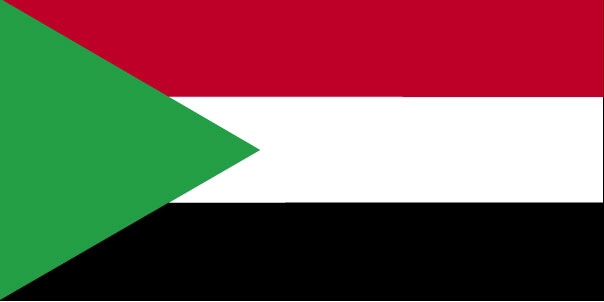
Flag, anthem, and other symbols of national identity.