English
 Español
 中文
中文 हिन्दी
 Français
Government and Politics
Government and Politics of Syria
Government structure, leadership, capital, military, and national symbols of Syria.
Government Structure
Constitutional foundations, branches, parties, and leadership.
- Government Type
- republic under military regime since March 1963
- Administrative Divisions
- 14 provinces (muhafazat, singular - muhafazah); Al Hasakah, Al Ladhiqiyah, Al Qunaytirah, Ar Raqqah, As Suwayda', Dar'a, Dayr az Zawr, Dimashq, Halab, Hamah, Hims, Idlib, Rif Dimashq, Tartus
- Legal System
- based on Islamic law and civil law system; special religious courts; has not accepted compulsory ICJ jurisdiction
- Suffrage
- 18 years of age; universal
- Citizenship
- citizenship by birth: no citizenship by descent only: the father must be a citizen of Syria; if the father is unknown or stateless, the mother must be a citizen of Syria dual citizenship recognized: yes residency requirement for naturalization: 10 years
- Executive Branch
- chief of state: Following the fall of Bashar al-ASAD's government in December 2024, Syria entered a transitional period. Ahmad al-SHARAA (also known as Abu Mohammad al-JOLANI), leader of Hayat Tahrir al-Sham (HTS), was named transitional president in January 2025 after rebel forces led by HTS captured Damascus and effectively ended over five decades of Assad family rule. head of government: Mohammad al-BASHIR was appointed head of the transitional government (Prime Minister) in December 2024, tasked with overseeing a transitional period expected to last until March 2025, after which a new governing framework is to be established. cabinet: A transitional governing body has been established, with ministers appointed to manage the transition and maintain basic governmental functions across Syrian territory. elections: Under the Assad government, the president was approved by popular referendum for a seven-year term. Bashar al-ASAD had most recently secured approval in a 2021 referendum, officially receiving 95.1% of the vote — an election widely criticized by Western governments and human rights organizations as neither free nor fair. With the collapse of the Assad government, the future electoral framework for Syria remains under discussion as part of the transitional process. note: Bashar al-ASAD fled Syria on 8 December 2024 as rebel forces swept through the country, ultimately taking Damascus. This brought an end to the Assad family's grip on power, which began when Hafiz al-ASAD seized control in 1970. Hafiz al-ASAD died on 10 June 2000, after which his son Bashar assumed the presidency following a referendum held on 10 July 2000.
- Legislative Branch
- unicameral People's Council or Majlis al-Shaab (250 seats; members elected by popular vote to serve four-year terms) elections: last held 2-3 March 2003 (next to be held NA 2007) election results: percent of vote by party - NPF 67%, independents 33%; seats by party - NPF 167, independents 83; note - the constitution guarantees that the Ba'th Party (part of the NPF alliance) receives one-half of the seats
- Judicial Branch
- Supreme Constitutional Court (adjudicates electoral disputes and rules on constitutionality of laws and decrees; justices appointed for four-year terms by the President); High Judicial Council (appoints and dismisses judges; headed by the President); Court of Cassation (national level); State Security Courts (hear cases related to national security); Personal Status Courts (religious; hear cases related to marriage and divorce); Courts of First Instance (local level; include magistrate, summary, and peace courts)
- Political Parties
- Arab Socialist Unionist Movement [Ahmed al-AHMED]; National Progressive Front or NPF (includes Arab Socialist Renaissance (Ba'th) Party; the governing party) [President Bashar al-ASAD, secretary general]; Socialist Unionist Democratic Party [Fadlallal Nasr Al-DIN]; Syrian Arab Socialist Party or ASP [Safwan QUDSI]; Syrian Communist Party (two branches) [Wissal Farha BAKDASH, Yuusuf Rashid FAYSAL]; Syrian Social National Party [Jubran URAYJI]; Unionist Socialist Party [Fayez ISMAIL]
- Head of State
- Bashar al-ASAD
- Head of Government
- Muhammad Naji al-UTRI
- Cabinet
- Council of Ministers appointed by the president
- Elections
- ar term (no term limits); referendum last held on 27 May 2007 (next to be held in May 2014); the president appoints the vice presidents, prime minister, and deputy prime ministers
- Election Results
- Bashar al-ASAD approved as president; percent of vote - Bashar al-ASAD 97.6%
- Constitution
- 13-Mar-73
- Independence
- 17 April 1946 (from League of Nations mandate under French administration)
- National Holiday
- Independence Day, 17 April (1946)
- International Organization Participation
- ABEDA, AFESD, AMF, CAEU, FAO, G-24, G-77, IAEA, IBRD, ICAO, ICC, ICCt (signatory), ICRM, IDA, IDB, IFAD, IFC, IFRCS, IHO, ILO, IMF, IMO, Interpol, IOC, ISO, ITU, LAS, NAM, OAPEC, OIC, UN, UNCTAD, UNESCO, UNIDO, UNRWA, UPU, WCO, WFTU, WHO, WMO, WToO
- Diplomatic Representation in the U.S.
- chief of mission: Ambassador Imad MUSTAFA chancery: 2215 Wyoming Avenue NW, Washington, DC 20008 telephone: [1] (202) 232-6313 FAX: [1] (202) 234-9548
- U.S. Diplomatic Representation
- chief of mission: Ambassador Margaret SCOBEY embassy: Abou Roumaneh, Al-Mansur Street, No. 2, Damascus mailing address: P. O. Box 29, Damascus telephone: [963] (11) 333-1342 FAX: [963] (11) 224-7938
Capital City
Seat of government and political history.
- Capital City
- Damascus
- Location
- 33 30 N, 36 18 E
- Time Difference
- UTC+3 (8 hours ahead of Washington, DC, during Standard Time)
- History
- Damascus is a very old city; its earliest name, Temeseq, first appears in an Egyptian geographical list of the 15th century B.C., but the meaning is uncertain
Embassy and Diplomatic Representation
Embassy location and contact details.
The U.S. Embassy in Damascus suspended operations in February 2012 and therefore cannot provide protection or routine consular services to U.S. citizens in Syria. The Government of the Czech Republic, acting through its Embassy in Damascus, serves as Protecting Power for U.S. interests in Syria. The range of consular services the Czech Republic provides to U.S. citizens is extremely limited, and those services may require significantly more processing time than at U.S. embassies or consulates outside of Syria. U.S. citizens in Syria who seek consular services should contact the U.S. Interests Section of the Embassy of the Czech Republic in Damascus at USIS_damascus@embassy.mzv.cz. U.S. citizens in Syria who are in need of emergency assistance in Syria, and are unable to reach the U.S. Interests Section of the Embassy of the Czech Republic or must make contact outside business hours, should contact the U.S. Embassy in Amman, Jordan: Telephone: 962 (6) 590-6950 (Daily 2-3:30 local time) Emergencies: 962 (6) 590-6500 E-mail: Amman-ACS@state.gov If you seek information about U.S. citizens’ services in Syria from the Office of Overseas Citizens’ Services in Washington, please e-mail: SyriaEmergencyUSC@state.gov.
Military
Branches, service obligations, expenditures, and manpower.
- Military Branches
- Syrian Armed Forces: Land Forces, Naval Forces, Air Forces (includes Air Defense Forces)
- Service Age and Obligation
- 18 years of age for compulsory and voluntary military service; conscript service obligation is 18 months; women are not conscripted but may volunteer to serve; re-enlistment obligation 5 years, with retirement after 15 years or age 40 (enlisted) or 20 years or age 45 (NCOs)
National Symbols
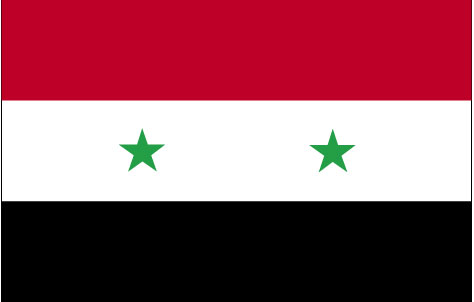
Flag, anthem, and other symbols of national identity.