English
 Español
 中文
中文 हिन्दी
 Français
Government and Politics
Government and Politics of Thailand
Government structure, leadership, capital, military, and national symbols of Thailand.
Government Structure
Constitutional foundations, branches, parties, and leadership.
- Government Type
- constitutional monarchy
- Administrative Divisions
- 76 provinces (changwat, singular and plural); Amnat Charoen, Ang Thong, Buriram, Chachoengsao, Chai Nat, Chaiyaphum, Chanthaburi, Chiang Mai, Chiang Rai, Chon Buri, Chumphon, Kalasin, Kamphaeng Phet, Kanchanaburi, Khon Kaen, Krabi, Krung Thep Mahanakhon (Bangkok), Lampang, Lamphun, Loei, Lop Buri, Mae Hong Son, Maha Sarakham, Mukdahan, Nakhon Nayok, Nakhon Pathom, Nakhon Phanom, Nakhon Ratchasima, Nakhon Sawan, Nakhon Si Thammarat, Nan, Narathiwat, Nong Bua Lamphu, Nong Khai, Nonthaburi, Pathum Thani, Pattani, Phangnga, Phatthalung, Phayao, Phetchabun, Phetchaburi, Phichit, Phitsanulok, Phra Nakhon Si Ayutthaya, Phrae, Phuket, Prachin Buri, Prachuap Khiri Khan, Ranong, Ratchaburi, Rayong, Roi Et, Sa Kaeo, Sakon Nakhon, Samut Prakan, Samut Sakhon, Samut Songkhram, Sara Buri, Satun, Sing Buri, Sisaket, Songkhla, Sukhothai, Suphan Buri, Surat Thani, Surin, Tak, Trang, Trat, Ubon Ratchathani, Udon Thani, Uthai Thani, Uttaradit, Yala, Yasothon
- Legal System
- based on civil law system, with influences of common law; has not accepted compulsory ICJ jurisdiction
- Suffrage
- 18 years of age; universal and compulsory
- Citizenship
- Citizenship by birth: no Citizenship by descent only: at least one parent must be a citizen of Thailand Dual citizenship recognized: no Residency requirement for naturalization: 5 years
- Executive Branch
- chief of state: King VAJIRALONGKORN Bodindradebayavarangkun, also known as Rama X (since 13 October 2016); the king is also the head of the Royal House of Chakri head of government: Prime Minister PAETONGTARN Shinawatra (since 18 August 2024); Deputy Prime Ministers ANUTIN Charnvirakul, PHOOMTHAM Wechayachai, and SURIYA Juangroongruangkit cabinet: Council of Ministers nominated by the prime minister and appointed by the king note: there is also a Privy Council that serves as an advisory body to the monarch elections: none; the monarch is hereditary; following national elections for the House of Representatives, the prime minister is typically the leader of the party or coalition commanding a parliamentary majority and is formally appointed by the king; the Constitutional Court and the Senate have at times played significant roles in determining who holds the office
- Legislative Branch
- bicameral National Assembly or Rathasapha consists of the Senate or Wuthisapha (200 seats; members elected by popular vote to serve six-year terms) and the House of Representatives or Sapha Phuthaen Ratsadon (500 seats; members elected by popular vote to serve four-year terms) elections: Senate - last held 4 March, 29 April, 4 June, 9 July, and 22 July 2000 (next to be held in April 2006); House of Representatives - last held 6 February 2005 (next to be held in February 2009) election results: Senate - percent of vote by party - NA; seats by party - NA; House of Representatives - percent of vote by party - NA; seats by party - TRT 376, DP 97, TNP 25, PP 2
- Judicial Branch
- Supreme Court or Sandika (judges appointed by the monarch)
- Political Parties
- Democrat Party or DP (Prachathipat Party) [ABHISIT Wetchachiwa]; People's Party or PP (Mahachon Party) [ANEK Laothamatas]; Thai Nation Party or TNP (Chat Thai Party) [BARNHARN SILPA-ARCHA]; Thai Rak Thai Party or TRT [THAKSIN Chinnawat]
- Head of State
- King PHUMIPHON Adunyadet
- Head of Government
- Prime Minister ABHISIT Wetchachiwa
- Cabinet
- Council of Ministers
- Elections
- monarch is hereditary; according to 2007 constitution, prime minister is elected from among members of House of Representatives; following national elections for House of Representatives, leader of party that could organize a majority coalition usually was appointed prime minister by king; prime minister is limited to two 4-year terms
- Constitution
- new constitution signed by King PHUMIPHON on 11 October 1997
- Independence
- 1238 (traditional founding date; never colonized)
- National Holiday
- Birthday of King PHUMIPHON, 5 December (1927)
- International Organization Participation
- APEC, ARF, AsDB, ASEAN, BIS, CP, FAO, G-77, IAEA, IBRD, ICAO, ICC, ICCt (signatory), ICFTU, ICRM, IDA, IFAD, IFC, IFRCS, IHO, ILO, IMF, IMO, Interpol, IOC, IOM, ISO, ITU, NAM, OAS (observer), OIC (observer), OPCW, OSCE (partner), PCA, UN, UNAMSIL, UNCTAD, UNESCO, UNHCR, UNIDO, UNMISET, UPU, WCL, WCO, WFTU, WHO, WIPO, WMO, WToO, WTrO
- Diplomatic Representation in the U.S.
- chief of mission: KASIT Piromya chancery: 1024 Wisconsin Avenue NW, Suite 401, Washington, DC 20007-3681 telephone: [1] (202) 944-3600 FAX: [1] (202) 944-3611 consulate(s) general: Chicago, Los Angeles, New York
- U.S. Diplomatic Representation
- chief of mission: Ambassador Ralph L. BOYCE embassy: 120-122 Wireless Road, Bangkok 10330 mailing address: APO AP 96546 telephone: [66] (2) 205-4000 FAX: [66] (2) 254-2990, 205-4131 consulate(s) general: Chiang Mai
Capital City
Seat of government and political history.
- Capital City
- Bangkok
- Location
- 13 45 N, 100 31 E
- Time Difference
- UTC+7 (12 hours ahead of Washington, DC, during Standard Time)
- History
- Bangkok was likely originally a colloquial name, but one that was widely adopted by foreign visitors; the name may derive from bang ko, where bang is the Thai word for "village on a stream" and ko means "island," both referencing the area's landscape, which was carved by rivers and canals; alternatively, the name may come from bang makok, where makok is the name of the Java plum, a plant bearing olive-like fruit; this possibility is supported by the former name of Wat Arun, a historic temple in the area, that used to be called Wat Makok; Krung Thep Maha Nakhon, the city's Thai name, means "City of Angels, Great City" or simply "Great City of Angels" and is a shortening of the full ceremonial name: Krungthepmahanakhon Amonrattanakosin Mahintharayutthaya Mahadilokphop Noppharatratchathaniburirom Udomratchaniwetmahasathan Amonphimanawatansathit Sakkathattiyawitsanukamprasit; translated the meaning is: "City of angels, great city of immortals, magnificent city of the nine gems, seat of the king, city of royal palaces, home of gods incarnate, erected by Vishvakarman at Indra's behest"; it holds the world's record as the longest place name (169 letters); Krung Thep is used colloquially
Embassy and Diplomatic Representation
Embassy location and contact details.
U.S. Embassy, Bangkok 95 Wireless Road, Bangkok 10330, Thailand Telephone: 66-2-205-4049, 02-205-4049 (within Thailand) Emergency after-hours telephone: 66-2-205-4000, 02-205-4000 (within Thailand) Facsimile: 66-2-205-4103, 02-205-4103 (within Thailand) U.S. Consulate General, Chiang Mai 387 Wichayanond Road, Chiang Mai 50300, Thailand Telephone: 66-53-107-700, 053-107-700 (within Thailand) Emergency after-hours telephone: 66-81-881-1878, 081-881-1878 (within Thailand) Facsimile: 66-53-252-633, 053-252-633 (within Thailand)
Military
Branches, service obligations, expenditures, and manpower.
- Military Branches
- Royal Thai Army (Kongthap Bok Thai, RTA), Royal Thai Navy (Kongthap Ruea Thai, RTN, includes Royal Thai Marine Corps), Royal Thai Air Force (Kongthap Agard Thai, RTAF)
- Service Age and Obligation
- 21 years of age for compulsory military service; 18 years of age for voluntary military service; males register at 18 years of age; 2-year conscript service obligation
National Symbols
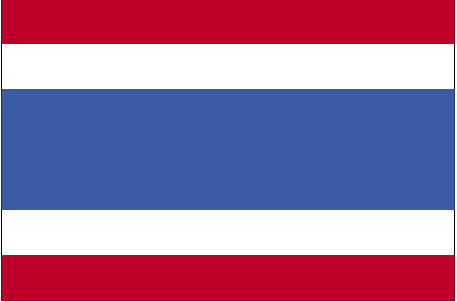
Flag, anthem, and other symbols of national identity.