English
 Español
 中文
中文 हिन्दी
 Français
Government and Politics
Government and Politics of Tunisia
Government structure, leadership, capital, military, and national symbols of Tunisia.
Government Structure
Constitutional foundations, branches, parties, and leadership.
- Government Type
- republic
- Administrative Divisions
- 24 governorates; Ariana (Aryanah), Beja (Bajah), Ben Arous (Bin 'Arus), Bizerte (Banzart), Gabes (Qabis), Gafsa (Qafsah), Jendouba (Jundubah), Kairouan (Al Qayrawan), Kasserine (Al Qasrayn), Kebili (Qibili), Kef (Al Kaf), Mahdia (Al Mahdiyah), Manouba (Manubah), Medenine (Madanin), Monastir (Al Munastir), Nabeul (Nabul), Sfax (Safaqis), Sidi Bou Zid (Sidi Bu Zayd), Siliana (Silyanah), Sousse (Susah), Tataouine (Tatawin), Tozeur (Tawzar), Tunis, Zaghouan (Zaghwan)
- Legal System
- based on French civil law system and Islamic law; some judicial review of legislative acts in the Supreme Court in joint session
- Suffrage
- 20 years of age; universal
- Citizenship
- citizenship by birth: no citizenship by descent only: at least one parent must be a citizen of Tunisia dual citizenship recognized: yes residency requirement for naturalization: 5 years
- Executive Branch
- chief of state: President Zine el Abidine BEN ALI (since 7 November 1987) head of government: Prime Minister Mohamed GHANNOUCHI (since 17 November 1999) cabinet: Council of Ministers appointed by the president elections: president elected by popular vote for a five-year term; election last held 24 October 2004 (next to be held October 2009); prime minister appointed by the president election results: President Zine El Abidine BEN ALI reelected for a fourth term; percent of vote - Zine El Abidine BEN ALI 94.5%, Mohamed BOUCHIHA 3.8%, Mohamed Ali HALOUANI 1%
- Legislative Branch
- bicameral system consists of the Chamber of Deputies or Majlis al-Nuwaab (189 seats; members elected by popular vote to serve five-year terms) and the Chamber of Advisors (126 seats; 85 members elected by municipal counselors, deputies, mayors, and professional associations and trade unions; 41 members are presidential appointees; members serve six-year terms) elections: Chamber of Deputies - last held 24 October 2004 (next to be held October 2009); Chamber of Advisors - last held 3 July 2005 (next to be held July 2011) election results: Chamber of Deputies - percent of vote by party - NA; seats by party - RCD 152, MDS 14, PUP 11, UDU 7, Al-Tajdid 3, PSL 2; Chamber of Advisors - percent of vote by party - NA; seats by party - RCD 71 (14 trade union seats vacant (boycotted))
- Judicial Branch
- Court of Cassation or Cour de Cassation
- Political Parties
- Al-Tajdid Movement [Ali HALOUANI]; Constitutional Democratic Rally Party (Rassemblement Constitutionnel Democratique) or RCD [President Zine El Abidine BEN ALI (official ruling party)]; Liberal Social Party or PSL [Mounir BEJI]; Movement of Socialist Democrats or MDS [Ismail BOULAHYA]; Popular Unity Party or PUP [Mohamed BOUCHIHA]; Progressive Democratic Party [Nejib CHEBBI]; Unionist Democratic Union or UDU [Ahmed INOUBLI]
- Head of State
- President Zine el Abidine BEN ALI
- Head of Government
- Prime Minister Mohamed GHANNOUCHI
- Cabinet
- Council of Ministers appointed by the president
- Elections
- president elected by popular vote for a five-year term (no term limits); election last held on 25 October 2009 (next to be held in October 2014); prime minister appointed by the president
- Election Results
- President Zine El Abidine BEN ALI reelected for a fifth term; percent of vote - Zine El Abidine BEN ALI 89.6%, Mohamed BOUCHIHA 5%, Ahmed INOUBLI 3.8%, Ahmed BRAHIM 1.6%; voter turnout 89.4%
- Constitution
- 1 June 1959; amended 12 July 1988
- Independence
- 20 March 1956 (from France)
- National Holiday
- Independence Day, 20 March (1956)
- International Organization Participation
- ABEDA, ACCT, AfDB, AFESD, AMF, AMU, AU, BSEC (observer), FAO, G-77, IAEA, IBRD, ICAO, ICC, ICFTU, ICRM, IDA, IDB, IFAD, IFC, IFRCS, IHO, ILO, IMF, IMO, Interpol, IOC, IOM, ISO, ITU, LAS, MICAH, MONUC, NAM, OAPEC, OAS (observer), OIC, OPCW, OSCE (partner), UN, UNCTAD, UNESCO, UNHCR, UNIDO, UNMEE, UNMIK, UPU, WCO, WFTU, WHO, WIPO, WMO, WToO, WTrO
- Diplomatic Representation in the U.S.
- chief of mission: Ambassador Mohamed Nejib HACHANA chancery: 1515 Massachusetts Avenue NW, Washington, DC 20005 telephone: [1] (202) 862-1850 FAX: [1] (202) 862-1858
- U.S. Diplomatic Representation
- chief of mission: Ambassador William J. HUDSON embassy: Zone Nord-Est des Berges du Lac Nord de Tunis 1053, Tunisia mailing address: use embassy street address telephone: [216] 71 107-000 FAX: [216] 71 107-090
Capital City
Seat of government and political history.
- Capital City
- Tunis
- Location
- 36 48 N, 10 11 E
- Time Difference
- UTC+1 (6 hours ahead of Washington, DC during Standard Time)
- History
- three possibilities exist for the derivation of the name; originally a Berber settlement (earliest reference 4th century B.C.), the strategic site fell to the Carthaginians (Phoenicians) and the city could be named after the Punic goddess Tanit, since many ancient cities were named after patron deities; alternatively, the Berber root word "ens," which means "to lie down" or "to pass the night," may indicate that the site was originally a camp or rest stop; finally, the name may be the same as the city of Tynes, mentioned in the writings of some ancient authors
Embassy and Diplomatic Representation
Embassy location and contact details.
U.S. Embassy in Tunis Les Berges du Lac 1053 Tunis, Tunisia Telephone: (216) 71-107-000, Fax: (216) 71-964-360 Email: consulartunis@state.gov
Military
Branches, service obligations, expenditures, and manpower.
- Military Branches
- Tunisian Armed Forces (Forces Armees Tunisiens, FAT): Tunisian Army (includes Tunisian Air Defense Force), Tunisian Navy, Republic of Tunisia Air Force (Al-Quwwat al-Jawwiya al-Jamahiriyah At'Tunisia)
- Service Age and Obligation
- 20-23 years of age for compulsory service, one year service obligation; 18-23 years of age for voluntary service; Tunisian nationality required
National Symbols
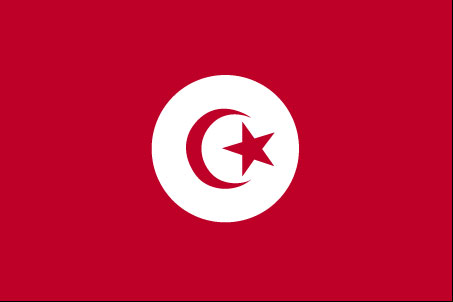
Flag, anthem, and other symbols of national identity.