English
 Español
 中文
中文 हिन्दी
 Français
Government and Politics
Government and Politics of United States of America
Government structure, leadership, capital, military, and national symbols of United States of America.
Government Structure
Constitutional foundations, branches, parties, and leadership.
- Government Type
- Constitution-based federal republic; strong democratic tradition
- Administrative Divisions
- 50 states and 1 district*; Alabama, Alaska, Arizona, Arkansas, California, Colorado, Connecticut, Delaware, District of Columbia*, Florida, Georgia, Hawaii, Idaho, Illinois, Indiana, Iowa, Kansas, Kentucky, Louisiana, Maine, Maryland, Massachusetts, Michigan, Minnesota, Mississippi, Missouri, Montana, Nebraska, Nevada, New Hampshire, New Jersey, New Mexico, New York, North Carolina, North Dakota, Ohio, Oklahoma, Oregon, Pennsylvania, Rhode Island, South Carolina, South Dakota, Tennessee, Texas, Utah, Vermont, Virginia, Washington, West Virginia, Wisconsin, Wyoming
- Legal System
- federal court system based on English common law; each state has its own unique legal system, of which all but one (Louisiana's) is based on English common law; judicial review of legislative acts; accepts compulsory ICJ jurisdiction with reservations
- Suffrage
- 18 years of age; universal
- Citizenship
- citizenship by birth: yes citizenship by descent only: yes dual citizenship recognized: no, but the US government acknowledges such situtations exist; US citizens are not encouraged to seek dual citizenship since it limits protection by the US residency requirement for naturalization: 5 years
- Executive Branch
- chief of state: President Donald J. TRUMP (since 20 January 2025); Vice President JD VANCE (since 20 January 2025); note - the president is both the chief of state and head of government head of government: President Donald J. TRUMP (since 20 January 2025); Vice President JD VANCE (since 20 January 2025); note - the president is both the chief of state and head of government cabinet: Cabinet appointed by the president with Senate approval elections: president and vice president elected on the same ticket by a college of representatives who are elected directly from each state; president and vice president serve four-year terms; election last held 5 November 2024 (next to be held 7 November 2028) election results: Donald J. TRUMP elected president; percent of popular vote - Donald J. TRUMP (Republican Party) 49.8%, Kamala D. HARRIS (Democratic Party) 48.3%, other 1.9%
- Legislative Branch
- bicameral Congress consists of the Senate (100 seats, one-third are renewed every two years; 2 members are elected from each state by popular vote to serve six-year terms) and the House of Representatives (435 seats; members are directly elected by popular vote to serve two-year terms) elections: Senate - last held 2 November 2004 (next to be held on 7 November 2006); House of Representatives - last held 2 November 2004 (next to be held on 7 November 2006) election results: Senate - percent of vote by party - NA; seats by party - Republican Party 55, Democratic Party 44, independent 1; House of Representatives - percent of vote by party - NA; seats by party - Republican Party 231, Democratic Party 200, undecided 4
- Judicial Branch
- Supreme Court (its nine justices are appointed for life on condition of good behavior by the president with confirmation by the Senate); United States Courts of Appeal; United States District Courts; State and County Courts
- Political Parties
- Democratic Party [Howard DEAN]; Green Party [leader NA]; Libertarian Party [Steve DAMERELL]; Republican Party [Ken MEHLMAN]
- Head of State
- Barack H. OBAMA
- Head of Government
- Barack H. OBAMA
- Cabinet
- Cabinet appointed by the president with Senate approval
- Elections
- president and vice president elected on the same ticket by a college of representatives who are elected directly from each state; president and vice president serve four-year terms (eligible for a second term); election last held 4 November 2008 (next to be held on 6 November 2012)
- Election Results
- Barack H. OBAMA elected president; percent of popular vote - Barack H. OBAMA 52.4%, John MCCAIN 46.3%, other 1.3%;
- Constitution
- 17 September 1787, effective 4 March 1789
- Independence
- 4 July 1776
- National Holiday
- Independence Day, 4 July (1776)
- International Organization Participation
- AfDB, ANZUS, APEC, ARF, AsDB, ASEAN (dialogue partner), Australia Group, BIS, CE (observer), CERN (observer), CP, EAPC, EBRD, FAO, G-5, G-7, G- 8, G-10, IADB, IAEA, IBRD, ICAO, ICC, ICCt (signatory), ICFTU, ICRM, IDA, IEA, IFAD, IFC, IFRCS, IHO, ILO, IMF, IMO, Interpol, IOC, IOM, ISO, ITU, MIGA, MINUSTAH, NAM (guest), NATO, NEA, NSG, OAS, OECD, OPCW, OSCE, Paris Club, PCA, UN, UN Security Council, UNCTAD, UNESCO, UNHCR, UNITAR, UNMEE, UNMIK, UNMIL, UNMOVIC, UNOMIG, UNRWA, UNTSO, UPU, WCL, WCO, WHO, WIPO, WMO, WTO, ZC
Capital City
Seat of government and political history.
- Capital City
- Washington, DC
- Location
- 38 53 N, 77 02 W
- Time Difference
- UTC-5 (during Standard Time) time zone note: the 50 United States cover six time zones
- History
- named after George WASHINGTON (1732-1799), the first president of the United States
Military
Branches, service obligations, expenditures, and manpower.
- Military Branches
- The United States Armed Forces: US Army, US Navy (includes Marine Corps), US Air Force, US Coast Guard; note - Coast Guard administered in peacetime by the Department of Homeland Security, but in wartime reports to the Department of the Navy
- Service Age and Obligation
- 18 years of age (17 years of age with parental consent) for male and female voluntary service; no conscription; maximum enlistment age 42 (Army), 27 (Air Force), 34 (Navy), 28 (Marines); service obligation 8 years, including 2-5 years active duty (Army), 2 years active (Navy), 4 years active (Air Force, Marines); Department of Defense is eliminating prohibitions restricting women from assignments in units smaller than brigades or near combat units
National Symbols
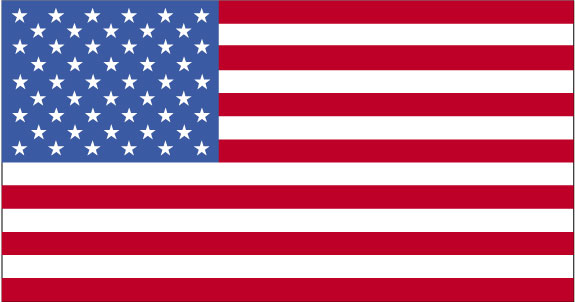
Flag, anthem, and other symbols of national identity.