English
 Español
 中文
中文 हिन्दी
 Français
Government and Politics
Government and Politics of Austria
Government structure, leadership, capital, military, and national symbols of Austria.
Government Structure
Constitutional foundations, branches, parties, and leadership.
- Government Type
- federal republic
- Administrative Divisions
- 9 states (Bundeslaender, singular - Bundesland); Burgenland, Kaernten, Niederoesterreich, Oberoesterreich, Salzburg, Steiermark, Tirol, Vorarlberg, Wien
- Legal System
- civil law system with Roman law origin; judicial review of legislative acts by the Constitutional Court; separate administrative and civil/penal supreme courts; accepts compulsory ICJ jurisdiction
- Suffrage
- 18 years of age; universal; compulsory for presidential elections
- Citizenship
- citizenship by birth: no citizenship by descent only: at least one parent must be a citizen of Austria dual citizenship recognized: no residency requirement for naturalization: 10 years
- Executive Branch
- chief of state: President Alexander VAN DER BELLEN (since 26 January 2017; re-elected December 2022) head of government: Chancellor Karl NEHAMMER (OeVP) (since 6 January 2022); Vice Chancellor Werner KOGLER (Greens) (since 7 January 2020) cabinet: Council of Ministers chosen by the president on the advice of the chancellor elections: president elected by direct popular vote for a six-year term; presidential election last held on 9 October 2022 (next to be held in 2028); chancellor traditionally chosen by the president from the plurality party in the National Council; vice chancellor chosen by the president on the advice of the chancellor election results: Alexander VAN DER BELLEN re-elected president in the first round; percent of vote - Alexander VAN DER BELLEN (independent) 56.7%, Walter ROSENKRANZ (FPOe) 17.7%, other candidates combined 25.6% note: government coalition - OeVP and Greens
- Legislative Branch
- bicameral Federal Assembly or Bundesversammlung consists of Federal Council or Bundesrat (62 members; members represent each of the states on the basis of population, but with each state having at least 3 representatives; members serve a five- or six-year term) and the National Council or Nationalrat (183 seats; members elected by direct popular vote to serve four-year terms) elections: National Council - last held 24 November 2002 (next to be held in the fall of 2006) election results: National Council - percent of vote by party - OeVP 42.3%, SPOe 36.5%, FPOe 10.0%, Greens 9.5%; seats by party - OeVP 79, SPOe 69, FPOe 18, Greens 17; seating as of May 2005 after split within the Freedom Party: OeVP 79, SPOe 69, Greens 17, BZOe 11, FPOe 7
- Judicial Branch
- Supreme Judicial Court or Oberster Gerichtshof; Administrative Court or Verwaltungsgerichtshof; Constitutional Court or Verfassungsgerichtshof
- Political Parties
- Alliance for the Future of Austria or BZOe [Joerg HAIDER]; Austrian People's Party or OeVP [Wolfgang SCHUESSEL]; Freedom Party of Austria or FPOe [Heinz Christian STRACHE]; Social Democratic Party of Austria or SPOe [Alfred GUSENBAUER]; The Greens [Alexander VAN DER BELLEN]
- Head of State
- President Heinz FISCHER (SPOe)
- Head of Government
- Chancellor Werner FAYMANN (OeVP)
- Cabinet
- Council of Ministers chosen by the president on the advice of the chancellor
- Elections
- president elected by direct popular vote for a six-year term (eligible for a second term); presidential election last held on 25 April 2010 (next to be held on 25 April 2016); chancellor formally chosen by the president but determined by the coalition parties forming a parliamentary majority; vice chancellor chosen by the president on the advice of the chancellor
- Election Results
- Heinz FISCHER reelected president; percent of vote - Heinz FISCHER 79.3%, Barbara ROSENKRANZ 15.2%, Rudolf GEHRING 5.4% note: government coalition - SPOe and OeVP
- Constitution
- 1920; revised 1929 (reinstated 1 May 1945)
- Independence
- 1156 (from Bavaria)
- National Holiday
- National Day, 26 October (1955); note - commemorates the State Treaty restoring national sovereignty and the end of occupation and the passage of the law on permanent neutrality
- International Organization Participation
- AfDB, AsDB, Australia Group, BIS, BSEC (observer), CE, CEI, CERN, EAPC, EBRD, EIB, EMU, ESA, EU, FAO, G- 9, IADB, IAEA, IBRD, ICAO, ICC, ICCt, ICFTU, ICRM, IDA, IEA, IFAD, IFC, IFRCS, ILO, IMF, IMO, Interpol, IOC, IOM, ISO, ITU, MINURSO, NAM (guest), NEA, NSG, OAS (observer), OECD, OPCW, OSCE, Paris Club, PCA, PFP, UN, UNCTAD, UNDOF, UNESCO, UNFICYP, UNHCR, UNIDO, UNITAR, UNMEE, UNMIK, UNMISET, UNOMIG, UNTSO, UPU, WCL, WCO, WEU (observer), WFTU, WHO, WIPO, WMO, WToO, WTrO, ZC
- Diplomatic Representation in the U.S.
- chief of mission: Ambassador Eva NOWOTNY chancery: 3524 International Court NW, Washington, DC 20008-3035 telephone: [1] (202) 895-6700 FAX: [1] (202) 895-6750 consulate(s) general: Chicago, Los Angeles, New York
- U.S. Diplomatic Representation
- chief of mission: Ambassador Susan R. McCAW embassy: Boltzmanngasse 16, A-1090, Vienna mailing address: use embassy street address telephone: [43] (1) 31339 FAX: [43] (1) 3100682
Capital City
Seat of government and political history.
- Capital City
- Vienna
- Location
- 48 12 N, 16 22 E
- Time Difference
- UTC+1 (6 hours ahead of Washington, DC, during Standard Time)
- History
- the origin of the name is disputed but may derive from early Celtic settlements of the area; a plausible reconstructed Celtic name from several centuries B.C. is Vedunia (meaning "forest stream"), which in Old High German became uuenia (wenia), and later wien (its current German form) in New High German; another possibility is that the name stems from the Roman settlement Vindobona, established around 15 B.C., and its Celtic-derived name (likely from the Celtic windo, meaning "white, fair, or bright" and bona meaning "base, fortification, or settlement" to give a connotation of "white settlement" or "white fort"); archeological remains of the latter survive at many sites in the center of Vienna
Embassy and Diplomatic Representation
Embassy location and contact details.
EMBASSY LOCATION: U.S. Embassy in Vienna, Consular Section Parkring 12a Telephone: 43- 1-31339-7535 After hours: 43-1-31339 Facsimile: 43-1-512 58 35 E-mail: ConsulateVienna@state.gov
Military
Branches, service obligations, expenditures, and manpower.
- Military Branches
- Land Forces (KdoLdSK), Air Forces (KdoLuSK)
- Service Age and Obligation
- Registration requirement at age 17, the legal minimum age for voluntary military service; 18 is the legal minimum age for compulsory service; males under the age of 35 must complete basic military training (6-month duration); males 18 to 50 years old in the militia or inactive reserve are subject to compulsory service
National Symbols
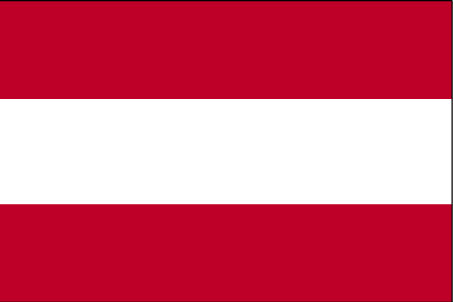
Flag, anthem, and other symbols of national identity.