English
 Español
 中文
中文 हिन्दी
 Français
Government and Politics
Government and Politics of Belarus
Government structure, leadership, capital, military, and national symbols of Belarus.
Government Structure
Constitutional foundations, branches, parties, and leadership.
- Government Type
- republic
- Administrative Divisions
- 6 voblastsi (singular - voblasts') and one municipality* (harady, singular - horad); Brestskaya (Brest), Homyel'skaya (Homyel'), Horad Minsk*, Hrodzyenskaya (Hrodna), Mahilyowskaya (Mahilyow), Minskaya, Vitsyebskaya (Vitsyebsk); note - when using a place name with the adjectival ending 'skaya,' the word Voblasts' should be added to the place name
- Legal System
- based on civil law system
- Suffrage
- 18 years of age; universal
- Citizenship
- citizenship by birth: no citizenship by descent only: at least one parent must be a citizen of Belarus dual citizenship recognized: no residency requirement for naturalization: 7 years
- Executive Branch
- chief of state: President Aleksandr LUKASHENKO (since 20 July 1994) head of government: Prime Minister Roman GOLOVCHENKO (since 4 June 2020); First Deputy Prime Minister Nikolai SNOPKOV (since June 2020) cabinet: Council of Ministers elections: president elected by popular vote for a seven-year term under constitutional changes approved in the February 2022 referendum; first election took place 23 June and 10 July 1994; Aleksandr LUKASHENKO extended his original term to 2001 via a November 1996 referendum; subsequent elections held in 2001, 2006, 2010, 2015, and 2020; an October 2004 referendum ended presidential term limits; the February 2022 constitutional referendum introduced further changes to the political system, including the creation of the All-Belarusian People's Assembly as a new supreme representative body; prime minister and deputy prime ministers appointed by the president election results: Aleksandr LUKASHENKO declared the winner of the August 9, 2020 presidential election with an official vote count of 80.1% against main opposition candidate Sviatlana TSIKHANOUSKAYA, who received 10.1%; the election was widely condemned by Western governments and international observers as neither free nor fair, and triggered mass protests across Belarus; Lukashenko was inaugurated for a sixth term on 23 September 2020 in a secret ceremony; under the 2022 constitution, Lukashenko was granted the right to serve two additional terms
- Legislative Branch
- bicameral National Assembly or Natsionalnoye Sobranie consists of the Council of the Republic or Soviet Respubliki (64 seats; 56 members elected by regional councils and 8 members appointed by the president, all for four-year terms) and the Chamber of Representatives or Palata Predstaviteley (110 seats; members elected by universal adult suffrage to serve four-year terms) elections: last held 17 and 31 October 2004; international observers widely denounced the elections as flawed and undemocratic, based on massive government falsification; pro-LUKASHENKO candidates won every seat, after many opposition candidates were disqualified for technical reasons election results: Soviet Respubliki - percent of vote by party - NA; seats by party - NA; Palata Predstaviteley - percent of vote by party - NA; seats by party - NA
- Judicial Branch
- Supreme Court (judges are appointed by the president); Constitutional Court (half of the judges appointed by the president and half appointed by the Chamber of Representatives)
- Political Parties
- Pro-government parties: Agrarian Party or AP [Mikhail SHIMANSKY]; Belarusian Communist Party or KPB [leader NA]; Belarusian Patriotic Movement (Belarusian Patriotic Party) or BPR [Nikolai ULAKHOVICH, chairman]; Liberal Democratic Party of Belarus [Sergei GAYDUKEVICH]; Party of Labor and Justice [Viktor SOKOLOV]; Social-Sports Party [Vladimir ALEXANDROVICH]; Opposition parties: 10 Plus Coalition [Alyaksandr MILINKEVICH], includes: Belarusian Party of Communists or PKB [Syarhey KALYAKIN]; Belarusian Party of Labor (unregistered) [Aleksandr BUKHVOSTOV, Leonid LEMESHONAK]; Belarusian Popular Front or BPF [Vintsyuk VYACHORKA]; Belarusian Social-Democratic Gramada [Stanislav SHUSHKEVICH]; Green Party [Oleg GROMYKO]; Party of Freedom and Progress (unregistered) [Vladimir NOVOSYAD]; United Civic Party or UCP [Anatol LYABEDKA]; Women's Party “Nadezhda7RDQUO; [Valentina MATUSEVICH, chairperson]; Other opposition includes: Belarusian Social-Democratic Party Nardonaya Hromada or BSDP NH [Alyaksandr KOZULIN, chairman]; Christian Conservative BPF [Zyanon PAZNIAK]; Ecological Party of Greens [Mikhail KARTASH]; Party of Popular Accord [Sergei YERMAKK]; Republican Party [Vladimir BELAZOR]
- Head of State
- President Aleksandr LUKASHENKO
- Head of Government
- Prime Minister Sergey SIDORSKIY
- Cabinet
- Council of Ministers
- Elections
- president elected by popular vote for a five-year term; first election took place 23 June and 10 July 1994; according to the 1994 constitution, the next election should have been held in 1999, however, Aleksandr LUKASHENKO extended his term to 2001 via a November 1996 referendum; subsequent election held 9 September 2001; an October 2004 referendum ended presidential term limits and allowed the president to run in a third election, which was held on 19 March 2006; prime minister and deputy prime ministers appointed by the president
- Election Results
- Aleksandr LUKASHENKO reelected president; percent of vote - Aleksandr LUKASHENKO 82.6%, Aleksandr MILINKEVICH 6%, Aleksandr KOZULIN 2.3%; note - election marred by electoral fraud
- Constitution
- 30 March 1994; revised by national referendum of 24 November 1996 giving the presidency greatly expanded powers and became effective 27 November 1996
- Independence
- 25 August 1991 (from Soviet Union)
- National Holiday
- Independence Day, 3 July (1944); note - 3 July 1944 was the date Minsk was liberated from German troops, 25 August 1991 was the date of independence from the Soviet Union
- International Organization Participation
- CEI, CIS, EAPC, EBRD, IAEA, IBRD, ICAO, ICFTU, ICRM, IFC, IFRCS, ILO, IMF, Interpol, IOC, IOM (observer), ISO, ITU, NAM, NSG, OPCW, OSCE, PCA, PFP, UN, UNCTAD, UNESCO, UNIDO, UPU, WCO, WFTU, WHO, WIPO, WMO, WTrO (observer)
- Diplomatic Representation in the U.S.
- chief of mission: Ambassador Mikhail KHVOSTOV chancery: 1619 New Hampshire Avenue NW, Washington, DC 20009 telephone: [1] (202) 986-1604 FAX: [1] (202) 986-1805 consulate(s) general: New York
- U.S. Diplomatic Representation
- chief of mission: Ambassador George A. KROL embassy: 46 Starovilenskaya St., Minsk 220002 mailing address: PSC 78, Box B Minsk, APO 09723 telephone: [375] (17) 210-12-83, 217-7347, 217-7348 FAX: [375] (17) 234-7853
Capital City
Seat of government and political history.
- Capital City
- Minsk
- Location
- 53 54 N, 27 34 E
- Time Difference
- UTC+2 (7 hours ahead of Washington, DC during Standard Time)
- History
- the origin of the name is disputed; Minsk may originally have been located 16 km to the southwest, on the banks of Menka River; remnants of a 10th-century settlement on the banks of the Menka have been found
Embassy and Diplomatic Representation
Embassy location and contact details.
U.S. Embassy Minsk 46 Starovilenskaya St. Minsk 220002 Telephone: (375 17) 210-1283 After hours: (375 29) 676-0134 Facsimile (375 17) 334-7853 or (375 17) 17-217-7160 (consular section) Email: ConsularMinsk@state.gov
Military
Branches, service obligations, expenditures, and manpower.
- Military Branches
- Belarus Armed Forces: Land Force, Air and Air Defense Force, Special Operations Force
- Service Age and Obligation
- 18-27 years of age for compulsory military service; conscript service obligation is 12-18 months, depending on academic qualifications; 17-year-olds are eligible to become cadets at military higher education institutes, where they are classified as military personnel
National Symbols
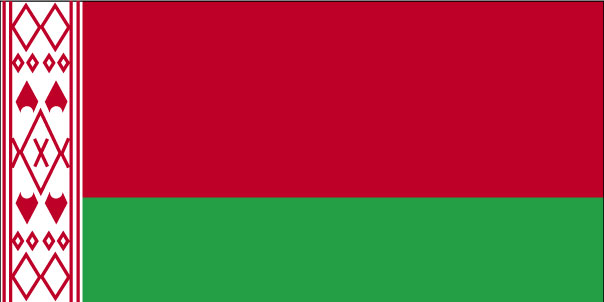
Flag, anthem, and other symbols of national identity.