English
 Español
 中文
中文 हिन्दी
 Français
Government and Politics
Government and Politics of Bosnia and Herzegovina
Government structure, leadership, capital, military, and national symbols of Bosnia and Herzegovina.
Government Structure
Constitutional foundations, branches, parties, and leadership.
- Government Type
- emerging federal democratic republic
- Administrative Divisions
- there are two first-order administrative divisions and one internationally supervised district* - Brcko district (Brcko Distrikt)*, the Bosniak/Croat Federation of Bosnia and Herzegovina (Federacija Bosna i Hercegovina) and the Bosnian Serb-led Republika Srpska; note - Brcko district is in northeastern Bosnia and is an administrative unit under the sovereignty of Bosnia and Herzegovina; the district remains under international supervision
- Legal System
- based on civil law system
- Suffrage
- 16 years of age, if employed; 18 years of age, universal
- Citizenship
- citizenship by birth: no citizenship by descent only: at least one parent must be a citizen of Bosnia and Herzegovina dual citizenship recognized: yes, provided there is a bilateral agreement with the other state residency requirement for naturalization: 8 years
- Executive Branch
- chief of state: The presidency of Bosnia and Herzegovina consists of three members — one Bosniak, one Croat, and one Serb — who collectively serve as the chief of state. As of the most recent term, the tripartite presidency includes Denis BECIROVIC (Bosniak), Zeljka CVIJANOVIC (Serb), and Zeljko KOMSIC (Croat), elected in October 2022. The chairmanship rotates among the three members every eight months; Denis BECIROVIC assumed the first chairmanship of the current term. head of government: Chairman of the Council of Ministers Borjana KRISTO (since February 2023) cabinet: Council of Ministers nominated by the council chairman and approved by the Parliamentary Assembly elections: The three members of the presidency (one Bosniak, one Croat, one Serb) are elected by popular vote for a four-year term; the chairmanship rotates among the three members every eight months; the most recent general election was held on 2 October 2022; the Chairman of the Council of Ministers is appointed by the presidency and confirmed by the House of Representatives election results: In the October 2022 elections, Denis BECIROVIC received the most votes among Bosniak candidates, Zeljko KOMSIC won the Croat seat, and Zeljka CVIJANOVIC secured the Serb seat; BECIROVIC assumed the initial chairmanship of the presidency note: President of the Federation of Bosnia and Herzegovina: Lidiia BRADARA (since 2023); President of Republika Srpska: Milorad DODIK (since January 2023), who also serves concurrently as the Serb member of the state-level presidency
- Legislative Branch
- bicameral Parliamentary Assembly or Skupstina consists of the national House of Representatives or Predstavnicki Dom (42 seats - elected by proportional representation, 28 seats allocated from the Federation of Bosnia and Herzegovina and 14 seats from the Republika Srpska; members elected by popular vote to serve four-year terms); and the House of Peoples or Dom Naroda (15 seats - 5 Bosniak, 5 Croat, 5 Serb; members elected by the Bosniak/Croat Federation's House of Representatives and the Republika Srpska's National Assembly to serve four-year terms); note - Bosnia's election law specifies four-year terms for the state and first-order administrative division entity legislatures elections: national House of Representatives - elections last held 5 October 2002 (next to be held in 2006); House of Peoples - last constituted in January 2003 (next to be constituted in 2007) election results: national House of Representatives - percent of vote by party/coalition - SDA 21.9%, SDS 14.0%, SBiH 10.5%, SDP 10.4%, SNSD 9.8%, HDZ-BH 9.5%, PDP 4.6%, other 19.3%; seats by party/coalition - SDA 10, SDS 5, SBiH 6, SDP 4, SNSD 3, HDZ-BH 5, PDP 2, other 7; House of Peoples - percent of vote by party/coalition - NA; seats by party/coalition - NA note: the Bosniak/Croat Federation has a bicameral legislature that consists of a House of Representatives (98 seats; members elected by popular vote to serve four-year terms); elections last held 5 October 2002 (next to be held in October 2006); percent of vote by party - NA; seats by party/coalition - SDA 32, HDZ-BH 16, SDP 15, SBiH 15, other 20; and a House of Peoples (60 seats - 30 Bosniak, 30 Croat); last constituted December 2002; the Republika Srpska has a National Assembly (83 seats; members elected by popular vote to serve four-year terms); elections last held 5 October 2002 (next to be held in the fall of 2006); percent of vote by party - NA; seats by party/coalition - SDS 26, SNSD 19, PDP 9, SDA 6, SRS 4, SBH 4, SPRS 3, DNZ 3, SDP 3, other 6; as a result of the 2002 constitutional reform process, a 28-member Republika Srpska Council of Peoples (COP) was established in the Republika Srpska National Assembly including eight Croats, eight Bosniaks, eight Serbs, and four members of the smaller communities
- Judicial Branch
- BH Constitutional Court (consists of nine members: four members are selected by the Bosniak/Croat Federation's House of Representatives, two members by the Republika Srpska's National Assembly, and three non-Bosnian members by the president of the European Court of Human Rights); BH State Court (consists of nine judges and three divisions - Administrative, Appellate and Criminal - having jurisdiction over cases related to state-level law and appellate jurisdiction over cases initiated in the entities); note - a War Crimes Chamber opened in March 2005 note: the entities each have a Supreme Court; each entity also has a number of lower courts; there are 10 cantonal courts in the Federation, plus a number of municipal courts; the Republika Srpska has five municipal courts
- Political Parties
- Alliance of Independent Social Democrats or SNSD [Milorad DODIK]; Bosnian Party or BOSS [Mirnes AJANOVIC]; Civic Democratic Party or GDS [Ibrahim SPAHIC]; Croat Christian Democratic Union of Bosnia and Herzegovina or HKDU [Marin TOPIC]; Croat Party of Rights or HSP [Zvonko JURISIC]; Croat Peasants Party or HSS [Marko TADIC]; Croatian Democratic Union of Bosnia and Herzegovina or HDZ-BH [Dragan COVIC]; Croatian Peoples Union [Milenko BRKIC]; Democratic National Union or DNZ [Rifet DOLIC]; Democratic Peoples Alliance [Marko PAVIC]; Liberal Democratic Party or LDS [Rasim KADIC]; New Croat Initiative or NHI [Kresimir ZUBAK]; Party for Bosnia and Herzegovina or SBiH [Safet HALILOVIC]; Party for Democratic Action or SDA [Sulejman TIHIC]; Party of Democratic Progress or PDP [Mladen IVANIC]; Serb Democratic Party or SDS [Dragan CAVIC]; Serb Radical Party of the Republika Srpska or SRS-RS [Milanko MIHAJLICA]; Serb Radical Party-Dr. Vojislav Seselj or SRS-VS [Radislav KANJERIC]; Social Democratic Party of BIH or SDP [Zlatko LAGUMDZIJA]; Social Democratic Union or SDU [Sejfudin TOKIC]; Socialist Party of Republika Srpska or SPRS [Petar DJOKIC]
- Head of State
- Chairman of the Presidency Nebojsa RADMANOVIC, Haris SILAJDZIC, and Zeljko KOMSIC
- Head of Government
- Chairman of the Council of Ministers Nikola SPIRIC
- Cabinet
- Council of Ministers nominated by the council chairman; approved by the National House of Representatives
- Elections
- the three members of the presidency (one Bosniak, one Croat, one Serb) are elected by popular vote for a four-year term (eligible for a second term, but then ineligible for four years); the chairmanship rotates every eight months and resumes where it left off following each national election; election last held 1 October 2006 (next to be held in 2010); the chairman of the Council of Ministers is appointed by the presidency and confirmed by the National House of Representatives
- Election Results
- percent of vote - Nebojsa RADMANOVIC with 53.3% of the votes for the Serb seat; Zeljko KOMSIC received 39.6% of the votes for the Croat seat; Haris SILAJDZIC received 62.8% of the votes for the Bosniak seat
- Constitution
- the Dayton Agreement, signed 14 December 1995, included a new constitution now in force; note - each of the entities also has its own constitution
- Independence
- 1 March 1992 (from Yugoslavia; referendum for independence was completed 1 March 1992; independence was declared 3 March 1992)
- National Holiday
- National Day, 25 November (1943)
- International Organization Participation
- BIS, CE, CEI, EBRD, FAO, G-77, IAEA, IBRD, ICAO, ICCt, IDA, IFAD, IFC, IFRCS, ILO, IMF, IMO, Interpol, IOC, IOM (observer), ISO, ITU, MONUC, NAM (guest), OAS (observer), OIC (observer), OPCW, OSCE, UN, UNCTAD, UNESCO, UNIDO, UNMEE, UPU, WHO, WIPO, WMO, WToO, WTrO (observer)
- Diplomatic Representation in the U.S.
- chief of mission: Ambassador Bisera TURKOVIC chancery: 2109 E Street NW, Washington, DC 20037 telephone: [1] (202) 337-1500 FAX: [1] (202) 337-1502 consulate(s) general: Chicago, New York
- U.S. Diplomatic Representation
- chief of mission: Ambassador Douglas L. McELHANEY embassy: Alipasina 43, 71000 Sarajevo mailing address: use street address telephone: [387] (33) 445-700 FAX: [387] (33) 659-722 branch office(s): Banja Luka, Mostar
Capital City
Seat of government and political history.
- Capital City
- Sarajevo
- Location
- 43 52 N, 18 25 E
- Time Difference
- UTC+1 (6 hours ahead of Washington, DC, during Standard Time)
- History
- the name derives from the Turkish noun saray, meaning "palace" or "mansion," and the term ova, signifying "plain(s)," to give a meaning of "palace plains" or "the plains about the palace"
Embassy and Diplomatic Representation
Embassy location and contact details.
U.S. Embassy Sarajevo 1 Robert C. Frasure Street 71000 Sarajevo Telephone: (387) 33 704 000 Emergency after-hours telephone: (387) 33 704 000. If after dialing you receive a recorded message, press “0” and ask for the embassy duty officer. Facsimile: (387) 33 221 837 E-mail: rws@state.gov
Military
Branches, service obligations, expenditures, and manpower.
- Military Branches
- Armed Forces of Bosnia and Herzegovina (AFBiH): Army of Bosnia and Herzegovina, Air and Air Defense Forces of Bosnia and Herzegovina (Zrakoplovstvo i Protuzracna Obrana, ZPO)
- Service Age and Obligation
- 18 years of age for voluntary military service; mandatory retirement at age 35 or after 15 years of service
National Symbols
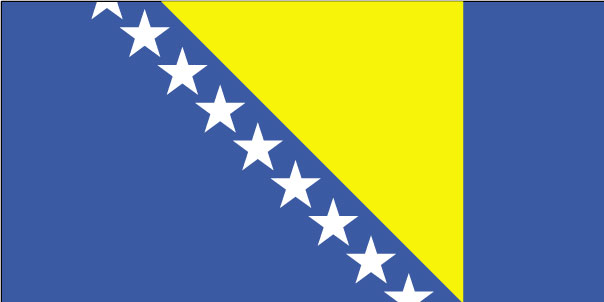
Flag, anthem, and other symbols of national identity.