English
 Español
 中文
中文 हिन्दी
 Français
Government and Politics
Government and Politics of Croatia
Government structure, leadership, capital, military, and national symbols of Croatia.
Government Structure
Constitutional foundations, branches, parties, and leadership.
- Government Type
- presidential/parliamentary democracy
- Administrative Divisions
- 20 counties (zupanije, zupanija - singular) and 1 city* (grad - singular); Bjelovarsko-Bilogorska Zupanija, Brodsko-Posavska Zupanija, Dubrovacko-Neretvanska Zupanija, Istarska Zupanija, Karlovacka Zupanija, Koprivnicko-Krizevacka Zupanija, Krapinsko-Zagorska Zupanija, Licko-Senjska Zupanija, Medimurska Zupanija, Osjecko-Baranjska Zupanija, Pozesko-Slavonska Zupanija, Primorsko-Goranska Zupanija, Sibensko-Kninska Zupanija, Sisacko-Moslavacka Zupanija, Splitsko-Dalmatinska Zupanija, Varazdinska Zupanija, Viroviticko-Podravska Zupanija, Vukovarsko-Srijemska Zupanija, Zadarska Zupanija, Zagreb*, Zagrebacka Zupanija
- Legal System
- based on civil law system
- Suffrage
- 18 years of age; universal (16 years of age, if employed)
- Citizenship
- Citizenship by birth: No Citizenship by descent only: At least one parent must be a citizen of Croatia Dual citizenship recognized: Yes Residency requirement for naturalization: 5 years
- Executive Branch
- chief of state: President Zoran MILANOVIC (since 18 February 2020) head of government: Prime Minister Andrej PLENKOVIC (since 19 October 2016); Deputy Prime Ministers Ranko OSTOJIC, Davor BOZINOVIC, and others as appointed within the coalition cabinet cabinet: Council of Ministers named by the prime minister and approved by the Croatian Parliament (Hrvatski Sabor) elections: president elected by popular vote for a five-year term; election last held in January 2020 (next to be held in January 2025); the leader of the majority party or the leader of the majority coalition is usually appointed prime minister by the president and then approved by the Assembly election results: Zoran MILANOVIC elected president in the second round; percent of vote - Zoran MILANOVIC (SDP) approximately 52.7%, Kolinda GRABAR-KITAROVIC (HDZ) approximately 47.3%
- Legislative Branch
- unicameral Assembly or Sabor (152 seats; note - one seat was added in the November 2003 parliamentary elections; members elected from party lists by popular vote to serve four-year terms) elections: last held 23 November 2003 (next to be held in 2007) election results: percent of vote by party - NA; number of seats by party - HDZ 66, SDP 34, HSS 10, HNS 10, HSP 8, IDS 4, Libra 3, HSU 3, SDSS 3, other 11 note: minority government coalition - HDZ, DC, HSLS, HSU, SDSS
- Judicial Branch
- Supreme Court; Constitutional Court; judges for both courts appointed for eight-year terms by the Judicial Council of the Republic, which is elected by the Assembly
- Political Parties
- Croatian Bloc or HB [Ivic PASALIC]; Croatian Christian Democratic Union or HKDU [Anto KOVACEVIC]; Croatian Democratic Union or HDZ [Ivo SANADER]; Croatian Party of Rights or HSP [Anto DJAPIC]; Croatian Peasant Party or HSS [Josip FRISCIC]; Croatian Pensioner Party or HSU [Vladimir JORDAN]; Croatian People's Party or HNS [Vesna PUSIC] (in 2005 party merged with Libra to become Croatian People's Party-Liberal Democrats or NS-LD [Vesna PUSIC]); Croatian Social Liberal Party or HSLS [Ivan CEHOK]; Croatian True Revival Party or HIP [Miroslav TUDJMAN]; Democratic Centre or DC [Vesna SKARE-OZBOLT]; Independent Democratic Serb Party or SDSS [Vojislav STANIMIROVIC]; Istrian Democratic Assembly or IDS [Ivan JAKOVCIC]; Liberal Party or LS [Zlatko BENASIC]; Social Democratic Party of Croatia or SDP [Ivica RACAN]
- Head of State
- President Ivo Jospiovic
- Head of Government
- Prime Minister Jadranka Kosor
- Cabinet
- Council of Ministers named by the prime minister and approved by the parliamentary Assembly
- Elections
- president elected by popular vote for a five-year term (eligible for a second term); election last held on 10 January 2010 (next to be held in December 2015); the leader of the majority party or the leader of the majority coalition usually appointed prime minister by the president and then approved by the assembly
- Election Results
- Ivo JOSIPOVIC elected president; percent of vote in the second round - Ivo JOSIPOVIC 60%, Milan BANDIC 40%
- Constitution
- adopted on 22 December 1990
- Independence
- 25 June 1991 (from Yugoslavia)
- National Holiday
- Statehood Day, 25 June (1991)
- International Organization Participation
- BIS, CE, CEI, EAPC, EBRD, FAO, IADB, IAEA, IBRD, ICAO, ICC, ICCt, ICFTU, ICRM, IDA, IFAD, IFC, IFRCS, IHO, ILO, IMF, IMO, Interpol, IOC, IOM, ISO, ITU, MINURSO, NAM (observer), OAS (observer), OPCW, OSCE, PCA, PFP, UN, UNAMSIL, UNCTAD, UNESCO, UNIDO, UNMEE, UNMIL, UNMISET, UNMOGIP, UPU, WCO, WHO, WIPO, WMO, WToO, WTrO
- Diplomatic Representation in the U.S.
- chief of mission: Ambassador Neven JURICA chancery: 2343 Massachusetts Avenue NW, Washington, DC 20008 telephone: [1] (202) 588-5899 FAX: [1] (202) 588-8936 consulate(s) general: Chicago, Los Angeles, New York
- U.S. Diplomatic Representation
- chief of mission: Ambassador Ralph FRANK embassy: 2 Thomas Jefferson, 10010 Zagreb mailing address: use street address telephone: [385] (1) 661-2200 FAX: [385] (1) 661-2373
Capital City
Seat of government and political history.
- Capital City
- Zagreb
- Location
- 45 48 N, 16 00 E
- Time Difference
- UTC+1 (6 hours ahead of Washington, DC, during Standard Time)
- History
- The name seems to be related to "digging"; archeologists suggest that the original settlement was established beyond a water-filled hole or graba and that the name derives from this; za in Slavic means "beyond"; the overall meaning may be "beyond the trench (fault, channel, ditch)"
Embassy and Diplomatic Representation
Embassy location and contact details.
U.S. Embassy Zagreb Ulica Thomasa Jeffersona br. 2 10010 Zagreb Telephone: 385 (1) 661-2200 Emergency After-Hours Telephone: 385 (1) 661-2400 Facsimile: 385 (1) 665-8933 E-mail: ZagrebACS@state.gov The U.S. Embassy Zagreb is located in the southern outskirts of Zagreb, near the airport.
Military
Branches, service obligations, expenditures, and manpower.
- Military Branches
- Armed Forces of the Republic of Croatia (Oruzane Snage Republike Hrvatske, OSRH) consists of five major commands directly subordinate to a General Staff: Ground Forces (Hrvatska Kopnena Vojska, HKoV), Naval Forces (Hrvatska Ratna Mornarica, HRM; includes coast guard), Air Force and Air Defense Command (Hrvatsko Ratno Zrakoplovstvo I Protuzracna Obrana), Joint Education and Training Command, Logistics Command; Military Police Force supports each of the three Croatian military forces
- Service Age and Obligation
- 18-27 years of age for voluntary military service; 6-month service obligation
National Symbols
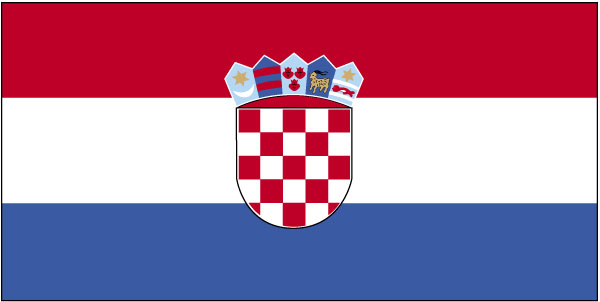
Flag, anthem, and other symbols of national identity.