English
 Español
 中文
中文 हिन्दी
 Français
Government and Politics
Government and Politics of French Polynesia
Government structure, leadership, capital, military, and national symbols of French Polynesia.
Government Structure
Constitutional foundations, branches, parties, and leadership.
- Government Type
- NA
- Administrative Divisions
- none (overseas territory of France); there are no first-order administrative divisions as defined by the US Government, but there are 5 archipelagic divisions named Archipel des Marquises, Archipel des Tuamotu, Archipel des Tubuai, Iles du Vent, and Iles Sous-le-Vent
- Legal System
- based on French system
- Suffrage
- 18 years of age; universal
- Citizenship
- See France
- Executive Branch
- chief of state: President Jacques CHIRAC of France (since 17 May 1995), represented by High Commissioner of the Republic Anne BOQUET (since September 2005) head of government: President of the Territorial Government of French Polynesia Oscar TEMARU (since 3 March 2005); President of the Territorial Assembly Antony GEROS (since 9 May 2004) cabinet: Council of Ministers; president submits a list of members of the Territorial Assembly for approval by them to serve as ministers elections: French president elected by popular vote for a five-year term; high commissioner appointed by the French president on the advice of the French Ministry of Interior; president of the Territorial Government and the president of the Territorial Assembly are elected by the members of the assembly
- Legislative Branch
- unicameral Territorial Assembly or Assemblee Territoriale (57 seats - changed from 49 seats for May 2004 election; members are elected by popular vote to serve five-year terms) elections: last held 23 May 2004 (next to be held May 2009) election results: percent of vote by party - NA; seats by party - People's Rally for the Republic (Gaullist) 28, Union for Democracy 27, New Star 1, This Country is Yours 1; after by-elections of 13 February 2005 seating was as follows: People's Rally for the Republic 27, Union for Democracy 27, and Alliance for a New Democracy 3 note: one seat was elected to the French Senate on 27 September 1998 (next to be held September 2007); results - percent of vote by party - NA; seats by party - NA; two seats were elected to the French National Assembly on 9 June-16 June 2002 (next to be held in 2007); results - percent of vote by party - NA; seats by party - UMP/RPR 1, UMP 1
- Judicial Branch
- Court of Appeal or Cour d'Appel; Court of the First Instance or Tribunal de Premiere Instance; Court of Administrative Law or Tribunal Administratif
- Political Parties
- Alliance for a New Democracy or ADN [Nicole BOUTEAU]; Independent Front for the Liberation of Polynesia (Tavini Huiraatira) [Oscar TEMARU]; New Fatherland Party (Ai'a Api) [Emile VERNAUDON]; People's Rally for the Republic of Polynesia or RPR (Tahoeraa Huiraatira) [Gaston FLOSSE]; The New Star (Te Fetia Api) [Philippe SHYLE]; This Country is Yours (No Oe E Te Nunaa) [Nicle BOUTEAU]; Union for Democracy or UPD [Oscar TEMARU]
- Head of State
- President Nicolas SARKOZY
- Head of Government
- President of French Polynesia Gaston TONG SANG
- Cabinet
- Council of Ministers; president submits a list of members of the Territorial Assembly for approval by them to serve as ministers
- Elections
- French president elected by popular vote for a five-year term; high commissioner appointed by the French president on the advice of the French Ministry of Interior; president of the territorial government and the president of the Territorial Assembly are elected by the members of the assembly for five-year terms (no term limits)
- Constitution
- 28 September 1958 (French Constitution)
- Independence
- none (overseas territory of France)
- National Holiday
- Bastille Day, 14 July (1789)
- International Organization Participation
- FZ, ICFTU, WMO
- Diplomatic Representation in the U.S.
- none (overseas territory of France)
- U.S. Diplomatic Representation
- none (overseas territory of France)
Capital City
Seat of government and political history.
- Capital City
- Papeete (located on Tahiti)
- Location
- 17 32 S, 149 34 W
- Time Difference
- UTC-10 (5 hours behind Washington, DC, during Standard Time)
- History
- The name means "water basket" and refers to the fact that the islanders originally used calabashes enclosed in baskets to fetch water at a spring in the area
Military
Branches, service obligations, expenditures, and manpower.
- Military Branches
- No regular military forces
National Symbols
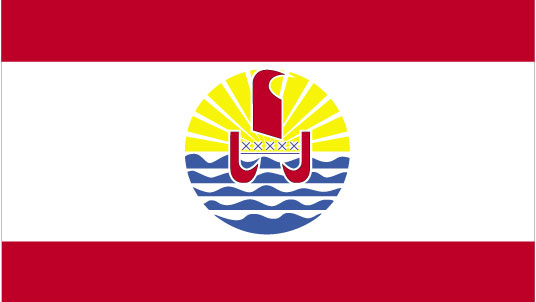
Flag, anthem, and other symbols of national identity.