English
 Español
 中文
中文 हिन्दी
 Français
Government and Politics
Government and Politics of Hungary
Government structure, leadership, capital, military, and national symbols of Hungary.
Government Structure
Constitutional foundations, branches, parties, and leadership.
- Government Type
- parliamentary democracy
- Administrative Divisions
- 19 counties (megyek, singular - megye), 20 urban counties* (singular - megyei varos), and 1 capital city** (fovaros); Bacs-Kiskun, Baranya, Bekes, Bekescsaba*, Borsod-Abauj-Zemplen, Budapest**, Csongrad, Debrecen*, Dunaujvaros*, Eger*, Fejer, Gyor*, Gyor-Moson-Sopron, Hajdu-Bihar, Heves, Hodmezovasarhely*, Jasz-Nagykun-Szolnok, Kaposvar*, Kecskemet*, Komarom-Esztergom, Miskolc*, Nagykanizsa*, Nograd, Nyiregyhaza*, Pecs*, Pest, Somogy, Sopron*, Szabolcs-Szatmar-Bereg, Szeged*, Szekesfehervar*, Szolnok*, Szombathely*, Tatabanya*, Tolna, Vas, Veszprem, Veszprem*, Zala, Zalaegerszeg*
- Legal System
- rule of law based on Western model
- Suffrage
- 18 years of age; universal
- Citizenship
- Citizenship by birth: No Citizenship by descent only: At least one parent must be a citizen of Hungary Dual citizenship recognized: Yes Residency requirement for naturalization: 8 years
- Executive Branch
- chief of state: President Tamas SULYOK (since 5 March 2024) head of government: Prime Minister Viktor ORBAN (since 29 May 2010, reappointed most recently on 24 May 2022) cabinet: Council of Ministers elected by the National Assembly on the recommendation of the president elections: president elected by the National Assembly for a five-year term; election last held on 26 February 2024 (next to be held in 2029); prime minister elected by the National Assembly on the recommendation of the president; election last held 24 May 2022 election results: Tamas SULYOK elected president without opposition following the resignation of Katalin NOVAK; Viktor ORBAN elected prime minister following the April 2022 legislative elections in which his Fidesz-KDNP alliance won a fourth consecutive supermajority note: to be elected, the president must win two-thirds of the legislative vote in the first two rounds or a simple majority in the third round; the president serves a largely ceremonial role, with executive power resting primarily with the prime minister
- Legislative Branch
- unicameral National Assembly or Orszaggyules (386 seats; members are elected by popular vote under a system of proportional and direct representation to serve four-year terms) elections: last held 7 and 21 April 2002 (next to be held 9 and 23 April 2006) election results: percent of vote by party (5% or more of the vote required for parliamentary representation in the first round) - Fidesz/MDF 48.70%, MSzP 46.11%, SzDSz 4.92%, other 0.27%; seats by party - Fidesz 164, MSzP 178, MDF 24, SzDSz 20
- Judicial Branch
- Constitutional Court (judges are elected by the National Assembly for nine-year terms)
- Political Parties
- Alliance of Free Democrats or SzDSz [Gabor KUNCZE]; Hungarian Civic Alliance or Fidesz [Viktor ORBAN, chairman]; Hungarian Democratic Forum or MDF [Ibolya DAVID]; Hungarian Socialist Party or MSzP [Istvan HILLER, chairman]
- Head of State
- President Laszlo SOLYOM
- Head of Government
- Prime Minister Viktor Orban
- Cabinet
- Council of Ministers prime minister elected by the National Assembly on the recommendation of the president; other ministers proposed by the prime minister and appointed and relieved of their duties by the president
- Elections
- president elected by the National Assembly for a five-year term (eligible for a second term); election last held 6-7 June 2005 (next to be held by June 2010); prime minister elected by the National Assembly on the recommendation of the president; election last held 29 September 2004
- Election Results
- Laszlo SOLYOM was elected president by a simple majority in the third round of voting, 185 to 182; Viktor ORBAN was elected prime minister; result of legislative vote - 261 to 107 note: to be elected, the president must win two-thirds of legislative vote in the first two rounds or a simple majority in the third round
- Constitution
- 18 August 1949, effective 20 August 1949, revised 19 April 1972; 18 October 1989 revision ensured legal rights for individuals and constitutional checks on the authority of the prime minister and also established the principle of parliamentary oversight; 1997 amendment streamlined the judicial system
- Independence
- 1001 (unification by King Stephen I)
- National Holiday
- Saint Stephen's Day, 20 August
- International Organization Participation
- Australia Group, BIS, CE, CEI, CERN, EAPC, EBRD, ESA (cooperating state), EU (new member), FAO, G- 9, IAEA, IBRD, ICAO, ICC, ICCt, ICFTU, ICRM, IDA, IEA, IFC, IFRCS, ILO, IMF, IMO, Interpol, IOC, IOM, ISO, ITU, MINURSO, NAM (guest), NATO, NEA, NSG, OAS (observer), OECD, OPCW, OSCE, PCA, PFP, UN, UNCTAD, UNESCO, UNFICYP, UNHCR, UNIDO, UNMIK, UNOMIG, UPU, WCL, WCO, WEU (associate), WFTU, WHO, WIPO, WMO, WToO, WTrO, ZC
- Diplomatic Representation in the U.S.
- chief of mission: Ambassador Andras SIMONYI chancery: 3910 Shoemaker Street NW, Washington, DC 20008 telephone: [1] (202) 362-6730 FAX: [1] (202) 966-8135 consulate(s) general: Los Angeles, New York
- U.S. Diplomatic Representation
- chief of mission: Ambassador George Herbert WALKER embassy: Szabadsag ter 12, H-1054 Budapest mailing address: pouch: American Embassy Budapest, 5270 Budapest Place, Department of State, Washington, DC 20521-5270 telephone: [36] (1) 475-4400 FAX: [36] (1) 475-4764
Capital City
Seat of government and political history.
- Capital City
- Budapest
- Location
- 47 30 N, 19 05 E
- Time Difference
- UTC+1 (6 hours ahead of Washington, DC, during Standard Time)
- History
- The Hungarian capital city was formed in 1873 from the merger of three cities on opposite banks of the Danube: Buda and Obuda (Old Buda) on the western shore and Pest on the eastern; the origins of the original names are obscure, but according to the second century A.D. geographer, Ptolemy, the settlement that would become Pest was called "Pession" in ancient times; "Buda" may derive from either a Slavic or Turkic personal name
Embassy and Diplomatic Representation
Embassy location and contact details.
The U.S. Embassy in Budapest Szabadság tér 12 H-1054 Budapest Main Telephone: (36)(1) 475-4400 U.S. Citizen Services Telephone: (36)(1) 475-4164 After-hours emergency calls -- for U.S. citizens only: (36)(1) 475-4400. Fax (36)(1) 475-4188 or (36)(1) 475-4113 Email: acs.budapest@state.gov
Military
Branches, service obligations, expenditures, and manpower.
- Military Branches
- Hungarian Defense Forces: Land Forces, Hungarian Air Force (Magyar Legiero, ML)
- Service Age and Obligation
- 18-25 years of age for voluntary military service; no conscription; 6-month service obligation
National Symbols
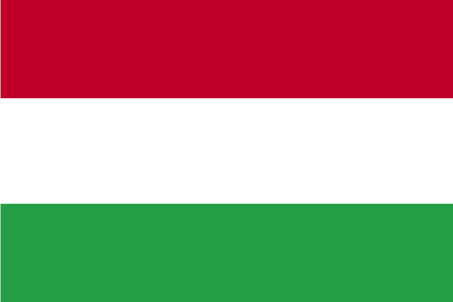
Flag, anthem, and other symbols of national identity.