English
 Español
 中文
中文 हिन्दी
 Français
Government and Politics
Government and Politics of Slovakia
Government structure, leadership, capital, military, and national symbols of Slovakia.
Government Structure
Constitutional foundations, branches, parties, and leadership.
- Government Type
- parliamentary democracy
- Administrative Divisions
- 8 regions (kraje, singular - kraj); Banskobystricky, Bratislavsky, Kosicky, Nitriansky, Presovsky, Trenciansky, Trnavsky, Zilinsky
- Legal System
- civil law system based on Austro-Hungarian codes; has not accepted compulsory ICJ jurisdiction; legal code modified to comply with the obligations of Organization on Security and Cooperation in Europe (OSCE) and to expunge Marxist-Leninist legal theory
- Suffrage
- 18 years of age; universal
- Citizenship
- citizenship by birth: no citizenship by descent only: at least one parent must be a citizen of Slovakia dual citizenship recognized: no residency requirement for naturalization: 5 years
- Executive Branch
- chief of state: President Peter PELLEGRINI (since 15 June 2024) head of government: Prime Minister Robert FICO (since 25 October 2023); Deputy Prime Ministers Robert KALINAK, Tomas TARABA, and Peter SZIJJARTO (since October 2023) cabinet: Cabinet appointed by the president on the recommendation of the prime minister elections: president elected by direct, popular vote for a five-year term; election last held 23 March and 6 April 2024 (next to be held in 2029); following National Council elections, the leader of the majority party or the leader of a majority coalition is usually appointed prime minister by the president election results: Peter PELLEGRINI elected president in runoff; percent of vote - Peter PELLEGRINI 53.1%, Ivan KORCOK 46.9%; Robert FICO appointed prime minister in October 2023 following parliamentary elections the previous month note: government coalition - SMER-SSD, SNS, HLAS-SD
- Legislative Branch
- unicameral National Council of the Slovak Republic or Narodna Rada Slovenskej Republiky (150 seats; members are elected on the basis of proportional representation to serve four-year terms) elections: last held 20-21 September 2002 (next to be held 17 June 2006) election results: percent of vote by party - HZDS-LS 19.5%, SDKU 15.1%, Smer 13.5%, SMK 11.2%, KDH 8.3%, ANO 8%, KSS 6.3%; seats by party - governing coalition 53 (SDKU 23, SMK 20, ANO 10), opposition 97 (Smer 27, HZDS-LS 22, KDH 15, KSS 9, and independents 24) (February 2006)
- Judicial Branch
- Supreme Court (judges are elected by the National Council); Constitutional Court (judges appointed by president from group of nominees approved by the National Council); Special Court (judges elected by a council of judges and appointed by president)
- Political Parties
- Christian Democratic Movement or KDH [Pavol HRUSOVSKY]; Direction (Smer) [Robert FICO]; Free Forum [Zuzana MARTINAKOVA]; Movement for Democracy or HZD [Jozef GRAPA]; Movement for a Democratic Slovakia-People's Party or HZDS-LS [Vladimir MECIAR]; New Citizens Alliance or ANO [Pavol RUSKO]; Party of the Hungarian Coalition or SMK [Bela BUGAR]; People's Union or LU [Gustav KRAJCI]; Slovak Communist Party or KSS [Jozef SEVC]; Slovak Democratic and Christian Union or SDKU [Mikulas DZURINDA]; Slovak National Party or SNS [Jan SLOTA]
- Head of State
- President Ivan GASPAROVIC
- Head of Government
- Prime MInister Robert FICO
- Cabinet
- Cabinet appointed by the president on the recommendation of the prime minister
- Elections
- president elected by popular vote for a five-year term (eligible for a second term); election last held on 21 March and 4 April 2009 (next to be held no later than April 2014); following National Council elections, the leader of the majority party or the leader of a majority coalition usually appointed prime minister by the president
- Election Results
- Ivan GASPAROVIC reelected president in runoff; percent of vote - Ivan GASPAROVIC 55.5%, Iveta RADICOVA 44.5%
- Constitution
- ratified 1 September 1992, fully effective 1 January 1993; changed in September 1998 to allow direct election of the president; amended February 2001 to allow Slovakia to apply for NATO and EU membership
- Independence
- 1 January 1993 (Czechoslovakia split into the Czech Republic and Slovakia)
- National Holiday
- Constitution Day, 1 September (1992)
- International Organization Participation
- Australia Group, BIS, BSEC (observer), CE, CEI, CERN, EAPC, EBRD, EU (new member), FAO, IAEA, IBRD, ICAO, ICC, ICCt, ICFTU, ICRM, IDA, IFC, IFRCS, ILO, IMF, IMO, Interpol, IOC, IOM, ISO, ITU, NAM (guest), NEA, NSG, OAS (observer), OECD, OPCW, OSCE, PCA, PFP, UN, UNAMSIL, UNCTAD, UNDOF, UNESCO, UNFICYP, UNIDO, UNMEE, UNMISET, UNTSO, UPU, WCL, WCO, WEU (associate partner), WFTU, WHO, WIPO, WMO, WToO, WTrO, ZC
- Diplomatic Representation in the U.S.
- chief of mission: Ambassador Rastislav KACER chancery: 3523 International Court NW, Washington, DC 20008 telephone: [1] (202) 237-1054 FAX: [1] (202) 237-6438 consulate(s) general: Los Angeles, New York
- U.S. Diplomatic Representation
- chief of mission: Ambassador Rodolphe “Skip” M. VALLEE embassy: Hviezdoslavovo Namestie 4, 81102 Bratislava mailing address: P.O. Box 309, 814 99 Bratislava telephone: [421] (2) 5443-3338 FAX: [421] (2) 5443-0096
Capital City
Seat of government and political history.
- Capital City
- Bratislava
- Location
- 48 09 N, 17 07 E
- Time Difference
- UTC+1 (6 hours ahead of Washington, DC,. during Standard Time)
- History
- the name was adopted in 1919 after Czechoslovakia gained its independence and may derive from later transliterations of the 9th century military commander, Braslav, or the 11th century Bohemian Duke BRETISLAV I; alternatively, the name may derive from the Slovak words brat (brother) and slava (glory)
Embassy and Diplomatic Representation
Embassy location and contact details.
U.S. Embassy, Bratislava Address: Hviezdoslavovo námestie 4, 811 02 Bratislava Mailing address: U.S. Embassy, P.O. Box 309, 814 99 Bratislava, Slovakia Telephone: (421)(2)5443 0861 or (421)(2) 5443 3338 Emergency after-hours telephone: (421) 903 703 666 Facsimile: (421)(2) 5441 8861 Email: consulbratislava@state.gov
Military
Branches, service obligations, expenditures, and manpower.
- Military Branches
- Armed Forces of the Slovak Republic (Ozbrojene Sily Slovenskej Republiky): Land Forces (Pozemne Sily), Air Forces (Vzdusne Sily)
- Service Age and Obligation
- 18-30 years of age for voluntary military service; conscription in peacetime suspended in 2006; women are eligible to serve
National Symbols
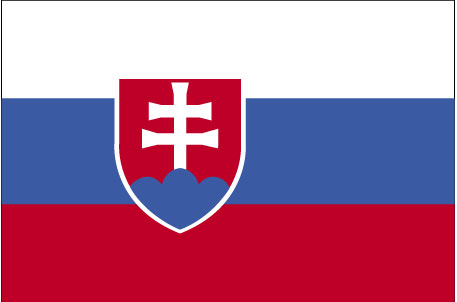
Flag, anthem, and other symbols of national identity.