English
 Español
 中文
中文 हिन्दी
 Français
Government and Politics
Government and Politics of Sweden
Government structure, leadership, capital, military, and national symbols of Sweden.
Government Structure
Constitutional foundations, branches, parties, and leadership.
- Government Type
- constitutional monarchy
- Administrative Divisions
- 21 counties (lan, singular and plural); Blekinge, Dalarnas, Gavleborgs, Gotlands, Hallands, Jamtlands, Jonkopings, Kalmar, Kronobergs, Norrbottens, Orebro, Ostergotlands, Skane, Sodermanlands, Stockholms, Uppsala, Varmlands, Vasterbottens, Vasternorrlands, Vastmanlands, Vastra Gotalands
- Legal System
- civil law system influenced by customary law; accepts compulsory ICJ jurisdiction, with reservations
- Suffrage
- 18 years of age; universal
- Citizenship
- citizenship by birth: no citizenship by descent only: the father must be a citizen of Sweden; in the case of a child born out of wedlock, the mother must be a citizen of Sweden and the father unknown dual citizenship recognized: no, unless the other citizenship was acquired involuntarily residency requirement for naturalization: 5 years
- Executive Branch
- chief of state: King CARL XVI GUSTAF (since 19 September 1973); Heir Apparent Princess VICTORIA Ingrid Alice Desiree, daughter of the monarch (born 14 July 1977) head of government: Prime Minister Ulf KRISTERSSON (since 18 October 2022) cabinet: Cabinet appointed by the prime minister elections: the monarchy is hereditary; following legislative elections, the leader of the majority party or majority coalition is elected prime minister by the parliament election results: Ulf KRISTERSSON elected prime minister following the September 2022 general election, in which his center-right Moderate Party-led coalition secured a narrow parliamentary majority; election held 11 September 2022 (next to be held in September 2026)
- Legislative Branch
- unicameral Parliament or Riksdag (349 seats; members are elected by popular vote on a proportional representation basis to serve four-year terms) elections: last held 15 September 2002 (next to be held on 17 September 2006) election results: percent of vote by party - Social Democrats 39.8%, Moderates 15.2%, Liberal Party 13.3%, Christian Democrats 9.1%, Left Party 8.3%, Center Party 6.1%, Greens 4.6%; seats by party - Social Democrats 144, Moderates 55, Liberal Party 48, Christian Democrats 33, Left Party 30, Center Party 22, Greens 17
- Judicial Branch
- Supreme Court or Hogsta Domstolen (judges are appointed by the prime minister and the cabinet)
- Political Parties
- Center Party [Maud OLOFSSON]; Christian Democratic Party [Goran HAGGLUND]; Green Party [no formal leader but party spokespersons are Maria WETTERSTRAND and Peter ERIKSSON]; Left Party or V (formerly Communist) [Lars OHLY]; Liberal People's Party [Lars LEIJONBORG]; Moderate Party (conservative) [Fredrik REINFELDT]; Social Democratic Party [Goran PERSSON]
- Head of State
- CARL XVI GUSTAF
- Head of Government
- Fredrik REINFELDT
- Cabinet
- Cabinet appointed by the prime minister
- Elections
- the monarchy is hereditary; following legislative elections, the prime minister is elected by the parliament; election last held on 17 September 2006 (next to be held in September 2010)
- Election Results
- Center-right coalition of Moderate, Center, Liberal, and Christian Democrats parties win 175 out of 349 votes; Fredrik REINFELDT becomes prime minister
- Constitution
- 1-Jan-75
- Independence
- 6 June 1523 (Gustav VASA elected king)
- National Holiday
- Flag Day, 6 June
- International Organization Participation
- AfDB, AsDB, Australia Group, BIS, CBSS, CE, CERN, EAPC, EBRD, EIB, ESA, EU, FAO, G- 6, G- 9, G-10, IADB, IAEA, IBRD, ICAO, ICC, ICCt, ICFTU, ICRM, IDA, IEA, IFAD, IFC, IFRCS, IHO, ILO, IMF, IMO, Interpol, IOC, IOM, ISO, ITU, MONUC, NAM (guest), NC, NEA, NIB, NSG, OAS (observer), OECD, OPCW, OSCE, Paris Club, PCA, PFP, UN, UNAMSIL, UNCTAD, UNDOF, UNESCO, UNHCR, UNIDO, UNITAR, UNMEE, UNMIK, UNMIL, UNMISET, UNMOGIP, UNOMIG, UNTSO, UPU, WCO, WEU (observer), WFTU, WHO, WIPO, WMO, WTrO, ZC
- Diplomatic Representation in the U.S.
- chief of mission: Ambassador Gunnar LUND chancery: 1501 M Street NW, Washington, DC 20005-1702 telephone: [1] (202) 467-2600 FAX: [1] (202) 467-2699 consulate(s) general: Los Angeles, New York
- U.S. Diplomatic Representation
- chief of mission: Ambassador (vacant); Charge d'Affaires Stephen V. NOBLE embassy: Dag Hammarskjolds VAG 31, SE-11589 Stockholm mailing address: American Embassy Stockholm, Department of State, 5750 Stockholm Place, Washington, DC 20521-5750 (pouch) telephone: [46] (08) 783 53 00 FAX: [46] (08) 661 19 64
Capital City
Seat of government and political history.
- Capital City
- Stockholm
- Location
- 59 20 N, 18 03 E
- Time Difference
- UTC+1 (6 hours ahead of Washington, DC, during Standard Time)
- History
- stock and holm literally mean "log" and "islet" in Swedish, but there is no consensus as to what the words refer to
Embassy and Diplomatic Representation
Embassy location and contact details.
U.S. Embassy in Stockholm Dag Hammarskjoldsvag 31 SE-115 89 Stockholm Telephone: (46) (8) 783-5300 Emergency after-hours telephone: (46) (8) 783-5300 Fax: (46) (8) 783-5480
Military
Branches, service obligations, expenditures, and manpower.
- Military Branches
- Swedish Armed Forces (Forsvarsmakten): Army (Armen), Royal Swedish Navy (Marinen), Swedish Air Force (Svenska Flygvapnet)
- Service Age and Obligation
- 18-47 years of age for male and female voluntary military service; Swedish citizenship required; service obligation: 7.5 months (Army), 7-15 months (Navy), 8-12 months (Air Force); the Swedish Parliament has abolished compulsory military service, with exclusively voluntary recruitment as of July 2010; conscription remains an option in emergencies; after completing initial service, soldiers have a reserve commitment until age 47
National Symbols
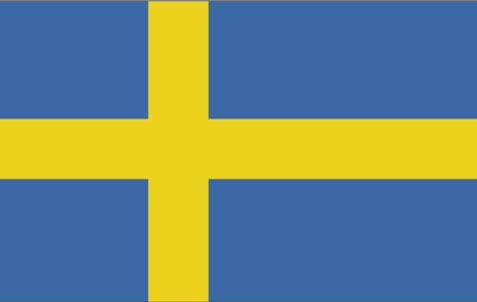
Flag, anthem, and other symbols of national identity.