English
 Español
 中文
中文 हिन्दी
 Français
Government and Politics
Government and Politics of Switzerland
Government structure, leadership, capital, military, and national symbols of Switzerland.
Government Structure
Constitutional foundations, branches, parties, and leadership.
- Government Type
- federal republic
- Administrative Divisions
- 26 cantons (cantons, singular - canton in French; cantoni, singular - cantone in Italian; kantone, singular - kanton in German); Aargau, Appenzell Ausser-Rhoden, Appenzell Inner-Rhoden, Basel-Landschaft, Basel-Stadt, Bern, Fribourg, Geneve, Glarus, Graubunden, Jura, Luzern, Neuchatel, Nidwalden, Obwalden, Sankt Gallen, Schaffhausen, Schwyz, Solothurn, Thurgau, Ticino, Uri, Valais, Vaud, Zug, Zurich
- Legal System
- civil law system influenced by customary law; judicial review of legislative acts, except with respect to federal decrees of general obligatory character; accepts compulsory ICJ jurisdiction, with reservations
- Suffrage
- 18 years of age; universal
- Citizenship
- citizenship by birth: no citizenship by descent only: at least one parent must be a citizen of Switzerland dual citizenship recognized: yes residency requirement for naturalization: 12 years including at least 3 of the last 5 years prior to application
- Executive Branch
- chief of state: President Moritz LEUENBERGER (since 8 January 2006); Vice President Micheline CALMY-REY (since 8 January 2006); note - the president is both the chief of state and head of government head of government: President Moritz LEUENBERGER (since 8 January 2006); Vice President Micheline CALMY-REY (since 8 January 2006); note - the president is both the chief of state and head of government cabinet: Federal Council or Bundesrat (in German), Conseil Federal (in French), Consiglio Federale (in Italian) elected by the Federal Assembly usually from among its own members for a four-year term elections: president and vice president elected by the Federal Assembly from among the members of the Federal Council for one-year terms that run concurrently; election last held 7 December 2005 (next to be held December 2006) election results: Moritz LUENBERGER elected president; percent of Federal Assembly vote - NA; Micheline CALMY-REY elected vice president; percent of legislative vote - NA
- Legislative Branch
- bicameral Federal Assembly or Bundesversammlung (in German), Assemblee Federale (in French), Assemblea Federale (in Italian) consists of the Council of States or Standerat (in German), Conseil des Etats (in French), Consiglio degli Stati (in Italian) (46 seats - consists of two representatives from each canton and one from each half canton; members serve four-year terms) and the National Council or Nationalrat (in German), Conseil National (in French), Consiglio Nazionale (in Italian) (200 seats - members are elected by popular vote on the basis of proportional representation to serve four-year terms) elections: Council of States - last held in most cantons 19 October 2003 (each canton determines when the next election will be held); National Council - last held 19 October 2003 (next to be held October 2007) election results: Council of States - percent of vote by party - NA%; seats by party - CVP 15, FDP 14, SVP 8, SPS 6, other 3; National Council - percent of vote by party - SVP 26.6%, SPS 23.3%, FDP 17.3%, CVP 14.4%, Greens 7.4%, other small parties all under 5%; seats by party - SVP 55, SPS 54, FDP 36, CVP 28, Green Party 13, other small parties 14
- Judicial Branch
- Federal Supreme Court (judges elected for six-year terms by the Federal Assembly)
- Political Parties
- Green Party (Grune Partei der Schweiz or Grune, Parti Ecologiste Suisse or Les Verts, Partito Ecologista Svizzero or I Verdi, Partida Ecologica Svizra or La Verda) [Ruth GENNER]; Christian Democratic People's Party (Christichdemokratische Volkspartei der Schweiz or CVP, Parti Democrate-Chretien Suisse or PDC, Partito Democratico-Cristiano Popolare Svizzero or PDC, Partida Cristiandemocratica dalla Svizra or PCD) [Doris LEUTHARD, president]; Radical Free Democratic Party (Freisinnig-Demokratische Partei der Schweiz or FDP, Parti Radical-Democratique Suisse or PRD, Partitio Liberal-Radicale Svizzero or PLR) [Marianne KLEINER-SCHLAEPFER, president]; Social Democratic Party (Sozialdemokratische Partei der Schweiz or SPS, Parti Socialist Suisse or PSS, Partito Socialista Svizzero or PSS, Partida Socialdemocratica de la Svizra or PSS) [Hans-Juerg FEHR, president]; Swiss People's Party (Schweizerische Volkspartei or SVP, Union Democratique du Centre or UDC, Unione Democratica de Centro or UDC, Uniun Democratica dal Center or UDC) [Ueli MAURER, president]; and other minor parties
- Head of State
- President Doris Leuthard
- Head of Government
- President Doris Leuthard
- Cabinet
- Federal Council or Bundesrat (in German), Conseil Federal (in French), Consiglio Federale (in Italian) elected by the Federal Assembly usually from among its members for a four-year term
- Elections
- president and vice president elected by the Federal Assembly from among the members of the Federal Council for a one-year term (they may not serve consecutive terms); election last held on 2 December 2009 (next to be held in December 2010)
- Election Results
- Doris LEUTHARD elected president; number of Federal Assembly votes - 158 of 183; Moritz LEUENBERGER elected vice president; number of Federal Assembly votes - 128 of 187
- Constitution
- revision of Constitution of 1874 approved by the Federal Parliament 18 December 1998; adopted by referendum 18 April 1999; officially entered into force 1 January 2000
- Independence
- 1 August 1291 (Founding of the Swiss Confederation)
- National Holiday
- Founding of the Swiss Confederation, 1 August (1291)
- International Organization Participation
- ACCT, AfDB, AsDB, Australia Group, BIS, CE, CERN, EAPC, EBRD, EFTA, ESA, FAO, G-10, IADB, IAEA, IBRD, ICAO, ICC, ICCt, ICFTU, ICRM, IDA, IEA, IFAD, IFC, IFRCS, ILO, IMF, IMO, Interpol, IOC, IOM, ISO, ITU, LAIA (observer), MONUC, NAM (guest), NEA, NSG, OAS (observer), OECD, OPCW, OSCE, Paris Club, PCA, PFP, UN, UNCTAD, UNESCO, UNHCR, UNIDO, UNITAR, UNMEE, UNMIK, UNOMIG, UNTSO, UPU, WCL, WCO, WHO, WIPO, WMO, WToO, WTrO, ZC
- Diplomatic Representation in the U.S.
- chief of mission: Ambassador Christian BLICKENSTORFER chancery: 2900 Cathedral Avenue NW, Washington, DC 20008 telephone: [1] (202) 745-7900 FAX: [1] (202) 387-2564 consulate(s) general: Atlanta, Chicago, Houston, Los Angeles, New York, San Francisco consulate(s): Boston
- U.S. Diplomatic Representation
- chief of mission: Ambassador Pamela P. WILLEFORD embassy: Jubilaumsstrasse 93, CH-3005 Bern mailing address: use embassy street address telephone: [41] (031) 357 70 11 FAX: [41] (031) 357 73 44
Capital City
Seat of government and political history.
- Capital City
- Bern
- Location
- 46 55 N, 7 28 E
- Time Difference
- UTC+1 (6 hours ahead of Washington, DC, during Standard Time)
- History
- origin of the name is uncertain but may derive from a 2nd century B.C. Celtic place name, possibly "berna" meaning "cleft," that was subsequently adopted by a Roman settlement
Embassy and Diplomatic Representation
Embassy location and contact details.
United States Embassy Bern Sulgeneckstrasse 19, 3007 Bern Telephone: (41) (31) 357-7011 (2 p.m. – 4 p.m.) Emergency phone: after-hours/weekends – (41) (31) 357-7777 Facsimile: (41) (31) 357-7280 United States Consular Agency, Zurich, Zurich America Center, Dufourstrasse 101, 8008 Zurich Telephone: (41) (43) 499-2960 (10 a.m. – 1 p.m.) Facsimile: (41) (43) 499-2961 Email: zurich-ca@state.gov United States Consular Agency, Geneva rue Versonnex 7, 1207 Geneva Telephone: (41) (22) 840-5160 (10 a.m. – 1 p.m.) Facsimile: (41) (22) 840-5162. Email: Geneva-CA@state.gov
Military
Branches, service obligations, expenditures, and manpower.
- Military Branches
- Swiss Armed Forces: Land Forces, Swiss Air Force (Schweizer Luftwaffe)
- Service Age and Obligation
- 19-26 years of age for male compulsory military service; 18 years of age for voluntary male and female military service; every Swiss male has to serve at least 260 days in the armed forces; conscripts receive 18 weeks of mandatory training, followed by seven 3-week intermittent recalls for training during the next 10 years
National Symbols
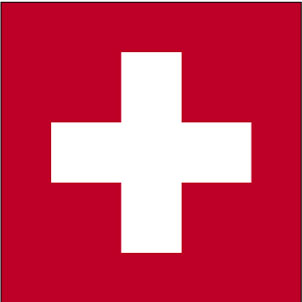
Flag, anthem, and other symbols of national identity.