English
 Español
 中文
中文 हिन्दी
 Français
Government and Politics
Government and Politics of Ukraine
Government structure, leadership, capital, military, and national symbols of Ukraine.
Government Structure
Constitutional foundations, branches, parties, and leadership.
- Government Type
- republic
- Administrative Divisions
- 24 oblasti (singular - oblast'), 1 autonomous republic* (avtomnaya respublika), and 2 municipalities (mista, singular - misto) with oblast status**; Cherkas'ka (Cherkasy), Chernihivs'ka (Chernihiv), Chernivets'ka (Chernivtsi), Dnipropetrovs'ka (Dnipropetrovs'k), Donets'ka (Donets'k), Ivano-Frankivs'ka (Ivano-Frankivs'k), Kharkivs'ka (Kharkiv), Khersons'ka (Kherson), Khmel'nyts'ka (Khmel'nyts'kyy), Kirovohrads'ka (Kirovohrad), Kyyiv**, Kyyivs'ka (Kiev), Luhans'ka (Luhans'k), L'vivs'ka (L'viv), Mykolayivs'ka (Mykolayiv), Odes'ka (Odesa), Poltavs'ka (Poltava), Avtonomna Respublika Krym* (Simferopol'), Rivnens'ka (Rivne), Sevastopol'**, Sums'ka (Sumy), Ternopil's'ka (Ternopil'), Vinnyts'ka (Vinnytsya), Volyns'ka (Luts'k), Zakarpats'ka (Uzhhorod), Zaporiz'ka (Zaporizhzhya), Zhytomyrs'ka (Zhytomyr); note - when using a place name with an adjectival ending ""s'ka"" or ""z'ka,"" the word Oblast' should be added to the place name
- Legal System
- based on civil law system; judicial review of legislative acts
- Suffrage
- 18 years of age; universal
- Citizenship
- citizenship by birth: no citizenship by descent only: at least one parent must be a citizen of Ukraine dual citizenship recognized: no residency requirement for naturalization: 5 years
- Executive Branch
- chief of state: President Viktor A. YUSHCHENKO (since 23 January 2005) head of government: Prime Minister Yuriy YEKHANUROV (since 22 September 2005); First Deputy Prime Minister - Stanislav STASHEVSKYY (since 27 September 2005) cabinet: Cabinet of Ministers selected by the prime minister; the only exceptions are the foreign and defense ministers, who are chosen by the president note: there is also a National Security and Defense Council or NSDC originally created in 1992 as the National Security Council; the NSDC staff is tasked with developing national security policy on domestic and international matters and advising the president; a Presidential Secretariat helps draft presidential edicts and provides policy support to the president elections: president elected by popular vote for a five-year term; note - a special repeat runoff presidential election between Viktor YUSHCHENKO and Viktor YANUKOVYCH took place on 26 December 2004 after the earlier 21 November 2004 contest - won by Mr. YANUKOVYCH - was invalidated by the Ukrainian Supreme Court because of widespread and significant violations; under constitutional reforms that went into effect 1 January 2006, the majority in parliament takes the lead in naming the prime minister election results: Viktor YUSHCHENKO elected president; percent of vote - Viktor YUSHCHENKO 51.99%, Viktor YANUKOVYCH 44.2%
- Legislative Branch
- unicameral Supreme Council or Verkhovna Rada (450 seats; under recent amendments to Ukraine's election law, the Rada's seats are allocated on a proportional basis to those parties that gain 3% or more of the national electoral vote; members serve five-year terms beginning with the March 2006 election) elections: last held 31 March 2002 (next to be held 26 March 2006) election results: percent of vote by party/bloc in 2002 - Our Ukraine 24%, CPU 20%, United Ukraine 12%, SPU 7%, Yuliya Tymoshenko Bloc 7%, United Social Democratic Party 6%, other 24%; seats by party/bloc - Regions of Ukraine 61, CPU 56, People's Party 41, Our Ukraine 40, Yuliya Tymoshenko Bloc 35, SPU 29, Lytyvn-led People's Bloc 22, United Social Democratic Party 19, Ukrainian People's Party 18, People's Movement of Ukraine (Rukh) 16, Vidrodzhennya (Revival) 16, Party of Industrialists and Entrepreneurs 16, Reforms and Order 15, United Ukraine 12, independent/unaffiliated 31, vacant 23 (January 2006) note: since the “Orange Revolution,” many Rada members from single-mandate districts resigned to take up positions in the executive branch and their seats remain vacant
- Judicial Branch
- Supreme Court; Constitutional Court
- Political Parties
- Communist Party of Ukraine or CPU [Petro SYMONENKO]; Fatherland Party (Batkivshchyna) [Yuliya TYMOSHENKO]; Lytyvn-led People's Bloc group [Ihor SHAROV]; Our Ukraine [Viktor YUSHCHENKO]; Party of Industrialists and Entrepreneurs [Anatoliy KINAKH]; People's Movement of Ukraine (Rukh) [Borys TARASYUK]; People's Party [Volodymyr LYTVYN]; People's Trust group [Anton KISSE]; PORA! (It's Time!) party [Vladyslav KASKIV]; Progressive Socialist Party [Natalya VITRENKO]; Reforms and Order Party [Viktor PYNZENYK]; Party of Regions [Viktor YANUKOVYCH]; Republican Party [Yuriy BOYKO]; Socialist Party of Ukraine or SPU [Oleksandr MOROZ, chairman]; Ukrainian People's Party [Yuriy KOSTENKO]; United Social Democratic Party [Viktor MEDVEDCHUK]; United Ukraine [Bohdan HUBSKYY]; Vidrodzhennya (Revival) [Anton KISSE]
- Head of State
- President Viktor Yanukovych
- Head of Government
- Prime Minister Mykola Azarov
- Cabinet
- Cabinet of Ministers selected by the prime minister; the only exceptions are the foreign and defense ministers, who are chosen by the presiden
- Elections
- president elected by popular vote for a five-year term (eligible for a second term); election last held on 17 January 2010 with runoff on 7 February 2010 (next to be held in 2015); under constitutional reforms that went into effect 1 January 2006, the majority in parliament takes the lead in naming the prime minister
- Election Results
- Viktor YANUKOVYCH elected president; percent of vote - Viktor YANUKOVYCH 48.95%, Yuliya TYMOSHENKO 45.5%
- Constitution
- adopted 28 June 1996
- Independence
- 24 August 1991 (from the Soviet Union)
- National Holiday
- Independence Day, 24 August (1991); the date of 22 January (1918), the day Ukraine first declared its independence (from Soviet Russia), is now celebrated as Unity Day
- International Organization Participation
- BSEC, CE, CEI, CIS, EAPC, EBRD, GUUAM, IAEA, IBRD, ICAO, ICC, ICCt (signatory), ICFTU, ICRM, IFC, IFRCS, IHO, ILO, IMF, IMO, Interpol, IOC, IOM, ISO, ITU, MONUC, NAM (observer), NSG, OAS (observer), OPCW, OSCE, PCA, PFP, UN, UNAMSIL, UNCTAD, UNESCO, UNIDO, UNIFIL, UNMEE, UNMIK, UNMOVIC, UNOMIG, UPU, WCL, WCO, WFTU, WHO, WIPO, WMO, WToO, WTrO (observer), ZC
- Diplomatic Representation in the U.S.
- chief of mission: Ambassador Oleh V. SHAMSHUR chancery: 3350 M Street NW, Washington, DC 20007 telephone: [1] (202) 333-0606 FAX: [1] (202) 333-0817 consulate(s) general: Chicago, New York
- U.S. Diplomatic Representation
- chief of mission: Ambassador John E. HERBST embassy: 10 Yuriia Kotsiubynskoho, 04053 Kiev mailing address: 5850 Kiev Place, Washington, DC 20521-5850 telephone: [380] (44) 490-4000 FAX: [380] (44) 490-4085
Capital City
Seat of government and political history.
- Capital City
- Kyiv (Kiev is the transliteration from Russian) note: pronounced KAY-yiv
- Location
- 50 26 N, 30 31 E
- Time Difference
- UTC+2 (7 hours ahead of Washington, DC during Standard Time)
- History
- the name is associated with that of Kyi, who along with his brothers Shchek and Khoryv, and their sister Lybid, are the legendary founders of the medieval city of Kyiv; Kyi being the eldest brother, the city was named after him
Embassy and Diplomatic Representation
Embassy location and contact details.
You need a valid passport to enter Ukraine. If you are a U.S. citizen, you do not need to have a Ukrainian visa as long as you will be in Ukraine for fewer than 90 days within a 180-day period for tourism. You need a visa or valid Ukrainian residency permit for all stays longer than 90 days. You cannot get a Ukrainian visa at the airport or at the border. If you need a visa, please get it in advance at a Ukrainian Embassy or Consulate. Contact information for Ukrainian embassies and consulates outside of the United States is available on the Ukrainian Ministry of Foreign Affairs website. Check your visa carefully so that you know the validity period. You are responsible for knowing the rules for the type of visa you have. Sometimes U.S. citizens try to come to Ukraine before their visa allows. Remember, in Ukraine the date is written day-month-year. For example, a visa issued on 01/05/13 is good from May 1, 2013, NOT from January 5, 2013. If you come to Ukraine before your visa allows, you can be stopped at the border, not allowed to enter Ukraine, and required to return to your point of origin at your own expense. The U.S. Embassy in Kyiv cannot stop this from happening. If you enter Ukraine without needing a visa (meaning you will be in Ukraine for fewer than 90 days within a 180-day period), you are automatically registered at the border for 90 days. Extensions of stay beyond 90 days are rarely authorized. To apply for an extension, talk to your local office of the Ukrainian State Department of Citizenship, Immigration, and Registration (officially VGIFRO, but still referred to almost universally by its old acronym, “OVIR”) at least three work days before your initial registration expires. Although three days is a minimum, it is in your interest to contact OVIR earlier. Most cities will have several OVIR offices. If you are given an extension, you will be allowed to stay in Ukraine until your new registration expires; however, if you leave Ukraine, you may have to wait 180 days to come back without a visa. If you do not get an extension, you must leave the country and cannot come back until 180 days after your initial entry into Ukraine. If you enter Ukraine on a long-term (“D”) visa, you must apply with OVIR for a residency permit within 45 days from your entry date. Once you have the residency permit you can reside in Ukraine for as long as it remains valid. To enter and exit the country, you will need your un-expired residency permit and a valid passport. For more details regarding Ukrainian visas and registration procedures, please contact the nearest Embassy of Ukraine or consulate abroad, or the nearest OVIR office within Ukraine. If you are going to visit Russia from Ukraine, remember you will also need a Russian visa. The Consular Section of the Russian Embassy in Ukraine is located at Prospekt Kutuzova 8, tel.: (380-44) 284-6816, fax: 284-7936, or at general@rucons.kiev.ua. For more details, review Country Specific Information for the Russian Federation. Please note that it currently takes at least two weeks for American citizens to receive Russian visas in Kyiv. The U.S. Embassy cannot intervene to expedite Russian visa issuance. Ukrainian law requires visitors to have valid health insurance. More information on medical insurance is below. Visit the Embassy of Ukraine’s website for the most current visa information. Also, see the Ukrainian Ministry of Foreign Affairs website.
Military
Branches, service obligations, expenditures, and manpower.
- Military Branches
- Ground Forces, Naval Forces, Air Forces
- Service Age and Obligation
- 18-25 years of age for compulsory and voluntary military service; conscript service obligation is 12 months for Army and Air Force, 18 months for Navy
National Symbols
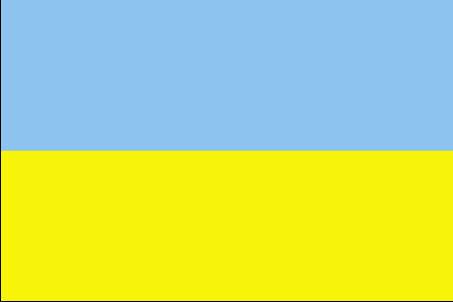
Flag, anthem, and other symbols of national identity.