
 English
 Español
 中文
中文 हिन्दी
 Français
On this page
Overview
Alabama sits in the heart of the Deep South, bordered by Tennessee to the north, Georgia to the east, Florida to the south, and Mississippi to the west, with a short coastline on the Gulf of Mexico. The state combines Appalachian foothills in the north, a fertile Black Belt prairie across its center, and pine-forested coastal plain stretching to the port city of Mobile.
Modern Alabama is shaped by three overlapping legacies: a long agrarian history rooted in cotton and slavery, a defining role in the twentieth-century Civil Rights Movement, and a postwar pivot to aerospace, automotive manufacturing, and biomedical research. Huntsville, where NASA developed the rockets that carried Americans to the Moon, has overtaken Birmingham to become the state’s largest city, and the Gulf Coast remains a major working port and a draw for visitors to the white-sand beaches at Gulf Shores and Orange Beach.
Geography & Climate
Alabama covers about 52,420 square miles and is the 30th largest state by area. The Appalachian foothills extend into the northern third of the state, including Cheaha Mountain — at 2,413 feet, the highest point in Alabama. The Black Belt, a band of dark prairie soil that runs east to west across the central state, gave its name first to the soil and later to the region’s majority-Black population. The southern third is a low-relief coastal plain that ends at the Gulf of Mexico and the bays of Mobile and Perdido.
The state’s rivers — the Alabama, Tombigbee, Coosa, Tallapoosa, and Chattahoochee — drain most of Alabama into Mobile Bay and ultimately the Gulf. Climate is humid subtropical, with hot summers, mild winters, and frequent thunderstorms; the state lies within Tornado Alley’s southern extension and faces tropical-storm risk along the coast.
History
Long before European contact, Mississippian peoples built the platform mounds at Moundville, one of the largest pre-Columbian sites in North America. By the time European explorers arrived, the land was inhabited by the Creek (Muscogee), Choctaw, Cherokee, and Chickasaw nations. France founded Mobile in 1702 as the first capital of French Louisiana; the area passed to Britain in 1763, to Spain in 1780, and to the United States after the Treaty of Paris and subsequent treaties. Alabama was admitted as the 22nd state on December 14, 1819.
Cotton agriculture and the enslavement of African Americans defined antebellum Alabama. Montgomery served briefly as the first capital of the Confederacy in 1861. After Reconstruction, sharecropping and racial segregation persisted for nearly a century. Alabama became a central battleground of the Civil Rights Movement: the Montgomery Bus Boycott of 1955–1956, the Birmingham campaign of 1963, and the Selma to Montgomery marches of 1965 were turning points that helped secure the Civil Rights Act of 1964 and the Voting Rights Act of 1965. In the same decades, the Marshall Space Flight Center in Huntsville led the development of the Saturn V rocket and remains a hub of U.S. space and defense work.
Economy
Alabama’s economy combines a strong manufacturing base — particularly automobiles and aerospace — with poultry-led agriculture, forestry, and the busy Port of Mobile. The state has actively recruited foreign automakers since the 1990s, and the Huntsville metropolitan area has become one of the country’s densest concentrations of aerospace and defense engineering talent.
- Automotive: Mercedes-Benz, Honda, Hyundai, and Toyota–Mazda operate major assembly plants in the state; Alabama is one of the top auto-producing states in the country.
- Aerospace and defense: NASA’s Marshall Space Flight Center and the U.S. Army’s Redstone Arsenal anchor Huntsville’s rocket, missile, and software-engineering industries.
- Agriculture and forestry: Poultry leads the state — Alabama is among the top broiler-chicken producers in the U.S. — followed by cattle, cotton, peanuts, soybeans, and timber.
- Steel and primary metals: Birmingham’s historic iron and steel industry has consolidated but still operates, alongside metal-fabrication and parts suppliers serving the automakers.
- Trade and tourism: The Port of Mobile handles bulk and container cargo and supports a regional shipbuilding industry; Gulf Shores and the U.S. Civil Rights Trail draw millions of visitors.
Government
Alabama operates under a constitution originally adopted in 1901 and substantially recompiled in 2022 to remove racist provisions and consolidate decades of amendments. The state is led by a Governor and Lieutenant Governor, with a bicameral legislature consisting of a 35-member Senate and a 105-member House of Representatives. The Alabama Supreme Court has nine elected justices. Montgomery has served as the state capital since 1846; the State Capitol on Goat Hill is also where the Selma to Montgomery marchers ended their 1965 walk for voting rights.
Culture
Alabama’s culture is shaped by Southern hospitality, college football — the Iron Bowl rivalry between the University of Alabama Crimson Tide and the Auburn Tigers is one of the most intense in American sports — and a deep musical heritage spanning W. C. Handy, Hank Williams, Nat King Cole, Sun Ra, the Muscle Shoals Sound studios, and Lionel Richie. The state is also home to literary giants Harper Lee and Truman Capote, and Mobile claims the oldest organized Mardi Gras in the United States, predating New Orleans by more than a decade. Gulf seafood, slow-cooked barbecue, and the white-sauce barbecue chicken of north Alabama anchor the cuisine.
Notable Cities
- Huntsville — NASA and missile-defense hub; the state’s largest and fastest-growing city.
- Birmingham — historic steel center turned biomedical and banking hub; capital of Civil Rights heritage sites.
- Montgomery — state capital and first capital of the Confederacy; endpoint of the 1965 Selma to Montgomery march.
- Mobile — historic port city on the Gulf Coast; founded 1702, home to the oldest Mardi Gras in the U.S.
- Tuscaloosa — home of the University of Alabama on the banks of the Black Warrior River.
- Auburn — home of Auburn University in east-central Alabama.
- Hoover — large suburban city south of Birmingham and a major retail and corporate center.
- Dothan — commercial and agricultural hub of the Wiregrass region in southeast Alabama.
State Symbols
Officially designated symbols of the State of Alabama — established by the State Legislature to celebrate the state’s natural and cultural identity.
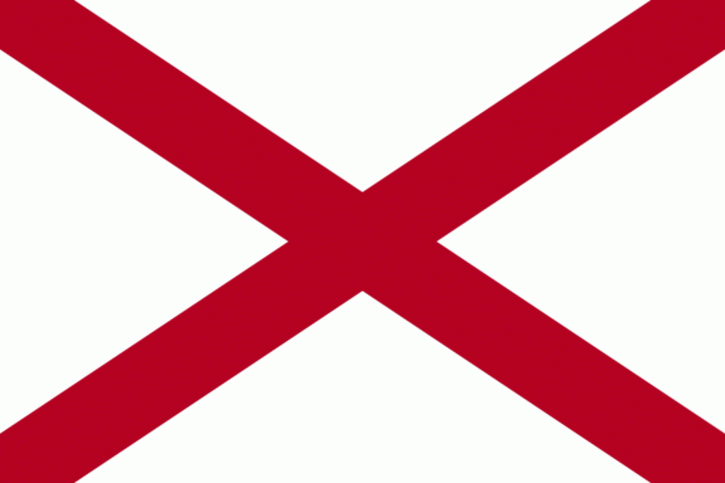
State Flag
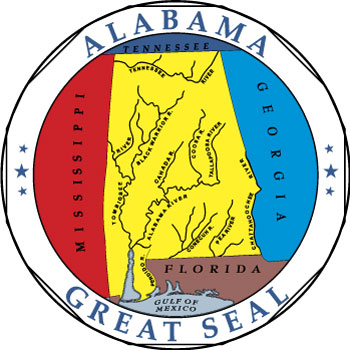
Great Seal
Nickname
The Yellowhammer State
Motto
Audemus jura nostra defendere ("We dare defend our rights")
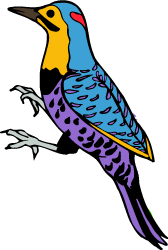
Bird
Yellowhammer (Northern Flicker)
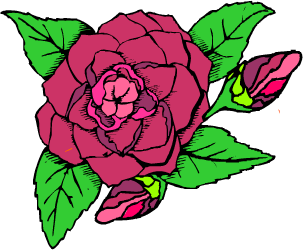
Flower
Camellia
Mammal
American Black Bear
Tree
Longleaf Pine
Saltwater Fish
Fighting Tarpon
Freshwater Fish
Largemouth Bass
Insect
Monarch Butterfly
Mineral
Hematite
Song
"Alabama"