
 English
 Español
 中文
中文 हिन्दी
 Français
On this page
Overview
Arizona is a state in the southwestern United States, bordered by Utah, New Mexico, Mexico, California, and Nevada, with a short corner shared with Colorado at the Four Corners. It is the sixth-largest state by area and one of the fastest-growing by population, with roughly 7.6 million residents concentrated in the Phoenix and Tucson metropolitan areas.
The state spans a remarkable range of landscapes, from the saguaro-studded Sonoran Desert in the south to the high pine forests of the Colorado Plateau and the deep chasms of the Grand Canyon in the north. Twenty-two federally recognized tribal nations, including the Navajo, Hopi, and Tohono O’odham, hold sovereign lands across roughly a quarter of the state.
Arizona joined the Union on February 14, 1912 as the 48th and last of the contiguous states. Its economy was built on the so-called “Five C’s” — copper, cattle, cotton, citrus, and climate — but today is anchored by technology, defense, healthcare, semiconductor manufacturing, and tourism centered on the Grand Canyon and a sunbelt lifestyle.
Geography & Climate
Arizona is divided into three broad physiographic regions. The Colorado Plateau covers the northern third of the state, a high tableland of canyons, mesas, and ponderosa-pine forests cut by the Colorado River and its tributaries. The Mogollon Rim, a 200-mile escarpment, marks its southern edge.
South of the Rim lies the Transition Zone, a rugged band of mountain ranges and basins including the White Mountains and the mineral-rich Verde and Tonto basins. Further south, the Basin and Range Province covers most of southern Arizona — broad desert valleys separated by sharp north-south mountain ranges, including the Sonoran Desert ecosystem famous for its saguaro cacti.
The state’s lowest point is the Colorado River at the Mexican border (about 70 feet above sea level); the highest is Humphreys Peak in the San Francisco Peaks at 12,633 feet. Arizona contains one of the seven natural wonders of the world — the Grand Canyon — along with Monument Valley, Petrified Forest National Park, Saguaro National Park, and the red-rock country around Sedona.
History
Indigenous peoples have lived in present-day Arizona for at least 12,000 years. The Ancestral Puebloans, Hohokam, Mogollon, and Sinagua cultures built irrigation canals, cliff dwellings, and trade networks long before European contact. Modern tribes include the Navajo Nation — the largest reservation in the United States — along with the Hopi, Tohono O’odham, Apache, and many others.
Spanish explorers arrived in the 1530s, and Jesuit missionary Eusebio Kino founded a string of missions in the late 1600s. The region was part of New Spain, then independent Mexico, before the southern portion of present-day Arizona was acquired by the United States through the Treaty of Guadalupe Hidalgo (1848) and the Gadsden Purchase (1853).
Arizona Territory was created in 1863 during the Civil War. The late 19th century brought mining booms, range wars, the Apache Wars, and the arrival of the railroad. After decades of negotiation over water rights and territorial governance, Arizona was admitted to the Union as the 48th state on February 14, 1912.
The 20th century transformed the state through large federal water projects — most notably Hoover Dam (1936) and the Central Arizona Project — which made cities like Phoenix and Tucson possible. World War II brought military bases and aircraft industry; air conditioning and post-war migration drove explosive growth that continues today.
Economy
Arizona’s economy has diversified well beyond the historic “Five C’s.” Semiconductor manufacturing, aerospace and defense, healthcare, financial services, and tourism now lead, supported by ongoing strength in mining and agriculture.
- Semiconductors and advanced manufacturing: Arizona is one of the top semiconductor manufacturing states. Intel’s Ocotillo campus in Chandler and TSMC’s new fabs in north Phoenix represent tens of billions of dollars of investment.
- Aerospace and defense: Major employers include Raytheon (Tucson), Boeing (Mesa), Honeywell Aerospace (Phoenix), and Luke and Davis-Monthan Air Force Bases. Arizona is a national center for helicopter and missile production.
- Tourism: The Grand Canyon alone draws more than 4 million visitors each year. Sedona, Lake Powell, Monument Valley, professional sports, and spring training baseball add billions more to the state economy.
- Mining: Arizona is the leading copper producer in the United States, accounting for roughly two-thirds of national output. Molybdenum, silver, and gold are also significant.
- Agriculture: Despite the desert climate, irrigation supports cotton, lettuce, citrus, dairy, and cattle. Yuma County alone supplies most of the leafy greens consumed in the United States during winter.
Government
Arizona’s state government operates under the Arizona Constitution of 1912, one of the more progressive state constitutions of its era. It originally included provisions for initiative, referendum, and recall of judges — the last of which President Taft required be removed before he signed Arizona’s admission. The provision was promptly added back after statehood.
The state legislature is bicameral, with a 30-seat Senate and 60-seat House. The Governor serves a four-year term and can serve a maximum of two consecutive terms. Arizona is one of a handful of states without a Lieutenant Governor; the Secretary of State is first in line of succession.
Arizona has nine seats in the U.S. House of Representatives following the 2020 reapportionment, plus two U.S. Senators. The state capital is Phoenix, and the Arizona Supreme Court has seven justices appointed through merit selection.
Culture
Arizona’s culture blends Native American, Mexican, Spanish colonial, and Anglo-American traditions, producing a distinctive Southwestern identity. Indigenous arts — Navajo weaving and silverwork, Hopi katsina carving, Apache basketry, Tohono O’odham pottery — are among the most important Native art traditions in North America.
Mexican and Sonoran culinary traditions shape much of the state’s food: chimichangas (claimed to have been invented in Tucson), Sonoran-style hot dogs, carne asada, and the cheese crisp are local staples. Tucson was designated a UNESCO City of Gastronomy in 2015, the first in the United States.
The state hosts a wealth of cultural festivals, including the Arizona Renaissance Festival, Tucson’s annual gem and mineral show (the largest in the world), the Heard Museum Guild Indian Fair & Market, and rodeos at Prescott (the world’s oldest) and Tucson. The Phoenix area is also a major spring training destination, hosting fifteen Major League Baseball teams in the Cactus League.
Notable Cities
- Phoenix — State capital and fifth-largest U.S. city. Anchor of the Valley of the Sun metropolitan area, home to roughly 5 million people, and a national hub for semiconductors, healthcare, and finance.
- Tucson — Second-largest city and home to the University of Arizona. UNESCO City of Gastronomy, surrounded by Saguaro National Park, and a center for astronomy, optics, and aerospace.
- Mesa — Largest suburb of Phoenix and the third-largest city in Arizona. Home to Boeing’s Apache helicopter plant and major spring training facilities.
- Flagstaff — High-country college town at 7,000 feet, sitting at the gateway to the Grand Canyon and beneath the San Francisco Peaks. Home to Northern Arizona University and Lowell Observatory, where Pluto was discovered.
- Sedona — Small resort city famous for its red sandstone formations, art galleries, and Oak Creek Canyon. A major tourist destination roughly two hours north of Phoenix.
State Symbols
Arizona’s official state symbols, designated by the legislature, celebrate the desert ecology and mining heritage of the Grand Canyon State.
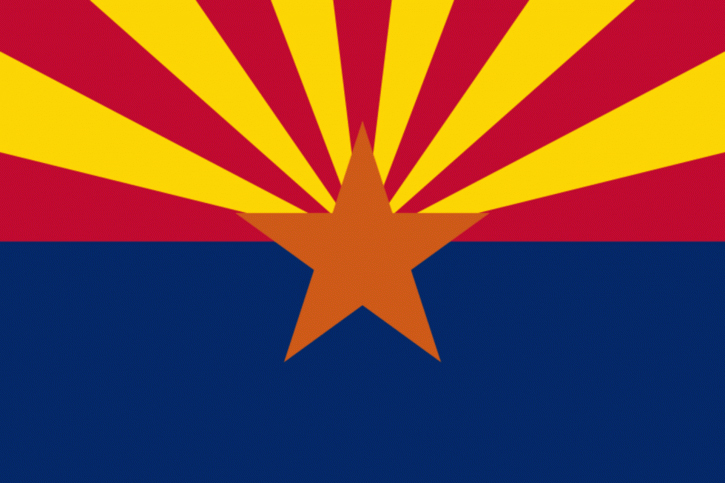
State Flag
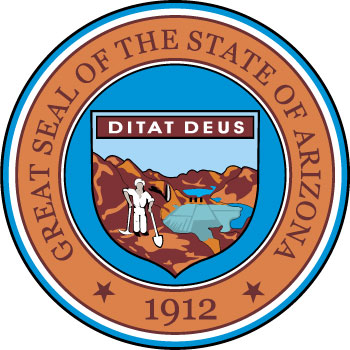
Great Seal
Nickname
The Grand Canyon State
Motto
Ditat Deus (“God enriches”)
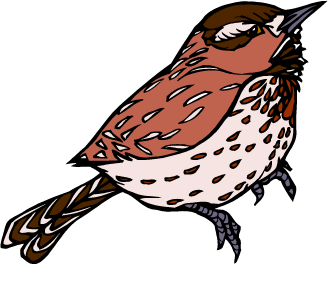
Bird
Cactus Wren
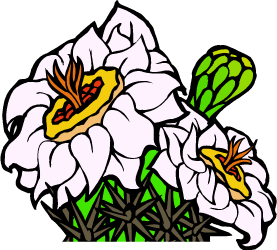
Flower
Saguaro Cactus Blossom
Tree
Palo Verde
Mammal
Ringtail
Reptile
Arizona Ridge-nosed Rattlesnake
Fish
Apache Trout
Amphibian
Arizona Tree Frog
Gemstone
Turquoise
Fossil
Petrified Wood
Song
“Arizona March Song” and “Arizona”