
 English
 Español
 中文
中文 हिन्दी
 Français
On this page
Overview
Arkansas is a south-central U.S. state bordered by Missouri, Tennessee, Mississippi, Louisiana, Texas, and Oklahoma. With roughly 3.07 million residents across 53,179 square miles, it ranks 33rd in population and 29th in area among the fifty states.
The state is celebrated as “The Natural State” for its hot springs, rugged Ozark and Ouachita Mountains, deep cypress swamps, and the wide Mississippi Delta. It is home to Hot Springs National Park — the smallest and oldest federal reservation in the National Park System — and to Crater of Diamonds State Park, the only diamond-producing site in the world open to the public.
Arkansas became the 25th state in 1836. Its economy historically centered on cotton, rice, and timber, but today is anchored by retail giant Walmart (headquartered in Bentonville), Tyson Foods (Springdale), poultry processing, aerospace, and steel production. Little Rock serves as both the state capital and largest city.
Geography & Climate
Arkansas divides naturally into two broad regions split by a diagonal line running northeast to southwest. The highlands of the northwest comprise the Ozark Plateau and the Ouachita Mountains — two distinct ranges separated by the Arkansas River Valley. The lowlands of the southeast include the Mississippi Alluvial Plain (the Delta) and the West Gulf Coastal Plain.
The Ozarks are a dissected plateau famous for caves, springs, and forested hills, while the Ouachitas are the only major U.S. mountain range running east-west. Between them, the Arkansas River cuts a broad valley containing Mount Magazine — at 2,753 feet, the highest point in the state.
The Mississippi Delta in eastern Arkansas is among the most agriculturally productive regions in the country, providing nearly half of the rice grown in the United States. Cypress and tupelo swamps of the lower Delta give way to pine forests in the south and west. Major rivers include the Mississippi, Arkansas, White, and Red.
History
Indigenous peoples lived in present-day Arkansas for thousands of years before European arrival. The Quapaw, Caddo, Osage, and earlier Mississippian mound-builder cultures shaped the region. The Spanish explorer Hernando de Soto crossed the Mississippi into Arkansas in 1541; the French explorer Henri de Tonti established Arkansas Post — the first permanent European settlement in the lower Mississippi Valley — in 1686.
Arkansas passed to the United States as part of the Louisiana Purchase in 1803. The Arkansas Territory was created in 1819 and admitted as the 25th state on June 15, 1836. It seceded with the Confederacy in 1861 and was readmitted in 1868 after the Civil War.
The 20th century brought the trauma of Jim Crow segregation and, in 1957, a national turning point when nine African-American students integrated Little Rock Central High School under federal military protection — one of the most consequential moments of the civil rights era. Arkansas Central High is now a National Historic Site.
The late 20th century saw the rise of Walmart in Bentonville and Tyson Foods in Springdale, transforming Arkansas into a corporate retail and food-processing powerhouse. Bill Clinton, the state’s governor from 1979–1981 and 1983–1992, was elected the 42nd President of the United States in 1992.
Economy
Arkansas’s economy combines a powerful corporate sector — anchored by some of the world’s largest companies — with strong agriculture, food processing, manufacturing, and tourism.
- Retail and logistics: Walmart, the world’s largest retailer by revenue, is headquartered in Bentonville and is by far the state’s largest private employer. J.B. Hunt Transport (Lowell) is one of the country’s largest trucking firms.
- Agriculture: Arkansas is the leading U.S. producer of rice and broiler chickens. Soybeans, cotton, corn, and aquaculture (notably catfish) are also major industries, concentrated in the Delta.
- Food processing: Tyson Foods, headquartered in Springdale, is the world’s second-largest processor of chicken, beef, and pork. Numerous poultry, rice, and seafood processors operate statewide.
- Aerospace and manufacturing: Arkansas hosts factories for Lockheed Martin, Sig Sauer, and Dassault Falcon Jet, plus steel mills owned by Nucor and Big River Steel. Aluminum and titanium production are also significant.
- Tourism: Hot Springs, Eureka Springs, the Ozark Mountains, Buffalo National River, and Crater of Diamonds State Park draw millions of visitors annually. The Crystal Bridges Museum of American Art in Bentonville is a major cultural destination.
Government
Arkansas operates under its fifth and current constitution, adopted in 1874 after the Reconstruction era. The General Assembly is bicameral, with a 35-seat Senate and a 100-seat House of Representatives. Both legislators and the governor serve four-year terms with two-term limits.
The Governor of Arkansas, like in most U.S. states, holds significant veto and appointment powers. The state also elects a Lieutenant Governor, Attorney General, Secretary of State, Treasurer, Auditor, and Land Commissioner. Arkansas is unusual in that the Lieutenant Governor and Governor can be from different parties.
Arkansas has four seats in the U.S. House of Representatives plus two U.S. Senators. The Arkansas Supreme Court has seven elected justices serving eight-year terms. The state capital and judicial center is Little Rock.
Culture
Arkansas culture is rooted in the rural South: country music, gospel, blues, and a strong food tradition centered on barbecue, catfish, fried chicken, and rice. The state has produced country singer Johnny Cash, soul and blues legend Levon Helm, gospel matriarch Mavis Staples, and singer Glen Campbell.
Hot Springs has been a destination for healing waters since the 19th century; its bathhouse row is now part of Hot Springs National Park. Eureka Springs preserves an entire Victorian resort town in the Ozarks, while Mountain View is the recognized capital of Ozark folk music. The annual Toad Suck Daze festival and the World Championship Duck Calling Contest in Stuttgart reflect the state’s blend of rural humor and outdoor heritage.
Arkansas is also home to the Crystal Bridges Museum of American Art, founded by Walmart heir Alice Walton in 2011, which holds one of the most important collections of American art outside the East Coast.
Notable Cities
- Little Rock — State capital and largest city, on the Arkansas River. Home to the Clinton Presidential Center, Little Rock Central High School National Historic Site, and the state’s major medical and government employers.
- Fayetteville — Home of the University of Arkansas and the cultural heart of Northwest Arkansas. Razorbacks athletics, the Walton Arts Center, and a vibrant downtown anchor the city.
- Bentonville — Headquarters of Walmart and home of the Crystal Bridges Museum of American Art. The rapid growth of the Walmart corporate ecosystem has transformed Bentonville into one of the wealthiest and fastest-growing small cities in the country.
- Hot Springs — Historic resort town built around 47 natural hot springs. Hot Springs National Park is the smallest and oldest federal reservation in the National Park System.
- Eureka Springs — Victorian-era Ozark resort town listed in its entirety on the National Register of Historic Places. Known for art galleries, healing-spring history, and dramatic hillside architecture.
State Symbols
Arkansas’s official state symbols, designated by the General Assembly, reflect the state’s diamond heritage, agricultural traditions, and rich natural environment.
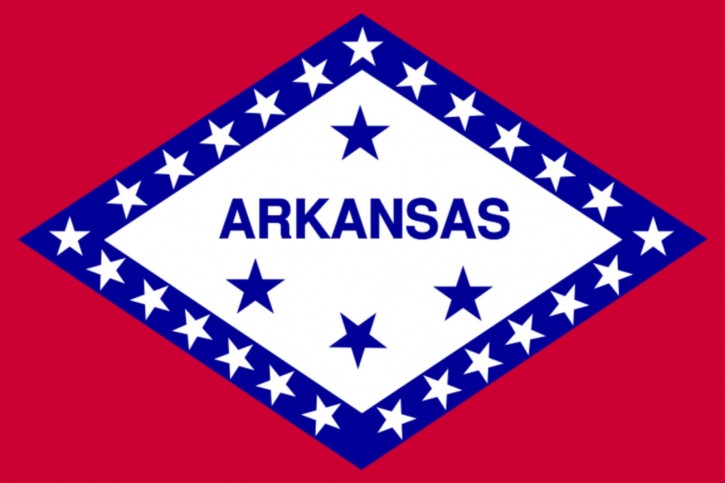
State Flag
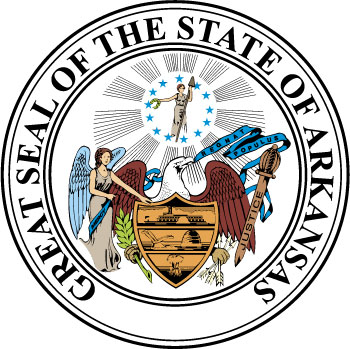
Great Seal
Nickname
The Natural State
Motto
Regnat Populus (“The people rule”)

Bird
Northern Mockingbird

Flower
Apple Blossom
Tree
Pine
Mammal
White-tailed Deer
Insect
Honeybee
Gem
Diamond
Mineral
Quartz
Rock
Bauxite
Beverage
Milk
Song
“Arkansas” (the state song); “Oh, Arkansas” (the historical song)