
 English
 Español
 中文
中文 हिन्दी
 Français
On this page
Overview
Alaska is the largest U.S. state by area — more than twice the size of Texas — but among the smallest by population. It occupies the northwest corner of North America, separated from the contiguous United States by the Canadian province of British Columbia and the Yukon, and lies just 55 miles from Russia across the Bering Strait. The state is famous for its glaciated mountains, boreal forests, Arctic tundra, and the world-class wilderness of its eight national parks.
Modern Alaska balances a small but oil-rich economy with one of the deepest Indigenous heritages in the country: Iñupiat, Yup’ik, Aleut (Unangan), Tlingit, Haida, Tsimshian, and Athabaskan peoples have inhabited the land for more than ten thousand years and remain culturally and politically central today. Residents share in the state’s oil wealth through the Alaska Permanent Fund Dividend, an annual payment funded by petroleum royalties that is unique among U.S. states.
Geography & Climate
At 665,384 square miles, Alaska is roughly one-fifth the size of the entire lower 48. The state stretches from the temperate rainforest of the Inside Passage in the southeast to the Arctic Ocean in the north, and from the long arc of the Aleutian Islands in the southwest to the Yukon border in the east. Denali, at 20,310 feet, is the highest peak in North America. Alaska contains more than 3 million lakes, an estimated 100,000 glaciers, and 17 of the 20 highest mountains in the United States.
Climate ranges from maritime in the southeast (cool, very wet) to continental in the interior (extreme — Fairbanks regularly sees winter lows near minus 40 °F and summer highs above 80 °F) to polar above the Arctic Circle. Earthquakes are frequent: the 1964 Great Alaska Earthquake at magnitude 9.2 was the most powerful ever recorded in North America. Volcanoes along the Aleutian arc and the Cook Inlet remain active.
History
Alaska has been inhabited for at least ten thousand years by Indigenous peoples whose descendant nations and communities — including the Iñupiat, Yup’ik, Aleut (Unangan), Tlingit, Haida, Tsimshian, and a dozen Athabaskan groups — remain central to the state today. Russian fur traders arrived after Vitus Bering’s 1741 expedition; the Russian-American Company established settlements at Kodiak and Sitka, and the latter served as the capital of Russian America. The United States purchased the territory from Russia in 1867 for $7.2 million in a transaction popularly known at the time as "Seward’s Folly."
Gold rushes near the turn of the twentieth century — at Juneau, Nome, and over the Chilkoot Pass into the Yukon — brought waves of newcomers. Alaska became a U.S. territory in 1912, served as a Pacific defense post during World War II (Japanese forces occupied Attu and Kiska in 1942–1943), and joined the Union as the 49th state on January 3, 1959. The 1968 discovery of oil at Prudhoe Bay and the 1977 completion of the Trans-Alaska Pipeline reshaped the state economy. The 1971 Alaska Native Claims Settlement Act transferred land and capital to twelve regional Native corporations, a legal framework unique to Alaska.
Economy
Alaska’s economy rests on petroleum, commercial fishing, tourism, mining, and the federal government — particularly the U.S. military. State residents pay no state income tax or state sales tax, and instead receive an annual Permanent Fund Dividend financed by petroleum royalties. Most freight and many passenger movements rely on aircraft and marine shipping because of the state’s limited road network.
- Oil and gas: Crude oil from the North Slope flows 800 miles south through the Trans-Alaska Pipeline to the ice-free port of Valdez; petroleum revenues fund the Permanent Fund and most of state government.
- Commercial fishing: Alaska is the largest U.S. producer of seafood by volume — salmon, pollock, cod, halibut, and king crab — with major ports at Dutch Harbor, Kodiak, and Sitka.
- Tourism: Cruise ships, the Iditarod, Denali and Glacier Bay national parks, northern-lights tours, and sportfishing draw more than two million visitors a year.
- Mining: The Red Dog Mine in the northwest Arctic is one of the world’s largest producers of zinc; Alaska also mines gold, silver, and coal.
- Federal presence: U.S. Department of Defense installations (Joint Base Elmendorf-Richardson, Eielson AFB, Fort Greely missile defense) and federal land management are major employers.
Government
Alaska operates under a constitution adopted in 1956 and effective at statehood in 1959. The state is led by a Governor and Lieutenant Governor, with a bicameral legislature consisting of a 20-member Senate and a 40-member House of Representatives. The Alaska Supreme Court has five justices appointed by the Governor and retained by voter election. Juneau has served as the state capital since 1906 and is unusual among U.S. capitals in being accessible only by air or sea — no road connects it to the rest of the state.
Culture
Alaska’s cultural identity rests on its deep Indigenous heritage, a frontier ethos of self-reliance, and an outdoor-recreation life shaped by long summer days and long winter nights. The Iditarod Trail Sled Dog Race covers roughly a thousand miles from Anchorage to Nome each March, the World Eskimo–Indian Olympics in Fairbanks celebrate traditional Native athletics, and the aurora borealis draws photographers and visitors from around the world. Local cuisine leans heavily on wild salmon, halibut, crab, reindeer sausage, and berries — and on a strong tradition of subsistence harvest among rural and Native communities.
Notable Cities
- Anchorage — state’s largest city, home to roughly 40 percent of all Alaskans; the country’s northernmost major airport hub.
- Juneau — state capital tucked between the Gastineau Channel and steep coastal mountains; accessible only by air or sea.
- Fairbanks — interior city near the Arctic Circle; site of the University of Alaska Fairbanks and the southern terminus of the Dalton Highway.
- Sitka — former capital of Russian America on Baranof Island; rich in Tlingit heritage and Russian-era landmarks.
- Ketchikan — southeastern port known as the "Salmon Capital of the World" and a major Inside Passage cruise stop.
- Wasilla — fast-growing Matanuska–Susitna Valley city north of Anchorage.
- Bethel — regional hub of the Yukon–Kuskokwim Delta and the largest Yup’ik community in the state.
- Kodiak — major commercial fishing port on Kodiak Island; home to a U.S. Coast Guard base.
State Symbols
Officially designated symbols of the State of Alaska — established by the State Legislature to celebrate the state’s natural and cultural identity.
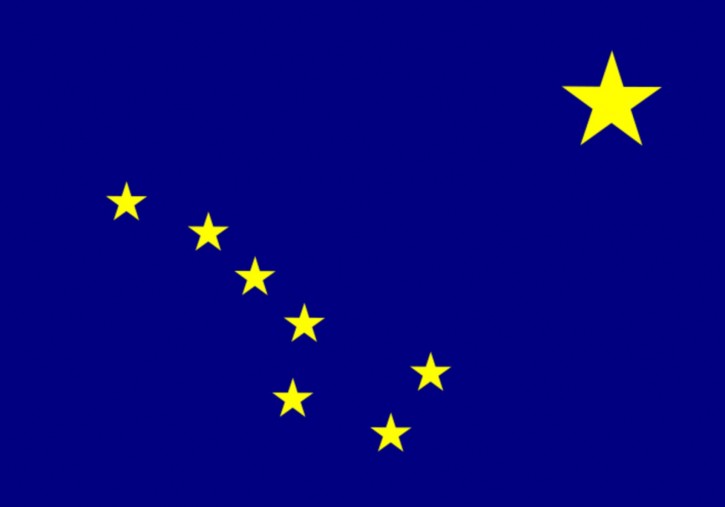
State Flag
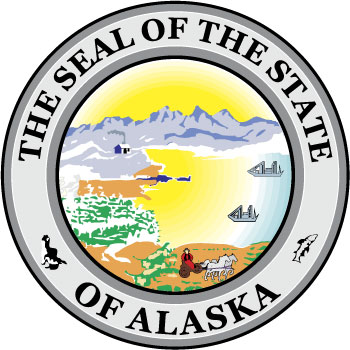
Great Seal
Nickname
The Last Frontier
Motto
North to the Future
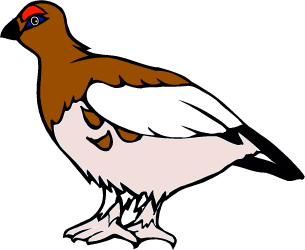
Bird
Willow Ptarmigan

Flower
Forget-me-not
Land Mammal
Moose
Marine Mammal
Bowhead Whale
Tree
Sitka Spruce
Fish
King Salmon (Chinook)
Insect
Four-spot Skimmer Dragonfly
Mineral
Gold
Song
"Alaska’s Flag"