
 English
 Español
 中文
中文 हिन्दी
 Français
On this page
Overview
California is the most populous state in the United States and the third largest by area. It covers a long stretch of the Pacific coast and reaches inland to the Sierra Nevada mountains and the Mojave Desert. Its economy is the largest of any U.S. state and would rank among the largest national economies in the world if measured independently.
Modern California is shaped by a striking combination of geography and migration. The state contains rainforests, glaciers, redwood groves, agricultural valleys, urban centers, and the lowest point in North America at Death Valley. Successive waves of newcomers — Native peoples, Spanish colonists, Mexican settlers, Gold Rush prospectors, twentieth-century industrial workers, and recent international migration — have produced one of the most ethnically and culturally diverse populations in the country.
Geography & Climate
California stretches roughly 770 miles from north to south along the Pacific coast. The state is divided into several distinct geographic regions: the Coast Ranges, the Central Valley, the Sierra Nevada, the Cascade Range in the far north, the Transverse and Peninsular Ranges in the south, and the Great Basin and Mojave deserts to the east. The Central Valley alone produces a significant share of the country’s fruits, vegetables, and nuts.
Climates range from Mediterranean along the coast to alpine in the high Sierra, and from cool maritime in the redwood belt to arid in the inland deserts. Wildfires, drought cycles, and earthquakes are recurring environmental challenges that shape land-use policy, infrastructure, and insurance markets.
History
Indigenous nations — including the Chumash, Ohlone, Pomo, Yokuts, and many others — inhabited the land for at least ten thousand years before European contact. Spanish missions established along the coast in the late 1700s remade the human geography of the region; California became part of independent Mexico in 1821. The 1846–1848 Mexican–American War transferred California to the United States, and the discovery of gold at Sutter’s Mill in 1848 triggered a population surge that brought statehood in 1850.
Twentieth-century California built the entertainment industry around Hollywood, the aerospace sector during World War II, and the technology industry around Stanford and Berkeley after the war. Postwar suburbanization, the agricultural workforce of the Central Valley, the Civil Rights movement, and successive immigration waves continue to shape the state’s politics and culture.
Economy
California’s economy is the largest of any U.S. state, anchored by technology in the San Francisco Bay Area and Silicon Valley, entertainment and aerospace in the greater Los Angeles area, and agriculture throughout the Central Valley. Major export categories include semiconductors, software, agricultural products, and entertainment.
- Technology: Apple, Google, Meta, Nvidia, and a dense ecosystem of venture-backed startups.
- Agriculture: Almonds, grapes, dairy, strawberries, lettuce, and tomatoes lead a wide portfolio.
- Entertainment: Film and television production centered on Hollywood; streaming and video-game studios.
- Tourism: National parks, beaches, theme parks, and wine regions draw tens of millions of visitors annually.
- Trade: The Ports of Los Angeles and Long Beach are among the busiest container ports in the Western Hemisphere.
Government
California operates under a constitution adopted in 1879 (replacing the original 1849 charter) and is governed by a Governor and Lieutenant Governor with a bicameral legislature consisting of a 40-member Senate and an 80-member Assembly. The state’s judiciary is led by a seven-justice Supreme Court. Direct democracy — via initiative, referendum, and recall — plays a comparatively large role in California politics.
Culture
California’s cultural footprint extends far beyond its borders, particularly through film, popular music, surf and skate culture, fast-food and culinary innovation, and Silicon Valley’s reshaping of digital life. The state is home to dozens of UNESCO-recognized communities, world-class universities (UC Berkeley, Stanford, UCLA, Caltech), and major museums (the Getty, LACMA, SFMOMA, the de Young).
Notable Cities
- Los Angeles — second-largest city in the U.S.; entertainment capital and major Pacific Rim trade hub.
- San Diego — coastal city with significant naval, biotech, and tourism industries.
- San Francisco — dense, hilly city anchoring the tech-heavy Bay Area.
- Sacramento — state capital at the confluence of the Sacramento and American rivers.
- San Jose — populous heart of Silicon Valley.
- Fresno — agricultural hub of the Central Valley.
- Long Beach — major Pacific port city adjacent to Los Angeles.
- Oakland — East Bay industrial and cultural center.
State Symbols
Officially designated symbols of the State of California — established by the State Legislature over the past 130+ years to celebrate the state’s natural and cultural identity.
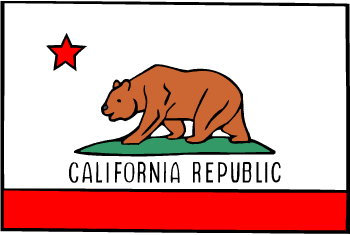
State Flag
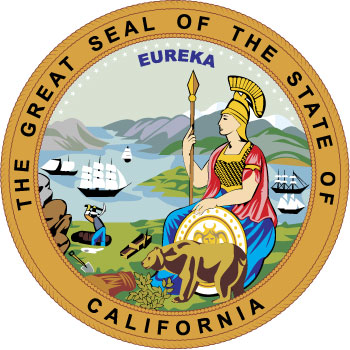
Great Seal
Nickname
The Golden State
Motto
Eureka ("I have found it")
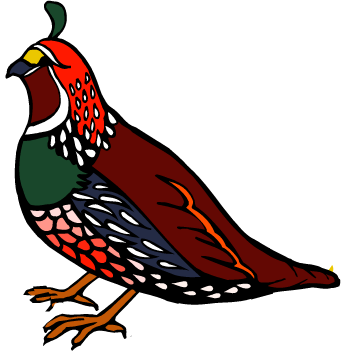
Bird
California Quail
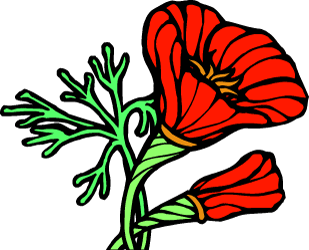
Flower
California Poppy

Animal
California Grizzly Bear
Tree
Coast Redwood & Giant Sequoia
Marine Mammal
Gray Whale
Fish
Golden Trout
Insect
California Dogface Butterfly
Mineral
Native Gold
Song
"I Love You, California"